USAID DEC
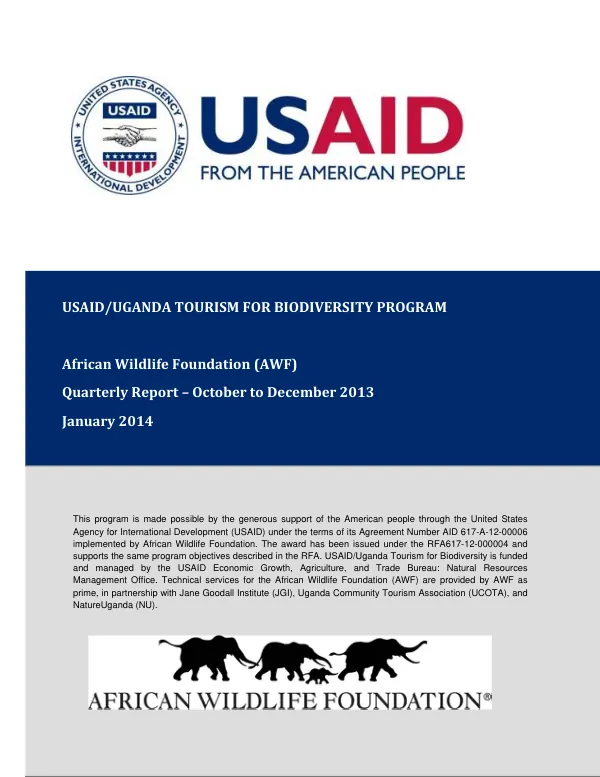
USAID/Uganda Tourism for Biodiversity Program Quarterly Report – October to December 2013
Sign inAFRICAN WILDLIFE FOUNDATION
USAID/Uganda Tourism for Biodiversity Program Quarterly Report – October to December 2013
The USAID/Uganda Tourism for Biodiversity Program is a collaborative effort between the African Wildlife Foundation (AWF) and other implementing partners to promote sustainable tourism and biodiversity conservation in Uganda.
2013 · 50 pages
Sign in to readA free account is required to download.
Abstract
The program is funded by the United States Agency for International Development (USAID) and is managed by the USAID Economic Growth, Agriculture, and Trade Bureau: Natural Resources Management Office. The program's primary objective is to promote sustainable tourism and biodiversity conservation in Uganda's protected areas, including national parks and forest reserves. To achieve this objective, the program focuses on three key areas: tourism product development, community engagement, and conservation. The program works with local communities, tour operators, and conservation organizations to develop and promote sustainable tourism products and services that benefit both local communities and the environment. In the Lake Mburo National Park, the program has focused on developing tourism products and infrastructure to support ecotourism. This includes the development of branding and signage for the park, as well as the installation of supporting infrastructure along new trails. The program has also worked with local communities to establish community tourism enterprises and participatory land use planning and zoning. In the Kidepo Valley National Park, the program has focused on improving tourism connectivity between the park and other protected areas in northern Uganda. This includes the development of a tourism mini-guide for the Northern Uganda route to Kidepo. The program has also worked with local communities to improve tourism in the park, including the support of Karenga community in land use planning to secure a community wildlife area (conservancy). In the Budongo Central Forest Reserve, the program has focused on improving tourism infrastructure, including the extension of the chimp trail network at Kaniyo Pabidi and the establishment of 57 km of biking trails. The program has also worked with local communities to build the capacity of the National Forestry Authority (NFA) in tourism concessions, guiding, and community forest management. The program has also worked with other implementing partners, including the Jane Goodall Institute (JGI), Uganda Community Tourism Association (UCOTA), and NatureUganda (NU), to achieve its objectives. These partners have contributed to the program's success by providing technical expertise, resources, and support to local communities and conservation organizations. The program's progress has been monitored and evaluated through regular reporting and monitoring and evaluation activities. The program has also engaged with local communities, tour operators, and conservation organizations to ensure that the program's activities are aligned with their needs and priorities. The program's achievements include the development of sustainable tourism products and services, the improvement of tourism infrastructure, and the support of local communities in conservation and tourism development. The program has also contributed to the conservation of biodiversity in Uganda's protected areas, including national parks and forest reserves. The program's future plans include the continuation of its activities in the Lake Mburo National Park, Kidepo Valley National Park, and Budongo Central Forest Reserve. The program will also continue to work with local communities, tour operators, and conservation organizations to promote sustainable tourism and biodiversity conservation in Uganda.