USAID DEC
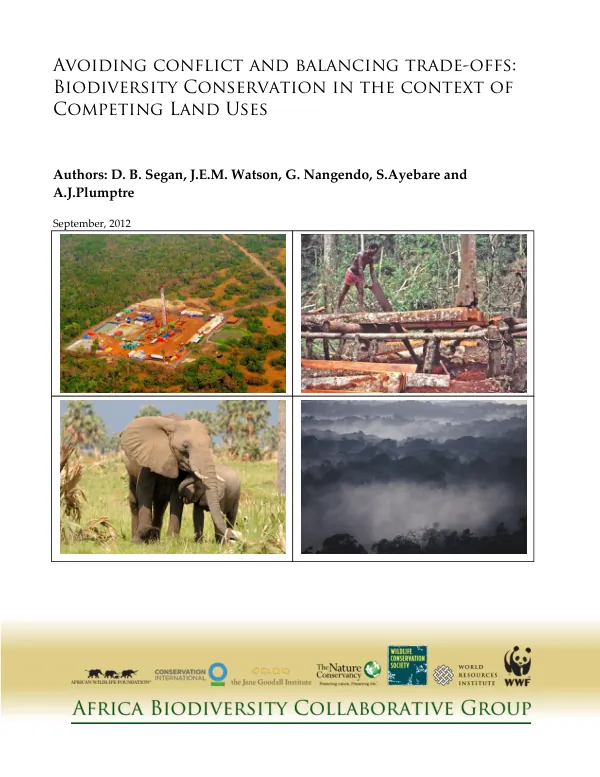
Navigating Trade-offs in Landscape Scale Planning: Biodiversity, Oil, Timber, Carbon and Agriculture A case study of the Murchison-Semliki Landscape
Sign inAFRICAN WILDLIFE FOUNDATION
Navigating Trade-offs in Landscape Scale Planning: Biodiversity, Oil, Timber, Carbon and Agriculture A case study of the Murchison-Semliki Landscape
Navigating Trade-offs in Landscape Scale Planning: Biodiversity, Oil, Timber, Carbon and Agriculture is a case study of the Murchison-Semliki Landscape in Uganda.
2013 · 12 pages
Sign in to readA free account is required to download.
Abstract
The landscape is increasingly under pressure from mining, timber extraction, and agriculture conservation, and is also a site where the Wildlife Conservation Society (WCS) has a REDD+ project in development. The Murchison-Semliki Landscape is a critical ecosystem in Africa that contains significant biodiversity. Woodland ecosystems in Africa are being cleared or degraded at an unprecedented rate, which will have a serious impact on biodiversity and contribute to ongoing carbon emissions. In 2011, the ABCG partners recognized the importance of having a work plan that developed methodologies to help identify and prioritize woodland areas that will achieve large conservation and mitigation gains. The case study was developed by WCS, Jane Goodall Institute (JGI), and African Wildlife Foundation (AWF) as part of the 2012 workplan. The study aimed to provide methods and case studies of the best ways to integrate the objectives of climate change mitigation, climate change adaptation, and biodiversity. Three case study areas were chosen: Murchison Falls-Semliki landscape in Uganda, Imbirikani Group Ranch in Kenya, and Masito-Ugalla Ecosystem (JGI). The study involved a two-day workshop at the Metropole Hotel in Kampala on July 27-28, 2012, for conservation managers, planners, members of the development community, and government. The workshop aimed to review the biodiversity values and multiple pressures on the Murchison Semliki landscape and introduce how systematic conservation planning and spatial optimization tools could be used to explore trade-offs in landscape conservation. The workshop presentations highlighted some of the key data (biodiversity, carbon, deforestation rates) and outstanding questions that were discussed later in the workshop. Dan Segan provided an overview of the principles of systematic conservation planning and the evolution of the discipline. The talk introduced the Marxan decision support tool and provided examples of how it has been used to examine trade-offs in conservation land use planning. The trade-off analysis was presented by Dan Segan and began by providing an overview of how the data collected was incorporated into the Marxan decision support tool, and then how the tool and scenario planning were used to explore trade-offs between the interests of different stakeholders in the landscape. The analysis was based on expert opinion for minimum viable population for threatened and endangered species and feedback of participants in the first workshop. The results of the analysis showed that the use of minimum viable conservation targets for all analysis means that results should be interpreted as the bare minimum in terms of areal extent required to support biodiversity in the landscape. The analysis was designed in part to explore the impact of extractive activities inside existing protected areas, and full results that include conservation priorities that build off the existing protected area base were not included in the workshop presentation due to time constraints. The study highlighted the importance of considering socio-economic interests within conservation prioritization and the need to wisely allocate scarce conservation resources. The group was interested in the implications of considering the return on investment from conservation activities and questioned if exploring trade-offs within landscape scale planning would lead to conservation triage. The study also explored the challenge of target setting in the Murchison Semliki landscape and in conservation more broadly. The Murchison-Semliki Landscape is a critical ecosystem in Africa that contains significant biodiversity, and the study highlights the need to balance the interests of different stakeholders in the landscape. The study provides a framework for exploring trade-offs in landscape scale planning and highlights the importance of considering socio-economic interests within conservation prioritization.