KOSOVO MINISTRY OF AGRICULTURE, FORESTRY AND RURAL DEVELOPMENT
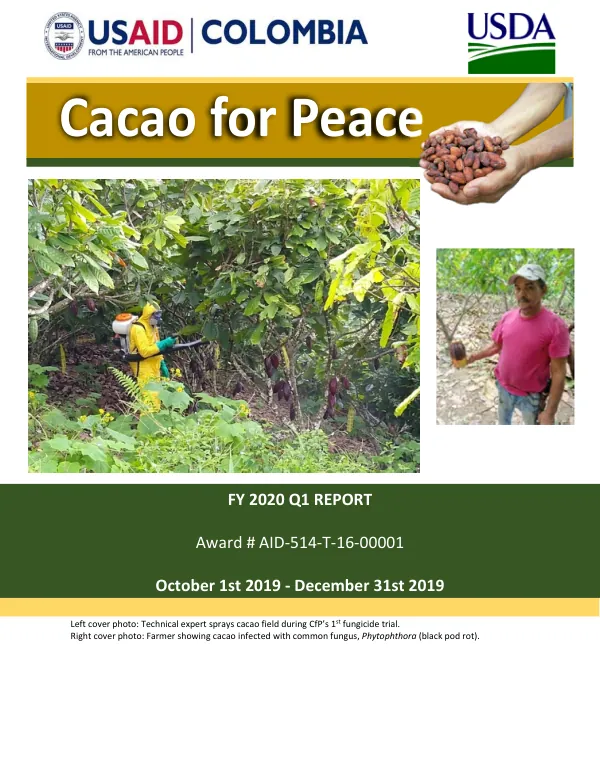
USAID/USDA Colombia Cacao for Peace | FY2020 Q1 Report
Cacao for Peace is a five-year program that aims to strengthen Colombia's public and private institutions in the cacao sector.
2020 · 23 pages
Sign in to readA free account is required to download.
Abstract
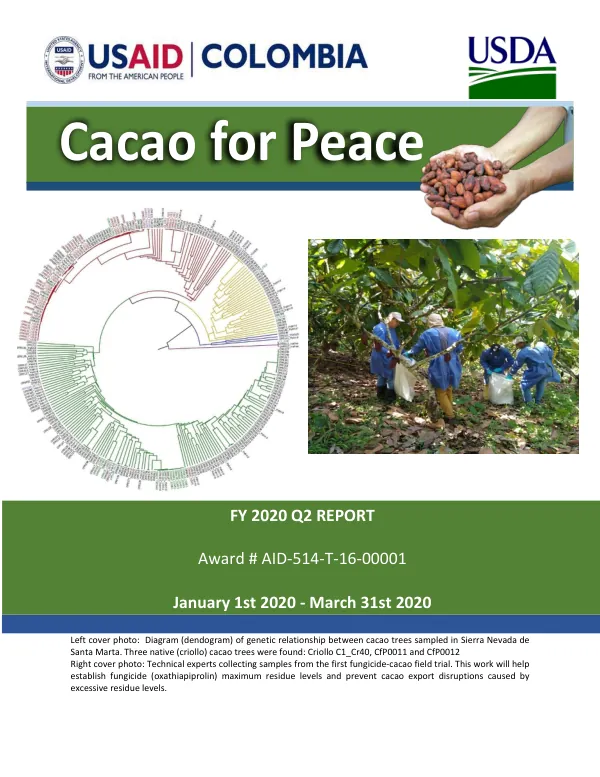
The program seeks to increase cacao yields, enhance farmer incomes, and contribute to rural stability and peace in Colombia. Through CfP, the United States builds Colombia's research and extension capability, leading to enhanced training for cacao farmers. This is the program's sixteenth quarterly report detailing major accomplishments and activities. The program's focus areas include Cooperative Research, Agricultural Extension, Education, and Institutional Technical Assistance. In Cooperative Research, CfP collaborated with Agrosavia to strengthen cacao research in Colombia. Agrosavia conducted four cacao research projects with technical assistance from USDA-ARS. One of the projects involved adapting a structure in Pima to serve as a quarantined greenhouse, which was approved by the Colombian Institute of Agriculture (ICA). The greenhouse is ready to receive USDA-ARS clones. Agrosavia also collected cacao leaf samples from various municipalities, which were sent to USDA for analysis. This will increase Agrosavia's cacao germplasm bank population for better research and breeding. In Agricultural Extension, training activities were carried out on good agricultural practices (GAP), integrated pest and disease management, and cacao association administration. There were 40 participants at these trainings. Sapling bags, shade cloth, and fertilizer were distributed to support cacao farmers after a dry summer and help meet replanting needs. Irrigation workshops, trainings, and supplies were given to demonstration farms to better cushion yields during volatile weather. In Education, three students successfully completed their M.S. degrees in August 2019. Two of the students are continuing their education at Penn State as PhD students funded by grants obtained by Penn State. All students are preparing publications to be submitted by the end of the semester. Three CfP-Colfuturo scholarship recipients attended Purdue University and will finish their master's requirements by December 2020. Two of the students are in PhD programs. In Institutional Technical Assistance, CfP initiated its first cacao disease fungicide field trial and analyzed cacao samples with the support of Michigan State University. The team generated fungicide residue data, which will allow Agrosavia to analyze its own samples in the future without assistance. The United States confectionery industry, which relies on cacao imports, accounts for $35 billion in annual sales. The industry is vulnerable to supply chain disruptions, and CfP aims to increase cacao yields and enhance farmer incomes to reduce this risk. The program's activities are focused on building Colombia's research and extension capability, leading to enhanced training for cacao farmers. This will increase cacao yields and enhance farmer incomes, contributing to rural stability and peace in Colombia. CfP's Institutional Technical Assistance focus area involves providing technical assistance to Agrosavia and other partners to enhance their capacity in cacao research and extension. CfP initiated its first cacao disease fungicide field trial and analyzed cacao samples with the support of Michigan State University. The team generated fungicide residue data, which will allow Agrosavia to analyze its own samples in the future without assistance. The program's activities are focused on building Colombia's research and extension capability, leading to enhanced training for cacao farmers. This will increase cacao yields and enhance farmer incomes, contributing to rural stability and peace in Colombia. The program's focus areas include Cooperative Research, Agricultural Extension, Education, and Institutional Technical Assistance.
Related documents