FLORIDA INTERNATIONAL UNIVERSITY
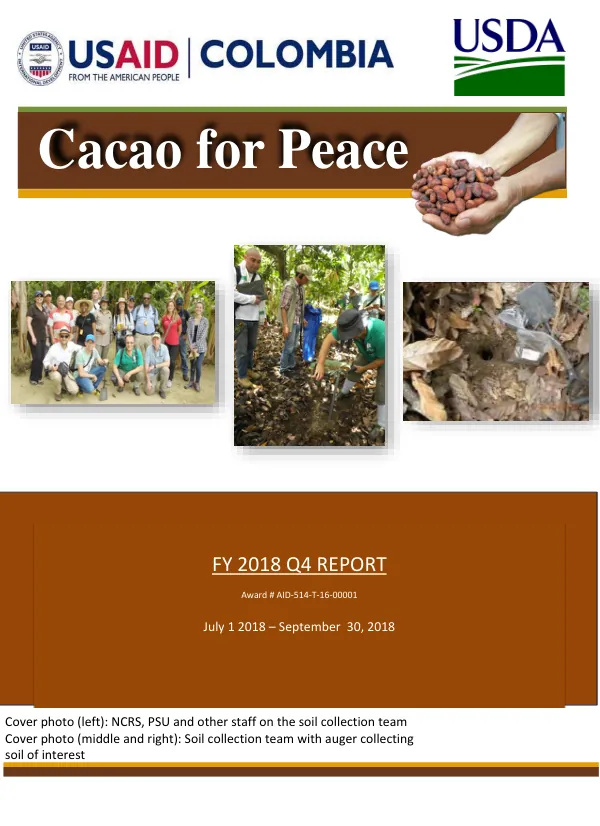
FY 2018 Q4 Report: USDA/Nigeria Agriculture Capacity Strengthening Program
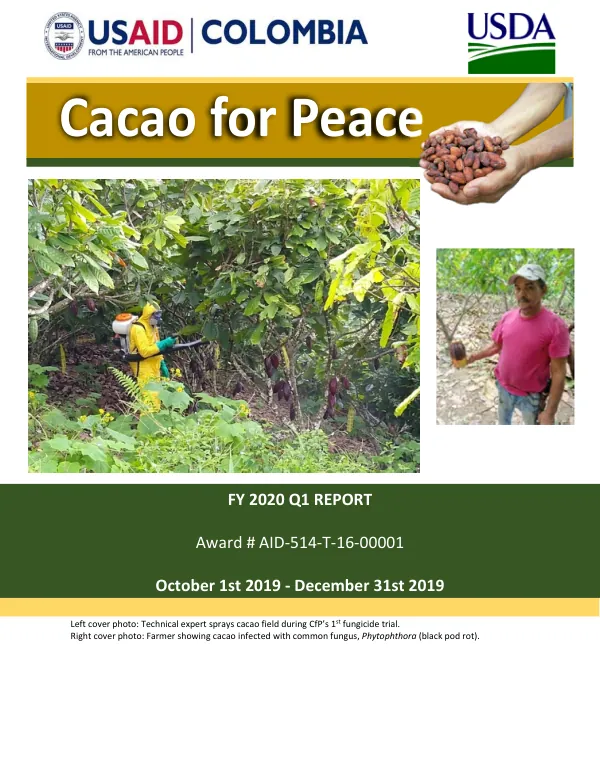
The Cacao for Peace initiative is a five-year program that aims to strengthen Colombia's public and private institutions in the cacao sector.
2018 · 24 pages
Sign in to readA free account is required to download.
Abstract
The objectives of the program are to increase cacao yields, increase cacao farmer incomes, and contribute to rural stability and peace in Colombia. The program is led by the United States Department of Agriculture (USDA) and is implemented in collaboration with various partners, including the International Center for Tropical Agriculture (CIAT), the Colombian Corporation for Agricultural Research (Corpoica), and the Colombian Ministry of Agriculture and Rural Development (MARD). The program focuses on four key areas: Cooperative Research, Agricultural Extension, Education, and Institutional Technical Assistance. In the Cooperative Research area, the program is conducting research on the use of gene editing technologies to address the issue of cadmium absorption by cacao. This research is being led by CIAT and is expected to determine if the genes responsible for cadmium uptake and translocation can be knocked out using CRISPR/Cas9. The program has also signed an agreement with CIAT for $100,000 to support this research. In the Agricultural Extension area, the program has made 45 technical assistance visits to farmers, focusing on reinforcing good agricultural practices such as pruning and grafting. The program has also purchased fertilizers for distribution to demonstration farms and has accompanied CfP Fulbright scholars from Penn State University on visits to farms in support of their research studies. Additionally, the program has replaced three departing Peace Corps volunteers with new volunteers who will be in-country for two years. In the Education area, all three CfP-Colfuturo scholarship recipients have arrived at Purdue University and have begun their studies towards obtaining PhDs. The students have identified research thesis topics in support of Cacao for Peace objectives. The four CfP Fulbright-Colombia scholarship recipients attending Penn State University are estimated to complete their studies the summer of 2019. In the Institutional Technical Assistance area, the program is developing an interinstitutional pest management project (IR-4) to identify and test fungicides for controlling cacao diseases, define maximum residue levels to avoid cacao trade disruptions, and train farmers on fungicide use good practices. The program has also partnered with the University of Florida to promote youth empowerment within the context of cacao farming and production in Colombia. The program has made significant progress in its first year, with major accomplishments and activities reported in this quarterly report. The program's focus on research, extension, education, and technical assistance has contributed to the development of Colombia's cacao sector and has helped to promote rural stability and peace in the country.
Related documents