INTERNATIONAL PEACE CORPS
Cacao for Peace FY 2020 Q2 Report
Cacao for Peace is a five-year program aimed at strengthening Colombia's public and private institutions in the cacao sector.
2020 · 33 pages
Sign in to readA free account is required to download.
Abstract
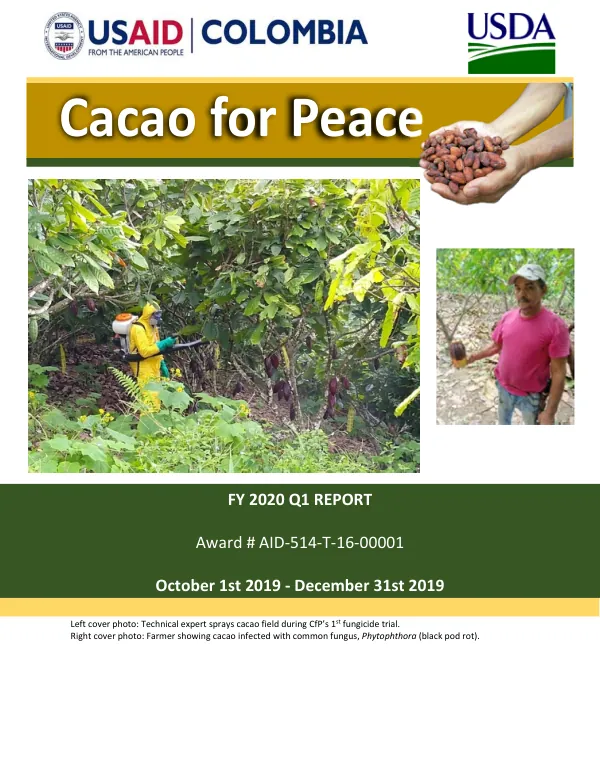
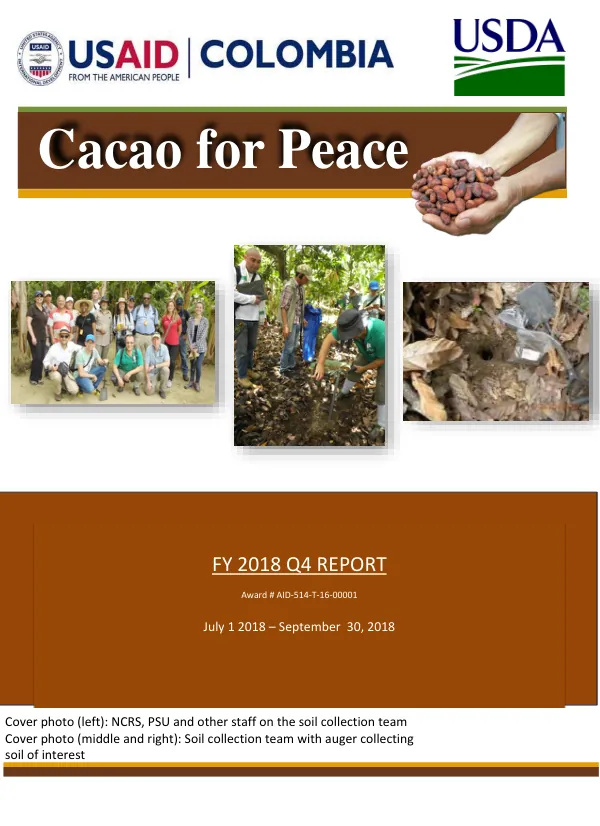
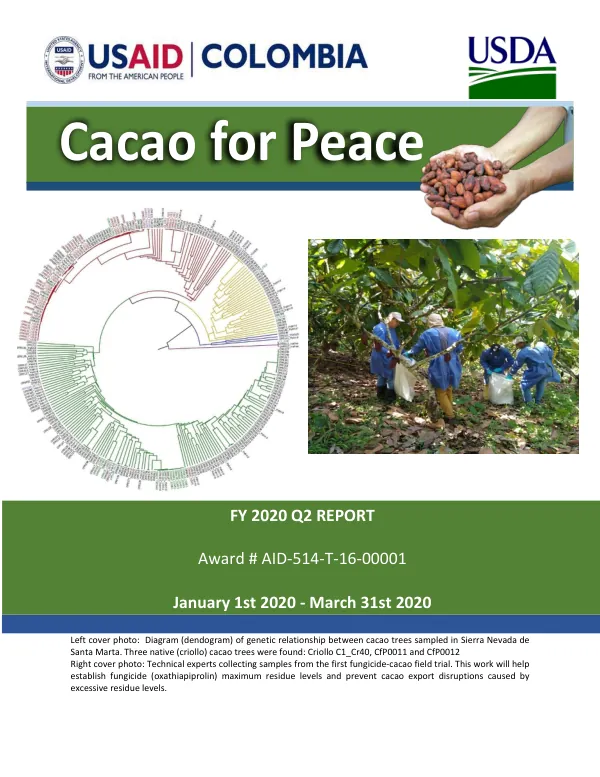
The program's objectives include increasing cacao yields, increasing cacao farmer incomes, and contributing to rural stability and peace in Colombia. Through Cacao for Peace, the USDA builds Colombia's research and extension capability, leading to enhanced training for cacao farmers. Cooperative research is a key focus area for the program. In January 2019, Cacao for Peace signed a cooperative agreement with Agrosavia to strengthen cacao research in Colombia. Agrosavia is conducting four cacao research activities with technical assistance from the USDA-ARS. These activities include germplasm bank reclassification, cacao breeding, cacao disease research, and cadmium mitigation. The germplasm bank reclassification activity involved collecting over 3,000 cacao leaf samples from Agrosavia's cacao germplasm bank in La Suiza Santander, which will be sent to the USDA-ARS for analysis. Cacao mapping is another key activity of the program. The Cacao for Peace mapping team, comprising CIAT, USDA/NRCS, and Penn State with USDA/ARS serving an advisory role, produced a preliminary genetic analysis of 295 trees. The analysis revealed 25 groups of samples who share the same genetic profile, with most of the materials being closely related to Trinitarian (hybrid) genetic groups. The refinement of the data analysis will help achieve further important conclusions. Agricultural extension is also a key focus area for the program. From January to mid-March of the first quarter of 2020, Cacao for Peace conducted training activities on cacao harvest and post-harvest management, fertilization, irrigation, cacao nurseries, records management, integrated pest and disease management, climate change, and soil conservation. The Cacao for Peace team provided technical assistance to 99 cacao farms during this quarter and conducted 164 cacao producer visits. These training activities will allow farmers to apply for Good Agricultural Practices (BPA) certification. Education is also a key focus area for the program. Three students successfully completed their M.S. degrees in August 2019: Jhony Bolanos, Johan Restrepo, and Alejandro Gil. The last of the group, Lina Tami, will complete her studies via distance learning due to COVID-19 and is still projected to graduate in Spring 2020. Jhony Bolanos, Alejandro Gil, and Lina Tami are continuing their education at Penn State as PhD students funded by grants obtained by Penn State. All students are preparing their publications to be submitted by the end of Spring semester 2020. Institutional technical assistance is also a key focus area for the program. During this quarter, Cacao for Peace initiated its first fungicide (oxathiapiprolin)/cacao field trial. Fruit and pod samples from the Tolima area have been harvested and the beans are currently fermenting to assess residue levels. The Colombia team is successfully following all suggested protocols. The program's geographic focus is on Colombia, with a specific emphasis on the cacao sector. The program's timeframes are from January 1st, 2020, to March 31st, 2020, with a five-year duration. The program's recommendations include continued support for cooperative research, agricultural extension, education, and institutional technical assistance.
Related documents