AECOM INTERNATIONAL
USAID Water Reuse and Water Conservation Project Briefing for MoEnv
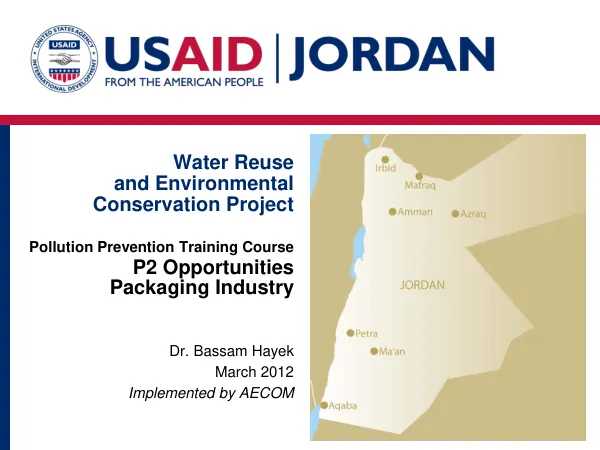
The Pollution Prevention Training Course for the Paper and Packaging Industry was implemented by AECOM in March 2012.
2012 · 17 pages
Sign in to readA free account is required to download.
Abstract
The objective of the course was to enable participants to describe key pollution prevention opportunities in the paper and packaging industry. The course outline consisted of six key steps in pollution prevention, a schematic process, examples of pollution prevention opportunities, and a summary. The six key steps in pollution prevention include planning, preparation, assessment, synthesis, implementation, and sustaining. Planning involves assembling a team, allocating resources, and defining the focus of the assessment. Preparation involves conducting material and energy flow analysis. Assessment involves identifying and evaluating options, while synthesis involves selecting options, planning, and implementing them. Implementation involves following up on results and continuing in another focus area. Sustaining involves maintaining the momentum of the pollution prevention efforts. A schematic process for pollution prevention in the paper and packaging industry is presented in the form of an overall flow diagram. The diagram illustrates the key steps involved in paper recycling, from reception and storage of used papers to cutting and filling. The diagram highlights opportunities for pollution prevention at each stage of the process, including reception and storage, sorting, pulping, beating and bleaching, stock preparation, paper making, cutting and filling, and converting. The course provides several examples of pollution prevention opportunities in the paper recycling process. For instance, reception and storage opportunities include controlling conditions such as timing, temperature, and humidity, and managing inventory to avoid storing materials that will be needed after long periods. Sorting opportunities include reducing waste by removing unwanted materials such as plastic and laminated paper, and segregating waste materials. Pulping opportunities include optimizing the use of water, reducing the quantity and quality of waste materials, and segregating waste materials. Beating and bleaching opportunities include improving energy efficiency, reducing the use of toxic chemicals, and reducing wastewater and solid residues. The course highlights the importance of pollution prevention in the paper and packaging industry, which is a significant contributor to environmental pollution. By implementing pollution prevention measures, the industry can reduce its environmental impact, conserve resources, and improve its competitiveness. The course provides a comprehensive framework for identifying and implementing pollution prevention opportunities in the paper and packaging industry, and it serves as a valuable resource for industry professionals, policymakers, and regulators.
Related documents