UNIVERSITY OF MARYLAND
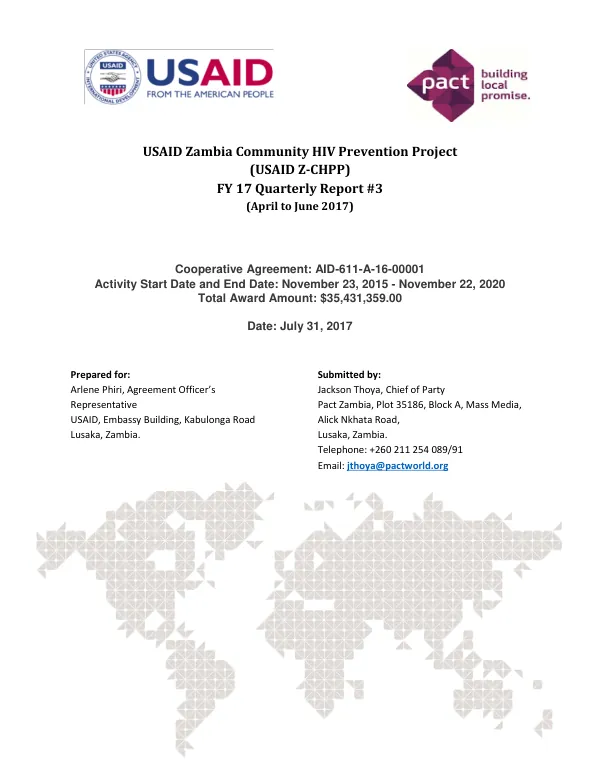
USAID Z-CHPP FY17 Quarterly Report 3
The USAID Zambia Community HIV Prevention Project (USAID Z-CHPP) is a cooperative agreement between USAID and Pact Zambia, with a total award amount of $35,431,359.00.
2017 · 34 pages
Sign in to readA free account is required to download.
Abstract
The project aims to reduce the spread of HIV among high-risk populations in Zambia, particularly adolescent girls and young women. The project's activity start date is November 23, 2015, and the end date is November 22, 2020. The project's major interventions in Quarter 3 (April to June 2017) included developing a social and behavior change communication (SBCC) strategy for reaching priority populations, developing tailored SBCC materials, and reviewing and adopting a community participatory theater manual. The project also developed interactive community radio programs and community HIV prevention manuals. Additionally, the project conducted a quarterly review meeting, a SIMS visit by USAID in Livingstone and Mazibuka, and project scale-up and quality improvement activities. The project's major program results accomplished in Quarter 3 included mitigating key determinants of risky behavior among priority populations, increasing high-impact services and completed referrals, and strengthening the capacity of local stakeholders to plan, monitor, evaluate, and ensure the quality of prevention interventions. The project also reported a 27% increase in household income among program participants compared to the control group. The DREAMS (Determined, Resilient, Empowered, AIDS-free, Mentored, and Safe) component of the project aimed to reduce young women's vulnerability to HIV, unintended pregnancy, and gender-based violence. The project's major interventions in Quarter 3 included safe spaces enrollment, model DREAMS centers, coordination and linkages, DREAMS innovation, and technical support provision. The project also reported significant results in screening and enrollment of adolescent girls and young women, services provision in DREAMS centers and safe spaces, and highly vulnerable young women linked to economic strengthening interventions to reduce transactional and age-disparate sex. The project's monitoring, evaluation, and research activities included data quality assurance, DHIS 2 database development, and facilitated a grants and finance management workshop. The project also facilitated close-out of Marie Stopes and University of Miami sub-awards. The project's human resource update for Quarter 3 included staff changes and new hires. The project's stakeholder collaboration activities included coordination meetings with local stakeholders and capacity development interventions. The project's challenges and opportunities for improvement included addressing the high prevalence of HIV among adolescent girls and young women, increasing access to high-impact services, and strengthening the capacity of local stakeholders to plan, monitor, evaluate, and ensure the quality of prevention interventions. The project's planned activities for the next quarter included community HIV prevention activities, DREAMS activities, economic strengthening activities, capacity development, and monitoring, evaluation, and research activities. The project's indicators included adolescent girls and young women (AGYW) screened and enrolled in DREAMS, services provided in DREAMS centers and safe spaces, and highly vulnerable young women linked to economic strengthening interventions. The project's objectives included reducing the spread of HIV among high-risk populations, increasing access to high-impact services, and strengthening the capacity of local stakeholders to plan, monitor, evaluate, and ensure the quality of prevention interventions.