AFRICAN WILDLIFE FOUNDATION
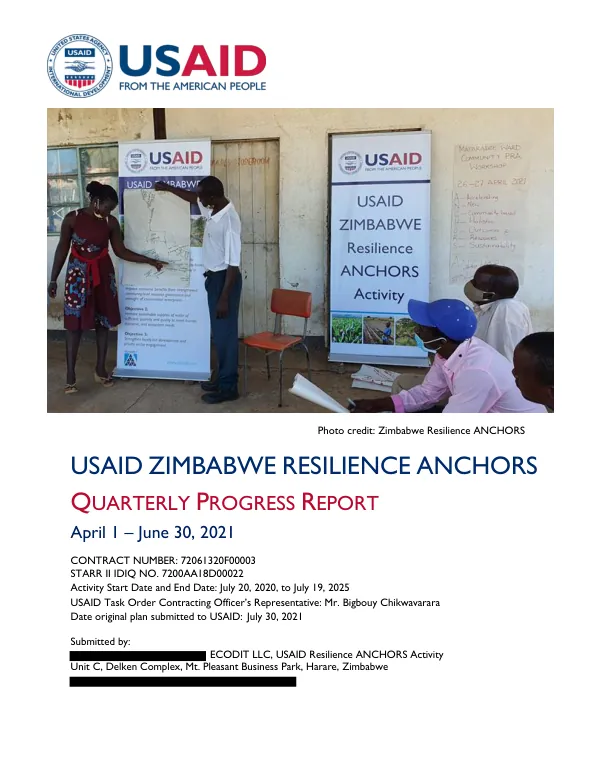
USAID Zimbabwe Resilience ANCHORS Quarterly Progress Report April 1 – June 30, 2021
The Resilience through Accelerating New Community-based Holistic Outcomes for Resource Sustainability (Resilience ANCHORS) Activity is a USAID-funded project implemented by ECODIT in Zimbabwe.
2021 · 19 pages
Sign in to readA free account is required to download.
Abstract
The project aims to increase the capacity of communities to sustainably protect and manage community-based natural resources and the wildlife economy in anticipation of future shocks and stresses. The project is being implemented in the Southeast Lowveld (SEL) of Zimbabwe, covering communities around Savé Valley Conservancy (SVC) and Gonarezhou National Park (GNP). The project has three main objectives: improve economic benefits from strengthened community-based natural resource management, enhance resilience of communities to future shocks and stresses, and promote sustainable use of natural resources. To achieve these objectives, the project is working with local communities, government agencies, and other stakeholders to develop and implement community-based natural resource management plans, provide training and capacity building, and support the development of sustainable livelihoods. Key achievements in Q3 FY21 include the finalization of subcontracts for three partners, African Wildlife Foundation (AWF), Zimbabwe Environmental Law Association (ZELA), and the Environmental Law Institute (ELI). Stakeholder engagement resulted in the signing of Memorandums of Understanding (MOU) with the Bikita and Chiredzi Rural District Councils (RDC), and a clearance letter from the Provincial Development Coordinator's (PDC) Office to work in Manicaland Province. The project also successfully conducted a project inception workshop to launch Resilience ANCHORS in the SVC landscape, and commenced the baseline survey targeting Resilience ANCHORS implementing wards in Bikita and Chiredzi. Other notable programmatic activities successfully undertaken include scoping visits to the Gonarezhou National Park (GNP) landscape to inform and initiate the development of an Activity Plan for work to be done in wards 29 and 30 of Chipinge District. The project also participated in key landscape and district level networking meetings, convened a SVC landscape partners inception workshop, and held coordination meetings to explore layering opportunities with USG-funded projects. The project completed the recruitment of a Finance and Contracts Officer and obtained USAID approval for the supply of vehicles, installation of solar, and partitioning of the Project office in Harare. The project coordination office in Harare and the SVC landscape field office have been secured and will be fully operational by the end of July 2021. Key challenges going into Q4 FY21 include navigating the tightening of lockdown restrictions due to the worsening COVID-19 pandemic, as well as managing the implications of organizational changes taking place within the SVC leadership. The project has received a waiver from the District Development Coordinator for Chiredzi to continue its work on the condition that the project abide by current COVID-19 prevention measures and regulations. Activities planned for Q3 FY21 not fully executed and pushed into Q4 FY21 include the "Pause and Reflect Workshop" now planned for August 2-5, 2021, to inform the annual planning process for PY2. The project also plans to complete the upgrading of the SVC website and finalize the technical designs for the entry gates into SVC. Despite the challenges associated with the COVID-19 pandemic and delays linked to seeking MOUs and clearance letters, Q3 FY21 was a successful period for Resilience ANCHORS, thanks to the continued support of USAID/Zimbabwe and partners.