PACT
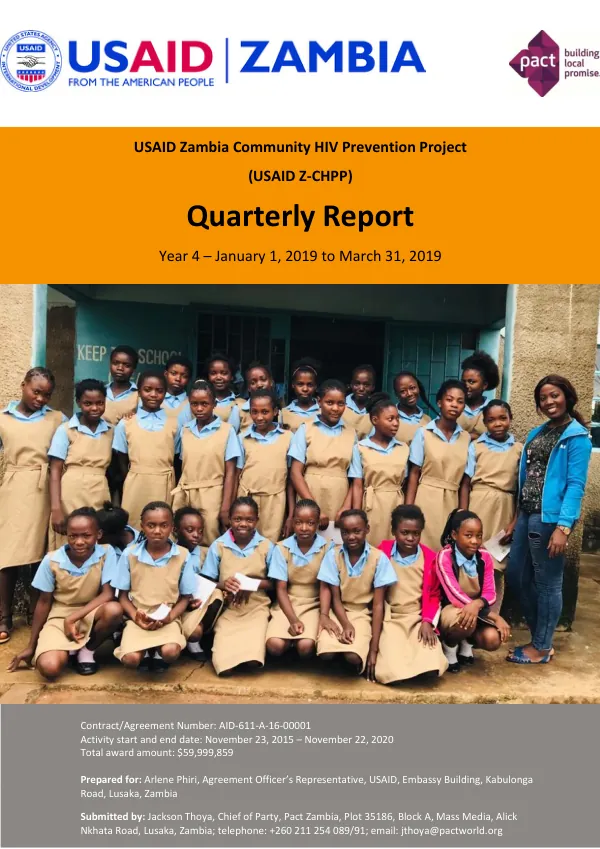
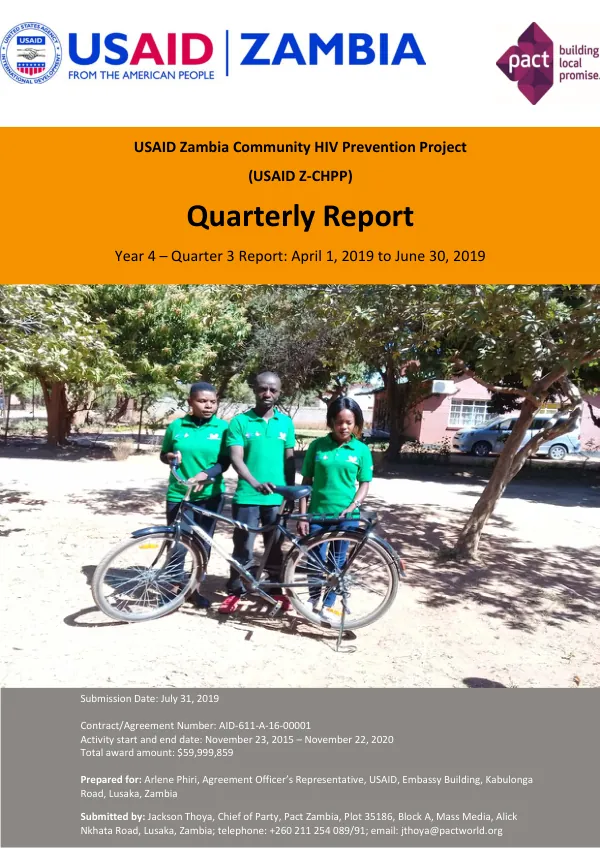
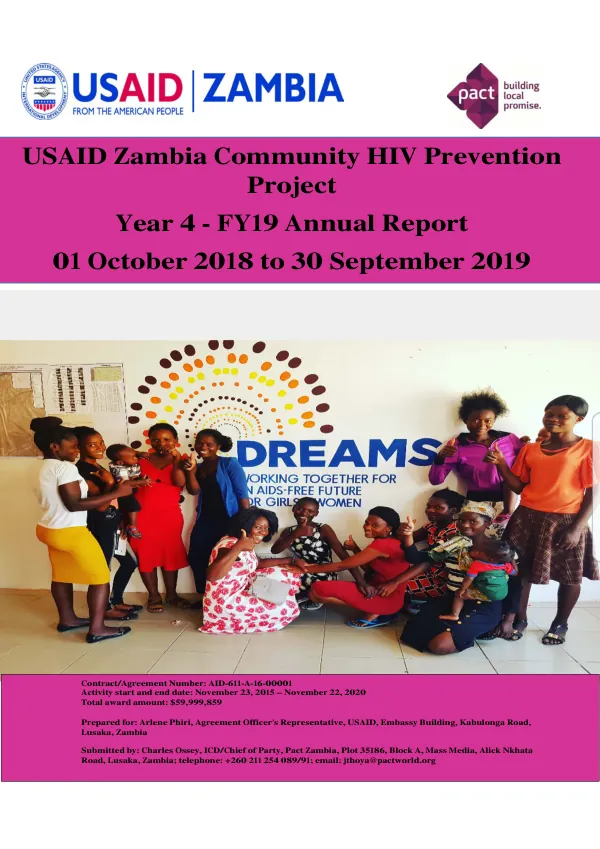
USAID Zambia Community HIV Prevention Project Year 4 - FY19 Annual Report
The USAID Zambia Community HIV Prevention Project (Z-CHPP) is a collaborative effort implemented in partnership with various organizations, including PLAN, Sport in Action, Young Women's Christian Association, Zambia Health Education Trust, Zambia Centre for Communications Program, Copperbelt Health Education Project, and Catholic Medical Mission Board.
2019 · 23 pages
Sign in to readA free account is required to download.
Abstract
The project's primary goal is to reduce new HIV infections in Zambia, focusing on priority populations such as people living with HIV, adolescent girls and young women, migrant and mobile people, discordant couples, non-injecting drug users, and other vulnerable groups. The project's FY19 implementation was successful in contributing to the reduction of new HIV infections in Zambia through mobilizing target priority populations for high-impact HIV services. Key achievements for FY19 include: Key determinants of risky behavior were reduced among 494,630 individuals from priority populations, resulting from the project's integrated package of services. Targeted information on high-impact HIV services was disseminated through various channels, and priority population clients participated in community dialogues. A total of 5,461,911 condoms were distributed, with 965,131 accessed by adolescent girls and young women in DREAMS Centres and safe spaces. The project identified 6,593 HIV-positive individuals and linked them to care, with an average linkage rate of 95%. The overall positivity yield with and without DREAMS was 17% and 32%, respectively. The project's new strategic approach to targeted testing resulted in higher yields compared to previous years. A total of 7,357 HIV Self-Test kits were distributed through the community HIV prevention component, while 668 were distributed through DREAMS in FY19. Forty DREAMS Centres were operated, providing high-impact HIV, education, economic strengthening, and mental health services. A total of 195,026 adolescent girls and young women enrolled in safe spaces, while 187,457 graduated from the stepping stones program. Sixteen thousand five hundred eight adolescent girls and young women received education support. Through DREAMS, 140 adolescent girls and young women were found to be HIV-positive and referred for HIV care, with 132 (representing 94%) linked to antiretroviral therapy. The project strengthened the capacity of local stakeholders to plan, monitor, evaluate, and ensure the quality of HIV prevention interventions. Pact assisted sub-partners and stakeholders in self-identifying and solving HIV response performance challenges and gaps. Their organizations and institutions were equipped with resource mobilization and M&E knowledge and skills, including the ability to monitor and track Institutional Strengthening Plans. Pact provided financial, mentoring, and backstopping support to enable sub-partners to coordinate and evaluate the HIV response, resulting in improved HIV response implementation, monitoring, and reporting. Despite challenges experienced in FY19, including the resignation of key USAID Z-CHPP staff, the slow pace of DREAMS partners to feed data into the DREAMS DHIS2 database, and the delayed roll-out of SMARTCARE LITE, the project dealt with these challenges by recruiting new staff to replace those that left and supporting DREAMS partners with training and tablets to speed up data input. The roll-out of SMARTCARE LITE will gather pace in quarter one of FY20. The project's integrated package of services, including SBCC interventions, targeted information on protective behaviors and uptake of high-impact HIV services, and referrals for uptake of HIV services, led to the mitigation of high-risk behaviors and practices and uptake of HIV services by priority population clients. A total of 494,630 priority population individuals (348,014 females, 146,616 males) were reached with HIV prevention interventions, resulting in the mitigation of key determinants of risky behavior among priority populations.
Related documents