USAID DEC
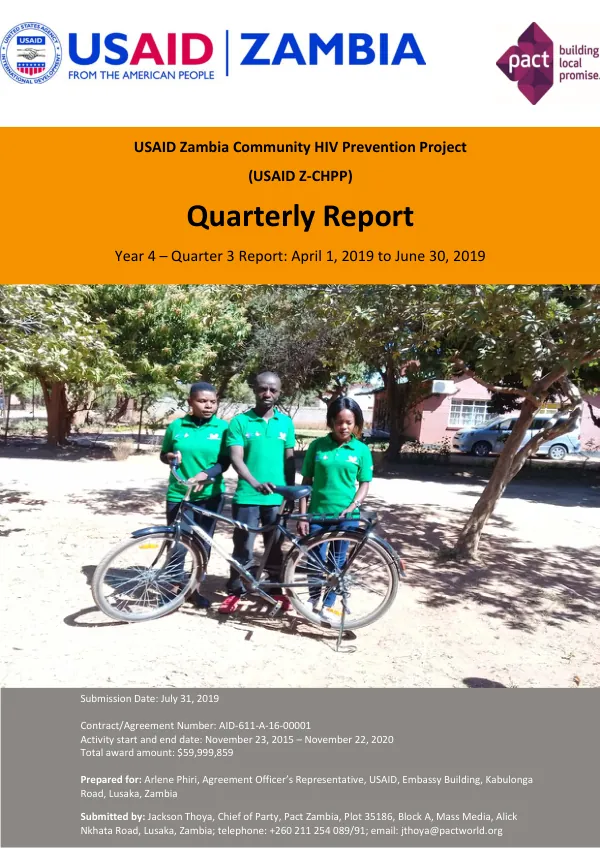
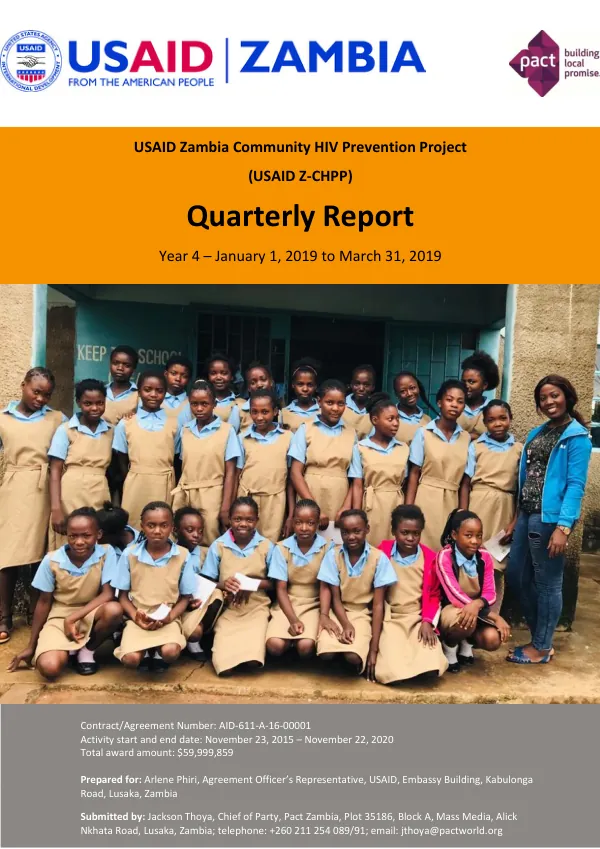
USAID Zambia Community HIV Prevention Project Quarterly Report Year 4 – January 1, 2019 to March 31, 2019
Sign inPACT
USAID Zambia Community HIV Prevention Project Quarterly Report Year 4 – January 1, 2019 to March 31, 2019
The Zambia Community HIV Prevention Project (USAID Z-CHPP) is a project implemented by Pact in 14 districts across five provinces of Zambia.
2019 · 25 pages
Sign in to readA free account is required to download.
Abstract
The project aims to reduce new HIV infections in Zambia by promoting increased adoption of high-impact HIV services and protective behaviors among priority populations. These populations include people living with HIV (PLHIV), discordant couples, adolescent girls and young women (AGYW) and their male sexual partners, and other high-risk groups such as mobile populations and non-injecting drug users. The project has made significant progress in achieving its objectives. In the second quarter of fiscal year 2019, USAID Z-CHPP reached 249,982 priority population individuals who completed standardized HIV prevention interventions to mitigate key determinants of risky behavior. These individuals included 187,663 females and 62,319 males. The project also distributed 1,203,776 condoms for HIV prevention, with 289,576 condoms distributed through DREAMS Centers. In addition, 23,082 people were counselled and tested for HIV, of whom 8.9% tested positive and were referred for care. The positivity rate stood at 8% with DREAMS and 24% without DREAMS. The project also reached 57,806 Orphans and Vulnerable Children (OVC) with HIV, family planning, economic strengthening, referrals for screening, treatment and care for Sexually Transmitted Infections (STI) and Sexual and Gender-Based Violence (SGBV) services. The project is on track to meet key targets for fiscal year 2019, and has already met and surpassed the HTS target for the year. However, the project faced challenges in the second quarter, including the need for more in-depth analysis of project data and shortages of HIV self-test kits and condoms. To address these challenges, the project management is working with key staff to address the data gap and has accessed 2 million condoms for distribution to priority population clients through collaboration with DISCOVER-Health. The project is guided by an evidence-based approach that maximizes the use of resources on densely populated districts with high HIV burden, targets the most vulnerable population groups, and supports stakeholders to respond to the HIV epidemic. The project also uses the ecological model of combining prevention, access to treatment, and adherence efforts with sustained positive behavioral and structural changes. The project has strengthened the capacity of local stakeholders to plan, monitor, evaluate, and ensure the quality of prevention interventions. Pact has supported ZCCP, SIA, CHEP, ZHECT, CMMB, YWCA, and 14 District HIV and AIDS Committees (DHACS) to mount an effective HIV response. The project has also supported the implementation of DREAMS Centers, which have been instrumental in increasing access to HIV prevention services among priority populations. Overall, the USAID Z-CHPP project has made significant progress in achieving its objectives and is on track to meet its targets for fiscal year 2019. The project's evidence-based approach and commitment to strengthening the capacity of local stakeholders have been instrumental in its success.