ECODIT, INC.
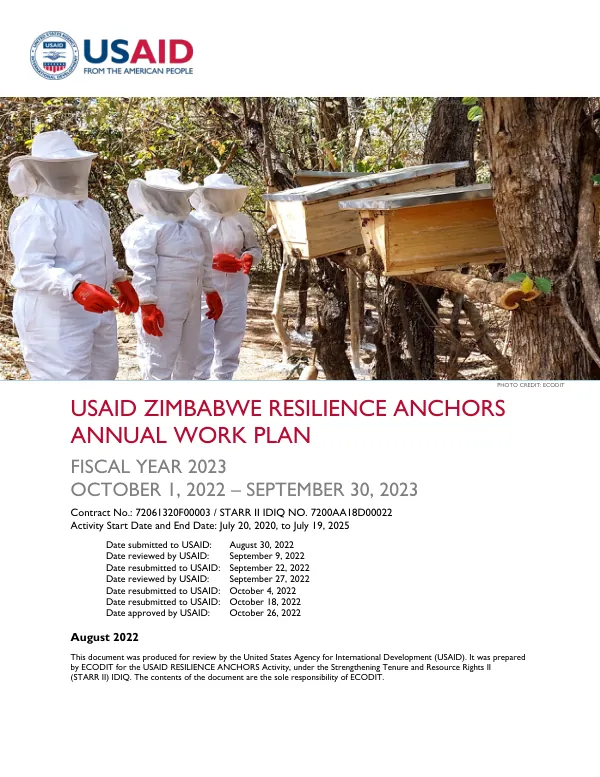
USAID Zimbabwe Resilience ANCHORS Annual Work Plan FY23
The USAID Zimbabwe Resilience ANCHORS Activity aims to strengthen community-level governance and oversight of conservation enterprises in three landscapes: Save Valley Conservancy (SVC), Gonarezhou National Park (GNP), and Mid-Zambezi Valley (MZV).
2023 · 56 pages
Sign in to readA free account is required to download.
Abstract
The activity focuses on improving economic benefits, increasing sustainable access to water, and strengthening locally led development and private sector engagement. The SVC landscape, covering 344,210 hectares, was established in 1991 and consists of 30 land titles that form 22 management properties. However, the national land reform program, which started in SVC in 2000, significantly affected SVC's ability to maintain strong governance, management, and relations with communities, government, and other stakeholders. The SVC needs a long-term solution to address internal issues and divisions, which have limited their ability to work effectively among themselves and with the Government of Zimbabwe (GoZ). The activity objectives for each landscape are aligned with the overall goal of strengthening community-level governance and oversight of conservation enterprises. Objective 1 aims to improve economic benefits from strengthened community-level governance and oversight of conservation enterprises. Objective 2 focuses on increasing sustainable access to supplies of water of sufficient quantity and quality to meet human, economic, and ecosystem needs. Objective 3 seeks to strengthen locally led development and private sector engagement. The activity will be implemented through three Activity Scopes of Work (ASOWs), each focusing on one of the three landscapes. The ASOWs will be implemented in collaboration with local communities, government agencies, and private sector partners. The activity will also involve crosscutting and coordination activities, such as those falling under the Monitoring, Evaluation and Learning (MEL) Plan, the Collaborating, Learning and Adapting (CLA) Strategy, and the Communications Strategy. The activity will be implemented over a period of 12 months, from October 1, 2022, to September 30, 2023. The timeline for activities in Year 3 (FY23) is outlined in the activity plan, which includes key milestones and deadlines for each objective. The activity budget for FY23 is also outlined in the plan, which includes a summary of the proposed activities and their associated costs. The activity will be monitored and evaluated through a Key Results Matrix, which will track progress against the activity objectives and key performance indicators. The activity will also be subject to regular review and assessment to ensure that it is meeting its objectives and making progress towards its goals. The activity will be implemented in collaboration with a range of stakeholders, including local communities, government agencies, and private sector partners. The activity will also involve the training of trainers and the development of community conservation plans, which will help to build the capacity of local communities to manage and conserve their natural resources. Overall, the USAID Zimbabwe Resilience ANCHORS Activity aims to strengthen community-level governance and oversight of conservation enterprises in three landscapes in Zimbabwe. The activity will be implemented over a period of 12 months and will involve a range of stakeholders, including local communities, government agencies, and private sector partners.
Related documents