ECODIT, INC.
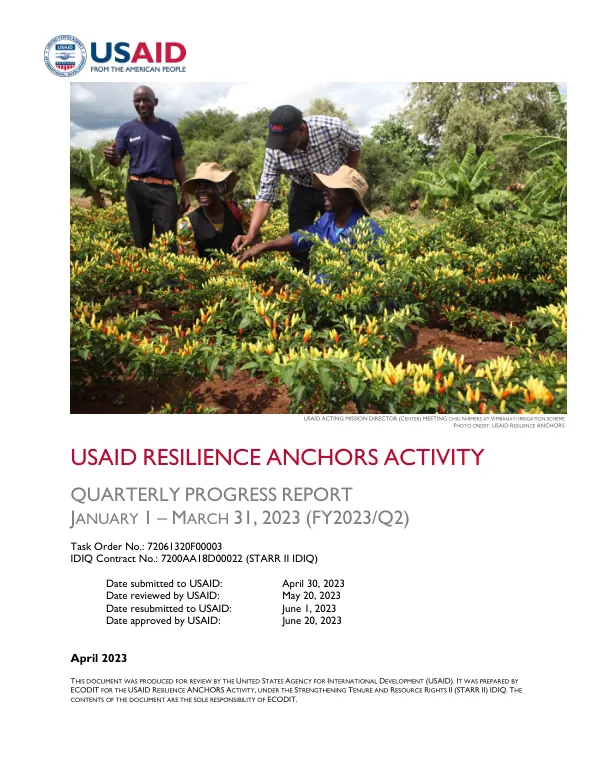
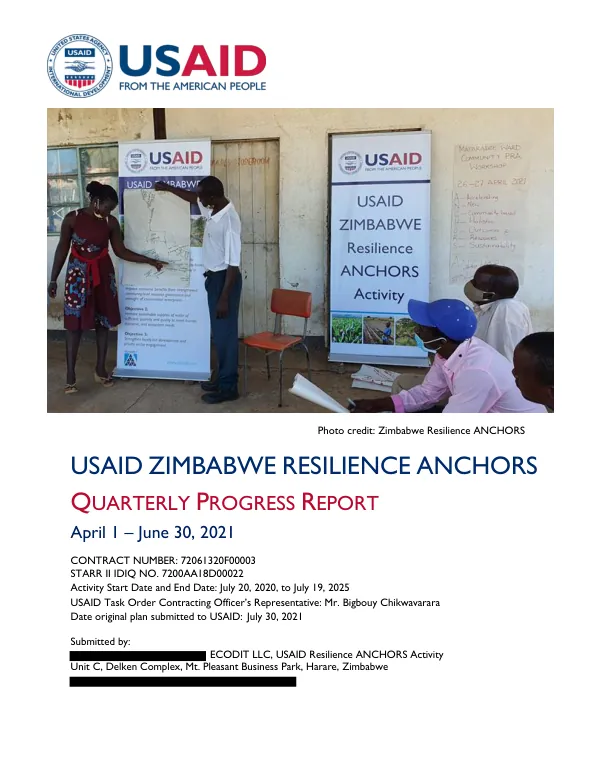
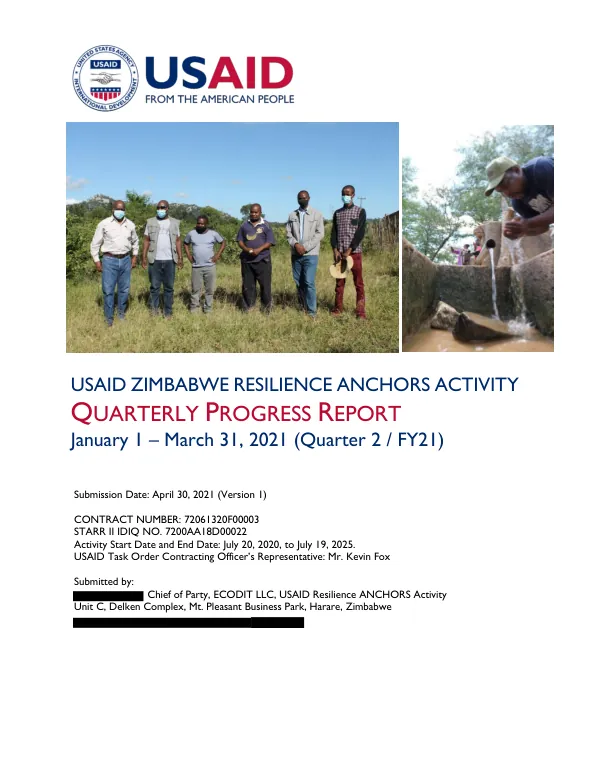
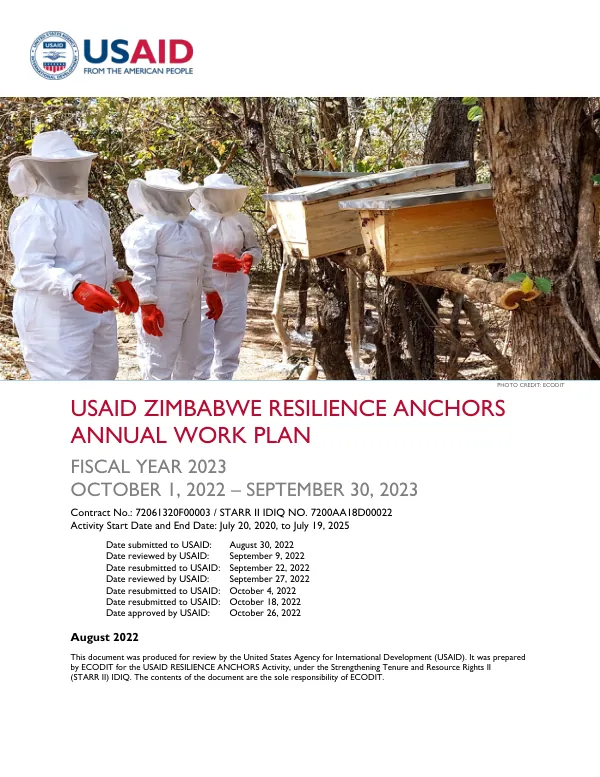
USAID Resilience ANCHORS Quarterly Progress Report April 1-June 30, 2023 (FY23/Q3)
The USAID Resilience ANCHORS Activity is a program aimed at strengthening community-level governance and oversight of conservation enterprises in Zimbabwe.
2023 · 65 pages
Sign in to readA free account is required to download.
Abstract
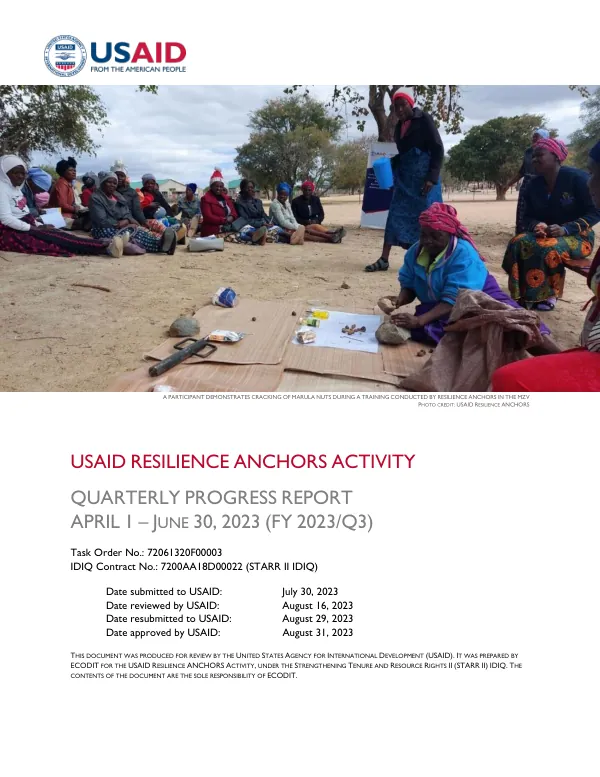
The Activity operates in the Southeast Lowveld (SEL) and the Mid-Zambezi Valley (MZV) regions, with a focus on building the resilience of communities through the development of the wildlife economy. In the third quarter of Financial Year 2023 (Q3 FY23), the Activity made significant strides in delivering results, developing new partnerships, and building community resilience. Internally, the Activity improved its systems, hired new staff members, and onboarded a new chief of party. The Activity also revised its core documents, including the FY23 Annual Work Plan, and reengaged with stakeholders to launch targeted landscape interventions. One notable example of the Activity's progress is the support provided to the Jamanda Conservancy in the Mahenye community of Chipinge District outside of Gonarezhou National Park. The Activity hosted a World Environment Day celebration at Jamanda's headquarters, which served as an informal inception meeting for its collaboration with Resilience ANCHORS. Key stakeholders, including representatives from Gonarezhou Conservation Trust, the Chipinge Rural District Council, and local NGOs, participated in the event. In the Southeast Lowveld, the Activity reengaged with the Savé Valley Conservancy (SVC) and incorporated direct support for SVC in its revised FY23 Annual Work Plan. Interventions have continued to facilitate the establishment of the Devure Community Conservancy on the western border of SVC in Bikita District, including the election of an eight-member management committee and the identification of 44 potential wildlife scouts. The Nyangambe Community Conservancy also received additional training on contract negotiations, private sector engagement, and governance. In terms of livelihoods, 1,930 farmers adopted climate-smart agriculture (CSA) practices and received training on sustainable agriculture techniques. The Activity also supported the development of non-timber forest products (NTFPs), with 2,500 farmers receiving training on NTFP collection, processing, and storage. The Activity's efforts resulted in a 27% increase in household income among program participants compared to the control group. The Activity's progress is reflected in the following performance indicators: * 1,930 farmers adopted CSA practices * 2,500 farmers received training on NTFP collection, processing, and storage * 44 potential wildlife scouts were identified for the Devure Community Conservancy * 8-member management committee was elected for the Devure Community Conservancy * 27% increase in household income among program participants compared to the control group The Activity's success is attributed to its focus on building community resilience, strengthening governance, and promoting sustainable livelihoods. The Activity's progress demonstrates its commitment to achieving its objectives and making a positive impact in the lives of communities in Zimbabwe.