HEALTH PARTNERS INTERNATIONAL
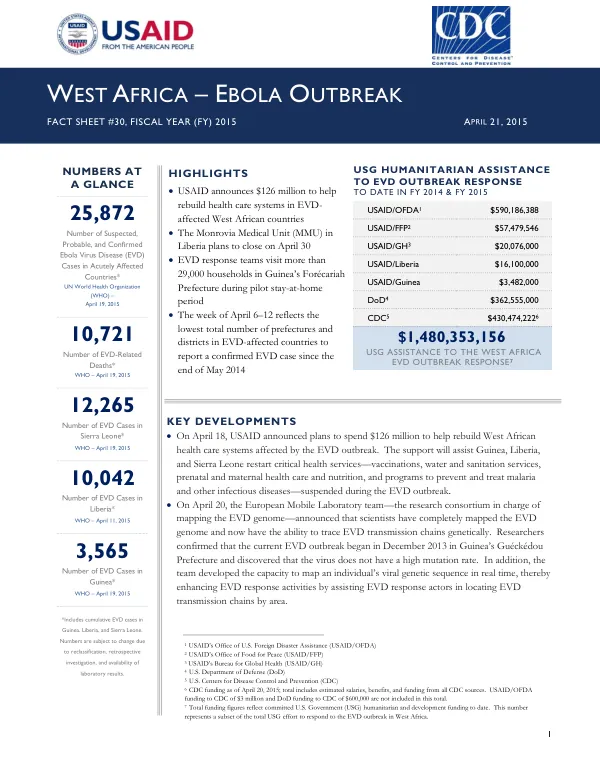
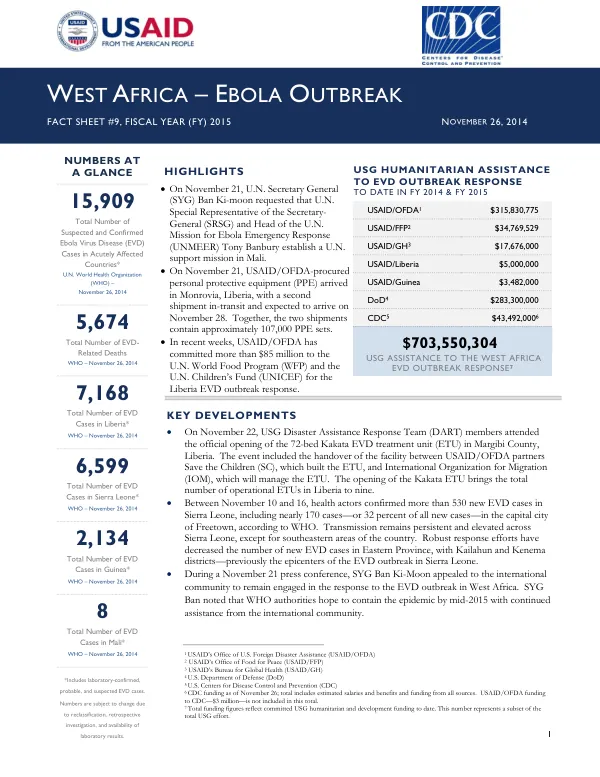
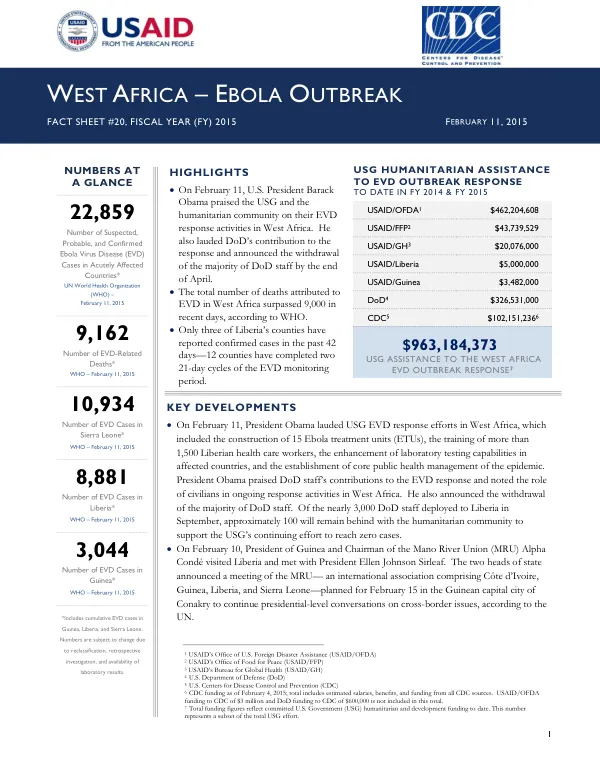
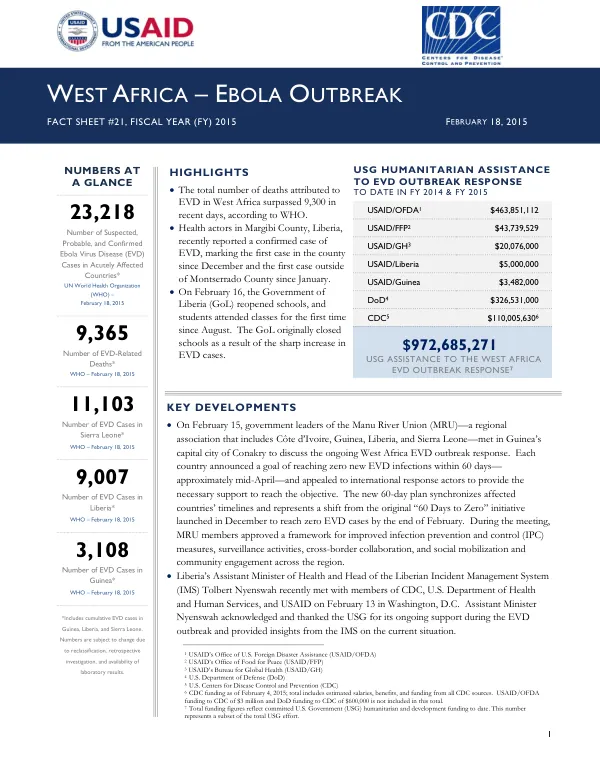
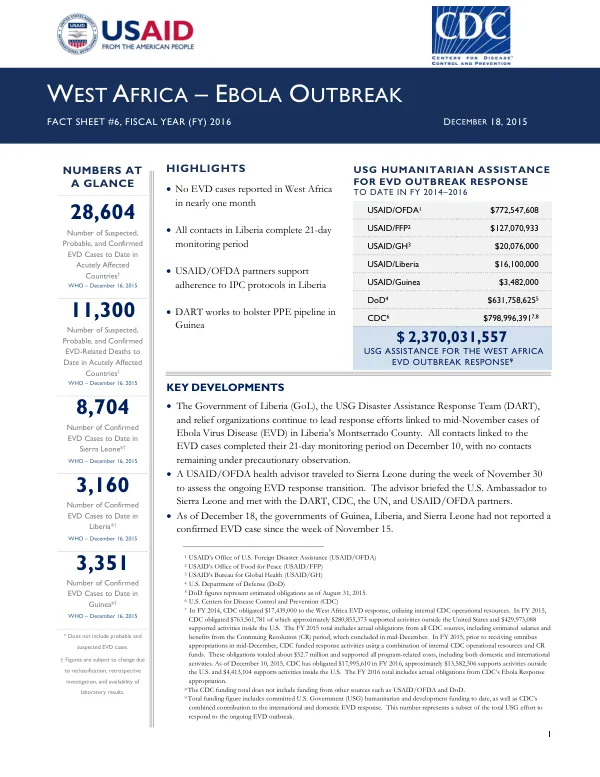
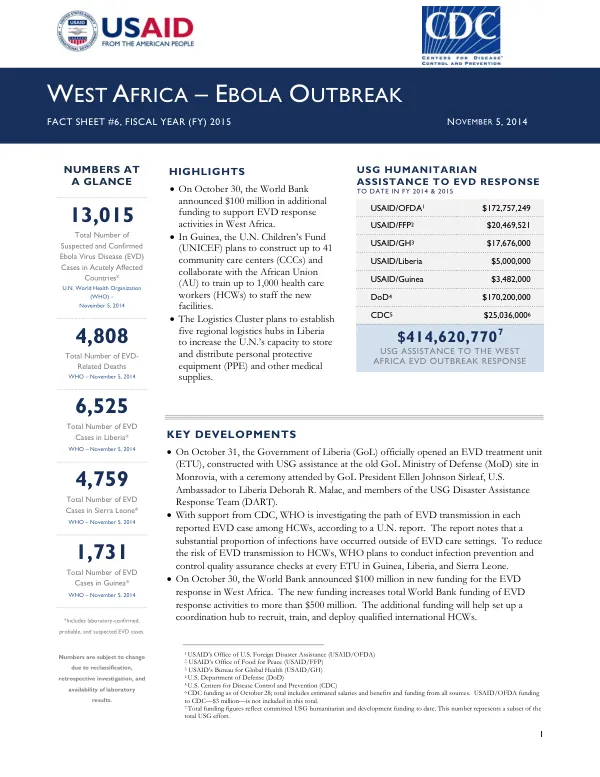
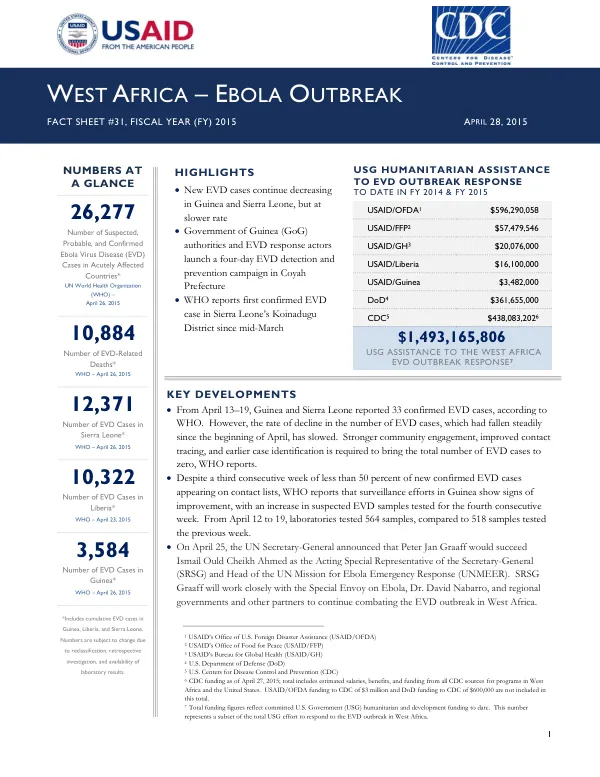
USG Humanitarian Assistance to EVD Outbreak Response to Date in FY 2014 & FY 2015
Ebola Virus Disease (EVD) cases in Guinea and Sierra Leone have continued to decline, but at a slower rate.
2015 · 7 pages
Sign in to readA free account is required to download.
Abstract
According to the World Health Organization (WHO), from April 13-19, Guinea and Sierra Leone reported 33 confirmed EVD cases. However, the rate of decline in the number of EVD cases has slowed, and stronger community engagement, improved contact tracing, and earlier case identification are required to bring the total number of EVD cases to zero. In Guinea, the Government of Guinea (GoG) authorities and EVD response actors launched a four-day EVD detection and prevention campaign in Coyah Prefecture. Preliminary reports indicate that approximately 600 teams visited more than 42,400 households, and EVD response actors received 23 community death alerts, although none tested positive for EVD. The National Ebola Coordination Cell confirmed effective implementation of the campaign. In Sierra Leone, the WHO reported the first confirmed EVD case in Koinadugu District since mid-March. The National Ebola Response Center (NERC) reports that the new case remains under investigation, with the source of transmission unknown. The Koinadugu District Ebola Response Center had quarantined a number of the confirmed case's contacts and continues contact tracing and surveillance efforts. The United States Government (USG) has provided significant humanitarian assistance to the EVD outbreak response in West Africa. As of April 28, 2015, the total USG funding for the EVD response in West Africa was $1,493,165,806. The USG funding includes contributions from USAID's Office of U.S. Foreign Disaster Assistance (USAID/OFDA), USAID's Office of Food for Peace (USAID/FFP), USAID's Bureau for Global Health (USAID/GH), the U.S. Department of Defense (DoD), and the U.S. Centers for Disease Control and Prevention (CDC). The USG assistance to the EVD outbreak response in West Africa includes support for EVD awareness messaging, infection prevention and control (IPC) kits, community care centers, and training to build county-level capacity to implement the Government of Liberia's Rapid Isolation and Treatment of Ebola strategy. The USG also supports EVD screening at all points of entry and exit throughout Sierra Leone, including at Freetown's Lungi International Airport. In Liberia, the Government of Liberia (GoL) Ministry of Health (MoH) and WHO, accompanied by USG Disaster Assistance Response Team (DART) staff, had visited eight Liberian counties to discuss the GoL-led EVD treatment unit (ETU) transition plan. The MoH and WHO plan to conduct visits to the remaining six counties beyond Montserrado County in the coming weeks. EVD specimen transport remains a challenge in many parts of Liberia, and the CDC Foundation has supported the non-governmental organization (NGO) Riders for Health to establish a specimen transport network in Liberia. The USG assistance to the EVD outbreak response in West Africa also includes support for strengthening IPC capacity in Sierra Leone's hospitals. USAID/OFDA is supporting the International Rescue Committee (IRC) with $5.3 million to strengthen IPC capacity in Sierra Leone's hospitals. In Kono's Koidu Government Hospital, an IRC IPC mentor is training approximately 300 hospital staff based on the IPC curriculum developed by CDC and the GoSL Ministry of Health and Sanitation.