INTERNATIONAL CHILDREN'S FUND, INC.
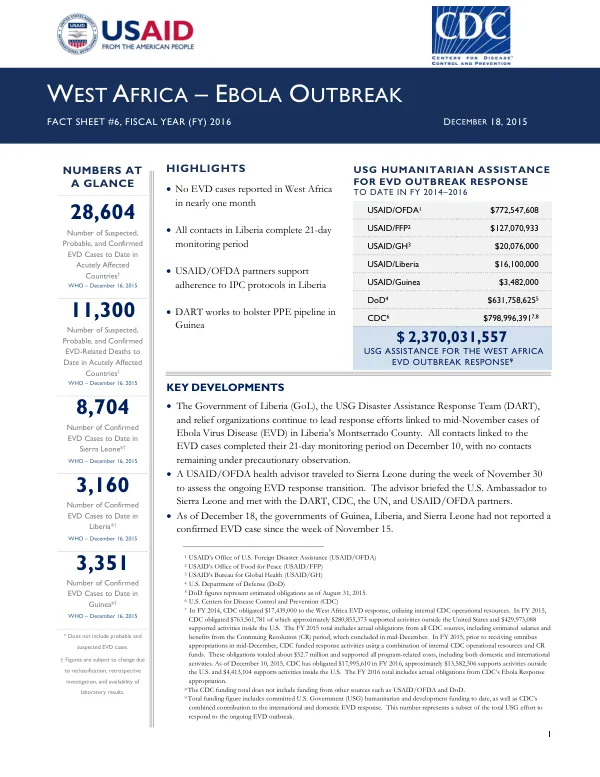
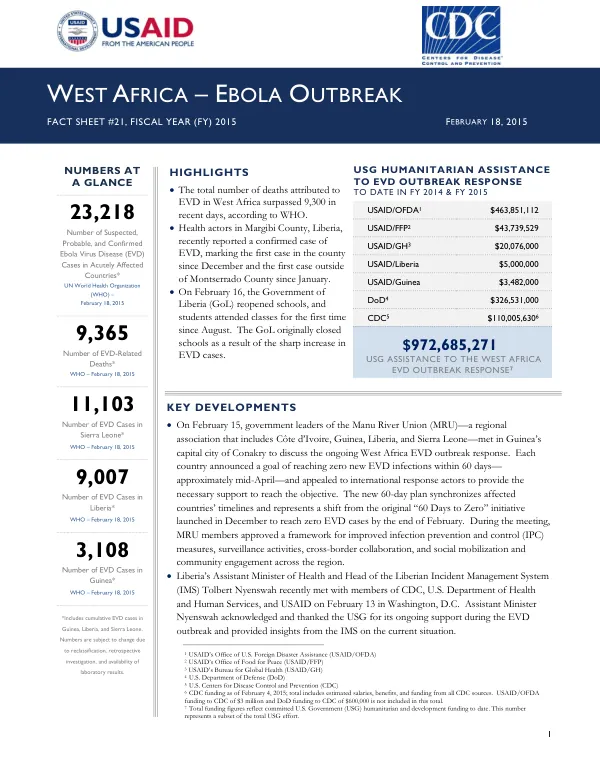
West Africa – Ebola Outbreak Fact Sheet #21, Fiscal Year (FY) 2015
The Manu River Union (MRU) held a meeting in Conakry, Guinea's capital city, on February 15 to discuss the ongoing West Africa EVD outbreak response.
2015 · 7 pages
Sign in to readA free account is required to download.
Abstract
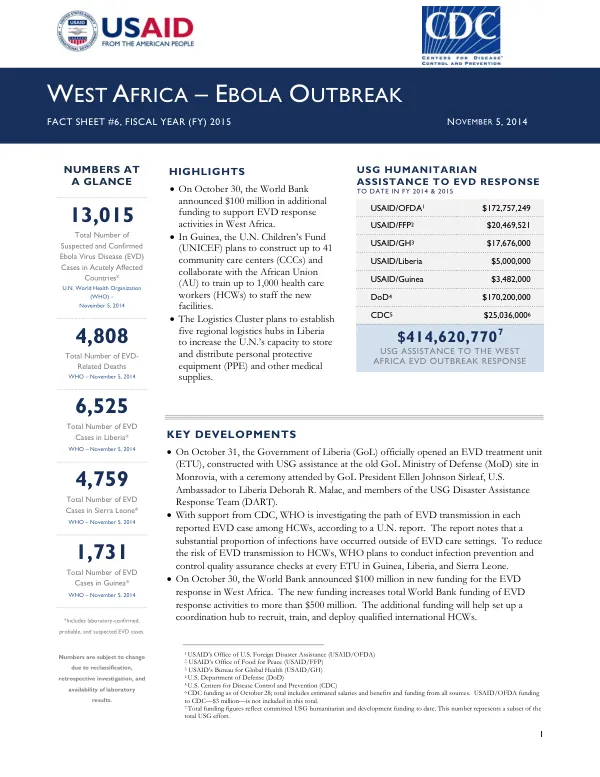
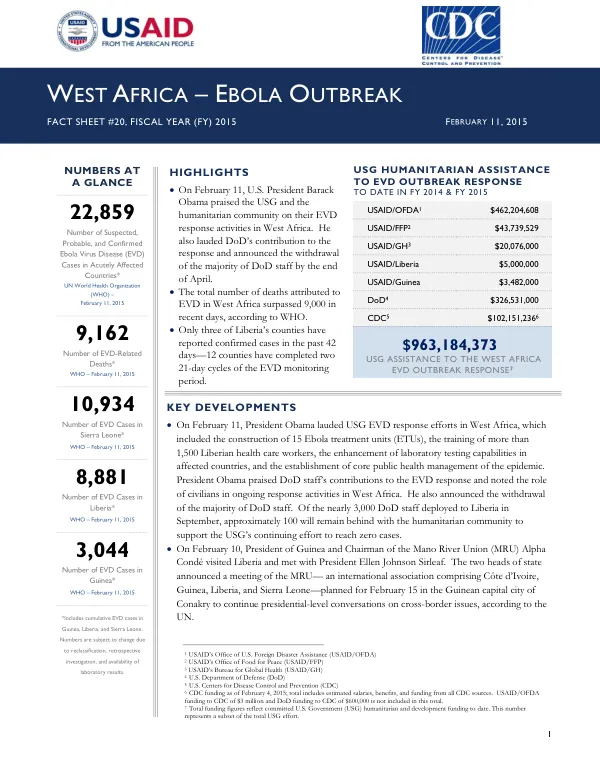
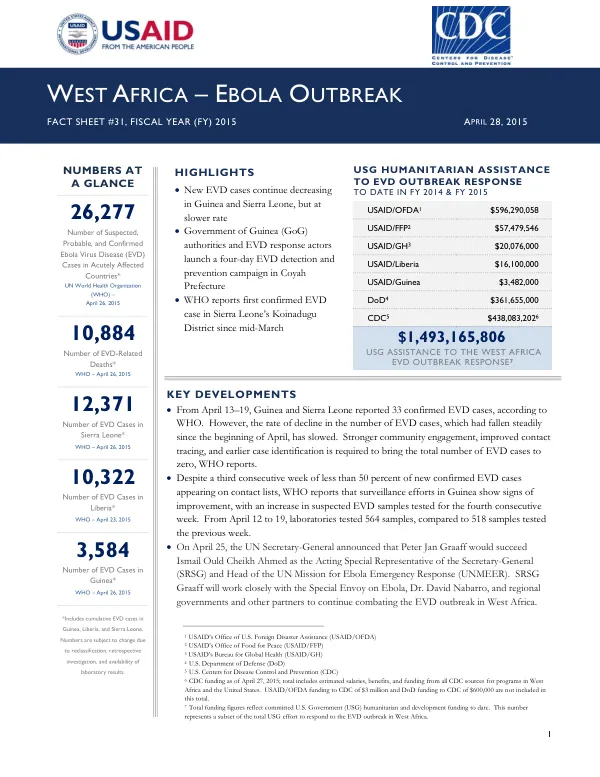
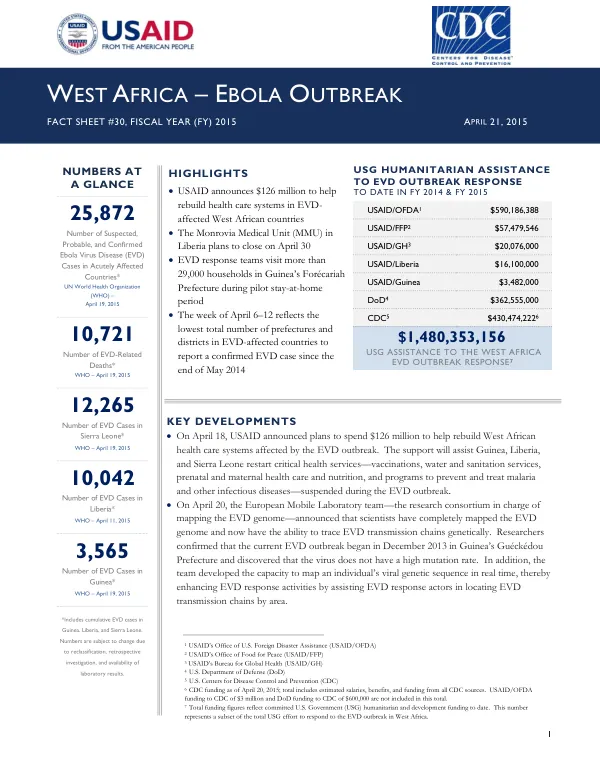
Government leaders from Côte d'Ivoire, Guinea, Liberia, and Sierra Leone announced a goal of reaching zero new EVD infections within 60 days, approximately mid-April, and appealed to international response actors for necessary support. The new 60-day plan synchronizes affected countries' timelines and represents a shift from the original "60 Days to Zero" initiative launched in December to reach zero EVD cases by the end of February. During the meeting, MRU members approved a framework for improved infection prevention and control (IPC) measures, surveillance activities, cross-border collaboration, and social mobilization and community engagement across the region. Liberia's Assistant Minister of Health and Head of the Liberian Incident Management System (IMS) Tolbert Nyenswah recently met with members of CDC, U.S. Department of Health and Human Services, and USAID on February 13 in Washington, D.C. Assistant Minister Nyenswah acknowledged and thanked the USG for its ongoing support during the EVD outbreak and provided insights from the IMS on the current situation. The total number of deaths attributed to EVD in West Africa surpassed 9,300 in recent days, according to WHO. Health actors in Margibi County, Liberia, recently reported a confirmed case of EVD, marking the first case in the county since December and the first case outside of Montserrado County since January. On February 16, the Government of Liberia (GoL) reopened schools, and students attended classes for the first time since August. The GoL originally closed schools as a result of the sharp increase in EVD cases. The total number of suspected, probable, and confirmed EVD cases in acutely affected countries is 23,218, according to WHO. The number of EVD-related deaths is 9,365. The number of EVD cases in Sierra Leone is 11,103, in Liberia is 9,007, and in Guinea is 3,108. These numbers are subject to change due to reclassification, retrospective investigation, and availability of laboratory results. Total weekly case incidence slightly decreased by approximately 11 percent across West Africa in the past week, with 128 new confirmed cases recorded between February 8 and 15, according to WHO. In Liberia, between February 10 and 16, the GoL reported five new confirmed EVD cases in Margibi and Montserrado. All of the new cases are related to the only known active chain of transmission in Liberia—a cluster from the St. Paul Bridge area of Montserrado. As of February 16, the GoL had reported 14 confirmed EVD cases during the previous 21 days. Approximately 220 households from four communities near Kakata town, Margibi, remain under observation following the county's first EVD case in eight weeks. International Medical Corps (IMC) admitted nine additional individuals with EVD-related symptoms to the USAID/OFDA-supported EVD treatment unit (ETU) in Kakata on February 15 and 16. Initial EVD laboratory test results for at least six of the new patients were negative as of February 17. In Sierra Leone, of the 150 new confirmed EVD cases reported between February 3 and 16, nearly 80 occurred in Western Area, including 26 confirmed EVD cases linked to a cluster in the capital city of Freetown's Aberdeen area, according to the Government of Sierra Leone (GoSL). In response to the cluster, the GoSL, CDC, and WHO are implementing a robust response, including intensive surveillance, active case finding, and social mobilization activities in the affected areas. While Aberdeen remains a hotspot, CDC also reports multiple, active transmission chains in other parts of Western Area, demonstrating the need for a sustained, comprehensive EVD response across all of Western Area. The Government of Guinea (GoG) and WHO reported three new EVD cases in Guinea on February 17, including two in Forécariah Prefecture and one in Conakry. Of the 24 confirmed cases currently undergoing treatment at ETUs, eight patients are in Conakry and 16 others are in Coyah Prefecture. To date, in February, health actors have confirmed 138 EVD cases, representing approximately 90 percent of confirmed EVD cases reported in January. Community reticence, including violence targeting EVD response actors, reluctance to report EVD symptoms and contacts, and the propagation of false EVD-related rumors, remains one of the significant challenges facing the implementation of EVD response activities in Guinea.