CDC
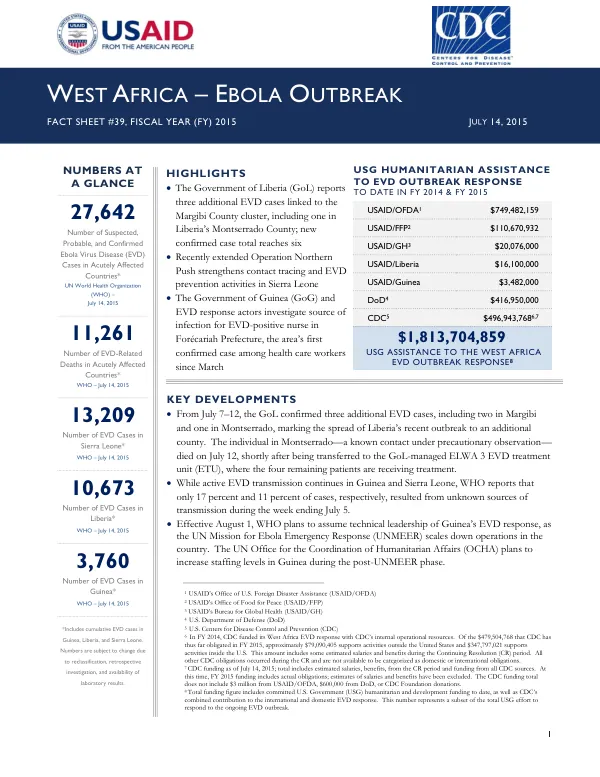
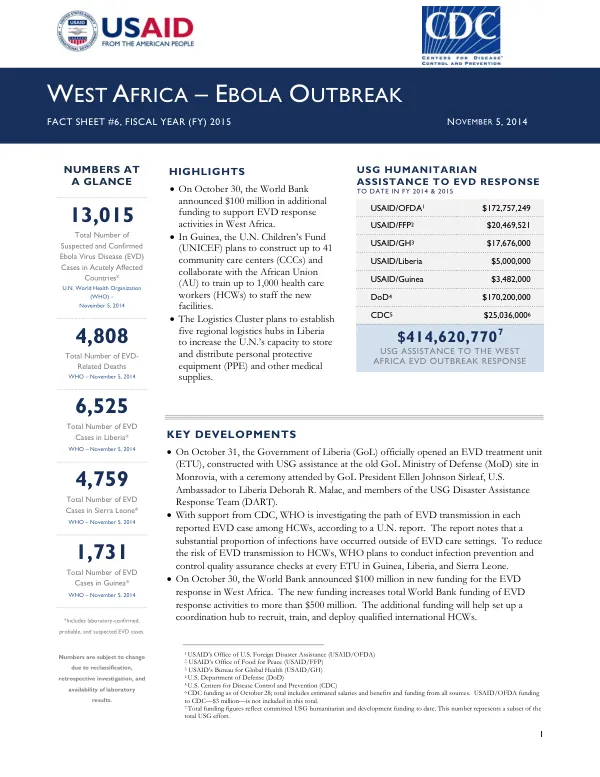
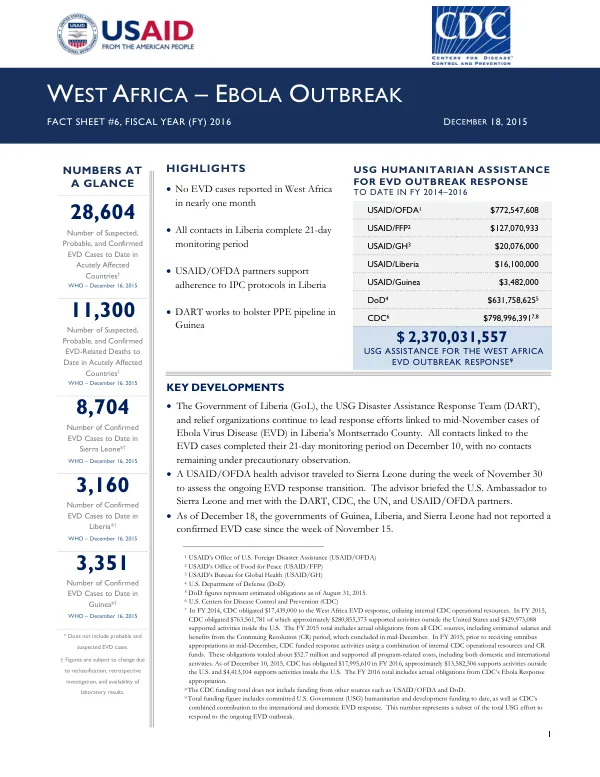
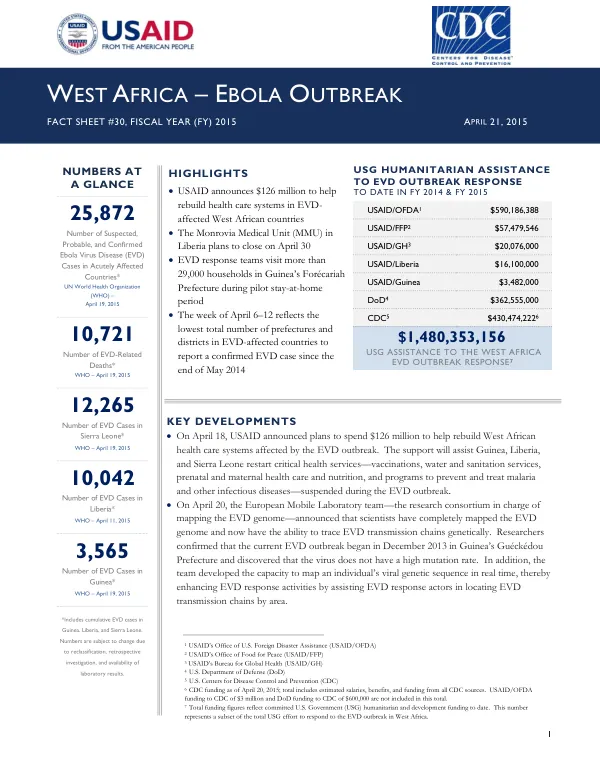
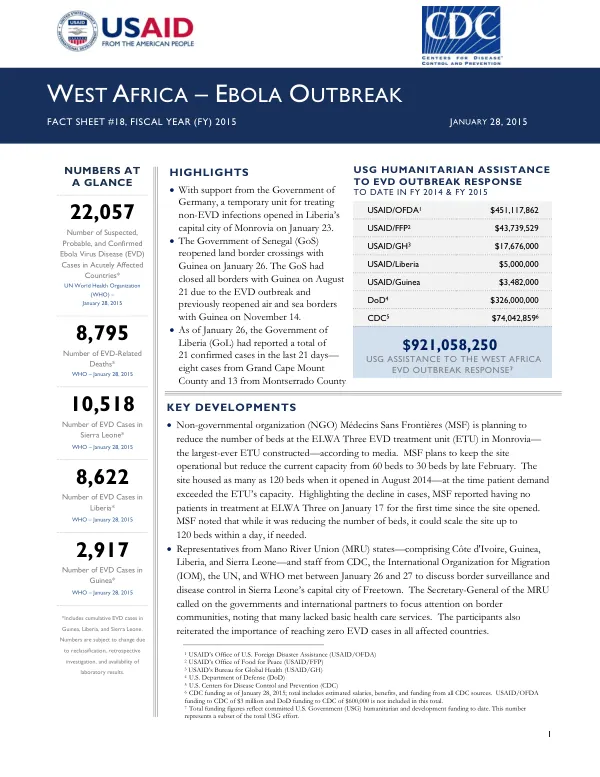
USG HUMANITARIAN ASSISTANCE TO EVD OUTBREAK RESPONSE TO DATE IN FY 2014 & FY 2015
Ebola Virus Disease (EVD) Outbreak Response in West Africa The EVD outbreak in West Africa has resulted in a significant number of cases and deaths.
2015 · 8 pages
Sign in to readA free account is required to download.
Abstract
As of January 28, 2015, the World Health Organization (WHO) reported 22,057 suspected, probable, and confirmed EVD cases in acutely affected countries, with 8,795 EVD-related deaths. The majority of cases have been reported in Guinea, Liberia, and Sierra Leone. In Liberia, the number of newly confirmed cases has remained at approximately one case per day. The Government of Liberia (GoL) reported 21 confirmed cases between January 5 and January 26. In Sierra Leone, new cases continue to decrease, with the Government of Sierra Leone (GoSL) reporting nine new cases on January 27 and 262 new cases in the two weeks between January 7 and 20. In Guinea, the number of new cases increased by 50% between January 19 and 25, with 30 confirmed cases reported. To address the outbreak, the Government of Liberia, with support from the German Red Cross (DRK) and German army, opened a Severe Infection Temporary Treatment Unit (SITTU) on January 23 to temporarily fill a gap in infectious disease care. The SITTU is designed to accept patients with symptoms consistent with EVD but not yet confirmed. Patients who test positive for EVD will be transferred to an EVD treatment unit (ETU), while those who test negative will be treated for other infectious diseases. In Sierra Leone, the current stage in the outbreak is marked by stable or decreasing transmission trends and localized hot spots in some districts. Despite progress in combating the outbreak, the GoSL is reporting new EVD cases among individuals not documented on existing contact lists in Bombali, Kambia, Kono, and Port Loko districts, as well as Western Area. In response, WHO and CDC have emphasized the need for improved contact tracing and surveillance to reach zero new confirmed cases of EVD in Sierra Leone. The US Government (USG) has provided significant humanitarian assistance to the EVD outbreak response, with a total of $921,058,250 committed to date. The USG assistance includes funding from USAID's Office of U.S. Foreign Disaster Assistance (USAID/OFDA), USAID's Office of Food for Peace (USAID/FFP), USAID's Bureau for Global Health (USAID/GH), the U.S. Department of Defense (DoD), and the Centers for Disease Control and Prevention (CDC). The DoD has constructed and supported the establishment of ETUs in various locations in Liberia, including Zorzor town, Lofa County, and Barclayville town, Grand Kru County. The ETUs are designed to provide treatment and care for patients with EVD, and have the capacity to scale up to 25 beds, if needed. The USG has also supported the establishment of a SITTU in Monrovia, Liberia, to provide temporary care for patients with symptoms consistent with EVD but not yet confirmed. The EVD outbreak response in West Africa requires a coordinated effort from governments, international partners, and local communities. The response includes contact tracing, surveillance, and treatment of patients with EVD, as well as provision of humanitarian assistance to affected communities. The USG continues to provide significant support to the EVD outbreak response, and is working closely with governments and international partners to bring the outbreak under control.