USAID DEC
Using Agriculture to Improve Child Health: Promoting Orange Sweet Potatoes Reduces Diarrhea
Sign inINTERNATIONAL FOOD AND POLICY RESEARCH INSTITUTE
Using Agriculture to Improve Child Health: Promoting Orange Sweet Potatoes Reduces Diarrhea
Vitamin A deficiency (VAD) is a prevalent public health problem in the developing world, affecting 190 million children under the age of five worldwide.
2015 · 10 pages
Sign in to readA free account is required to download.
Abstract
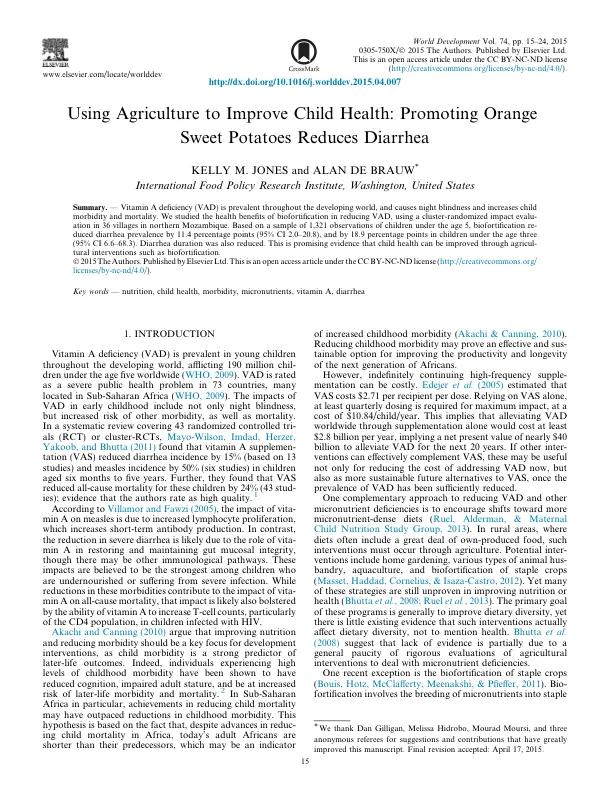
The condition is rated as a severe public health problem in 73 countries, many located in Sub-Saharan Africa. VAD increases the risk of night blindness, morbidity, and mortality in young children. A systematic review of 43 randomized controlled trials found that vitamin A supplementation (VAS) reduced diarrhea incidence by 15% and measles incidence by 50% in children aged six months to five years. VAS also reduced all-cause mortality for these children by 24%. The impact of vitamin A on measles is attributed to increased lymphocyte proliferation, which increases short-term antibody production. The reduction in severe diarrhea is likely due to the role of vitamin A in restoring and maintaining gut mucosal integrity. These impacts are believed to be the strongest among children who are undernourished or suffering from severe infection. Improving nutrition and reducing morbidity are key focuses for development interventions, as child morbidity is a strong predictor of later-life outcomes. Individuals experiencing high levels of childhood morbidity have been shown to have reduced cognition, impaired adult stature, and be at increased risk of later-life morbidity and mortality. Biofortification of staple crops is a promising approach to reducing VAD and other micronutrient deficiencies. This involves breeding micronutrients into staple crops using conventional breeding practices to control vitamin A, iron, and zinc deficiencies. Biofortification works by improving the nutritional quality of the variety of staple crops that households are already consuming, making it a potentially cost-effective way to reduce VAD or other micronutrient deficiencies. The primary goal of biofortification is to improve dietary diversity, yet there is little existing evidence that such interventions actually affect dietary diversity, not to mention health. The HarvestPlus Reaching End Users (REU) program in northern Mozambique promoted the cultivation of orange sweet potatoes (OSP) in home gardens, rather than the traditionally grown white or yellow varieties. The intervention included modules on production, consumption, and exchange of OSP. The REU was successful in promoting OSP adoption, increasing dietary intake of vitamin A, and decreasing VAD prevalence among both women of childbearing age and children. The REU project aimed to promote and distribute provitamin A-rich OSP in Mozambique with the goal of reducing vitamin A deficiency among children under the age of five and women of childbearing age. The project included three components: seed systems, demand creation, and marketing. In the seed systems component, vines for growing OSP were distributed to households in treatment villages and households were trained in planting OSP, how to disinfect vines, and vine preservation.
Related documents