USAID DEC
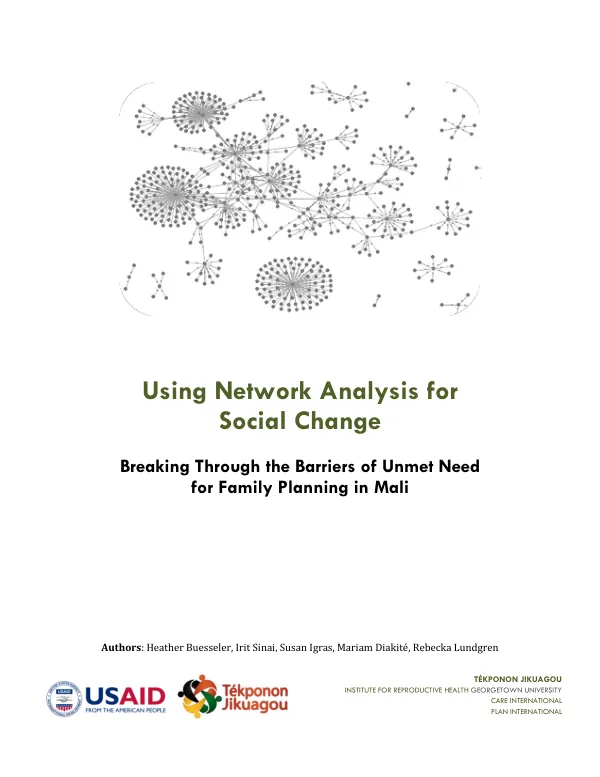
Using Network Analysis for Social Change: Breaking Through the Barriers of Unmet Need for Family Planning in Mali
Sign inCARE
Using Network Analysis for Social Change: Breaking Through the Barriers of Unmet Need for Family Planning in Mali
Breaking Through the Barriers of Unmet Need for Family Planning in Mali is a research project aimed at addressing the high levels of unmet need for family planning (FP) in the country.
2014 · 139 pages
Sign in to readA free account is required to download.
Abstract
Despite significant resources allocated for FP programs, unmet need remains high, and sustained FP use remains elusive. In Mali, nearly twenty years of FP programming efforts have led to high levels of knowledge about various methods of FP, yet increases in unmet need have outpaced increases in contraceptive prevalence. The project was designed to assess the effectiveness of a set of social network interventions to address unmet need for FP and improve reproductive health outcomes in Mali. To design the intervention package, the project first needed to understand the cultural context and social network dynamics, particularly power relations and gender norms as influences of family planning use. The first year of the project was dedicated to intensive formative research in two villages in Mali, Bougouba in Mopti Region, and Koloni in Sikasso Region. The research employed a three-phase "ethnographic sandwich" approach, consisting of ethnographic research, social network census, and in-depth interviews. The ethnographic research involved multi-faceted data collection methods, including focus group discussions, in-depth interviews, social mapping, and network analysis. The social network census aimed to map the social networks of individuals and couples in the two villages, while the in-depth interviews provided more detailed insights into the reproductive health decisions and behaviors of the study participants. The results of the ethnographic research highlighted the importance of social influencers, such as family members, friends, and community leaders, in shaping reproductive health decisions. The social network census revealed that individuals with higher network status were more likely to use family planning methods and have more positive attitudes towards FP. However, the network status of individuals was also influenced by power relations and gender norms, which can create barriers to FP use. The in-depth interviews provided further insights into the reproductive health decisions and behaviors of the study participants. The results suggested that programs can expect to achieve significant improvements in FP use and reproductive health outcomes by addressing the social contexts and relationships within which individuals and couples make reproductive health decisions. The project's findings have important implications for the design and implementation of FP programs in Mali and other countries in Sub-Saharan Africa. The project's research and analysis have informed the development of social network interventions to address unmet need for FP in Mali. The interventions aim to leverage social networks to promote FP use and improve reproductive health outcomes. The project's findings have also highlighted the need for a more nuanced understanding of the social contexts and relationships that influence reproductive health decisions, and the importance of addressing power relations and gender norms in FP programming efforts.
Related documents