USAID DEC
Women’s Social Networks and Family Planning Use in Mali: Formative Research Findings from ‘Terikunda Jékulu’
Sign inCOOPERATIVE FOR ASSISTANCE AND RELIEF EVERYWHERE INTERNATIONAL
Women’s Social Networks and Family Planning Use in Mali: Formative Research Findings from ‘Terikunda Jékulu’
The Terikunda Jékulu Project, a five-year research initiative, aims to address unmet need for family planning (FP) in Mali.
2015 · 10 pages
Sign in to readA free account is required to download.
Abstract
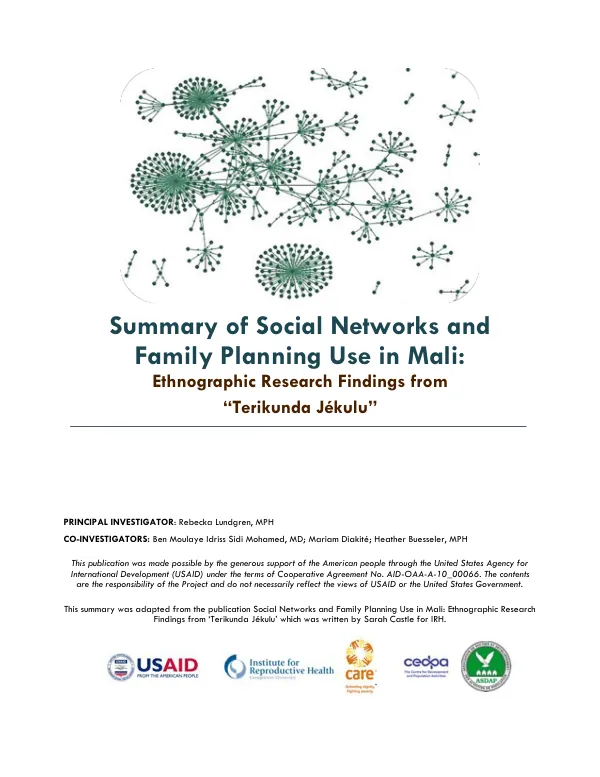
Funded by the United States Agency for International Development (USAID), the project involves conducting formative research, consisting of ethnography, social network mapping, and in-depth interviews, to better understand the influence of men and women's social networks on their attitudes, beliefs, desires, intentions, and behaviors regarding fertility and reproductive health. The ethnographic research was conducted in two contrasting settings of low and high family planning use and low and high unmet need. The two areas chosen for the ethnographic research were Bougouba and Koloni. The interviewees were chosen by a team of experienced interviewers using a screening mechanism that ascertained their unmet need status. Women who were not using contraception but did not wish to space or limit their births were excluded from the study. In both villages, most women wanted to use FP to space their births. Very few women wanted to limit the size of their family. Women using FP perceived that it helped them avoid short birth intervals, which were damaging to the health of both the mother and child. By contrast, men placed greater emphasis on the economic benefits for the household, thinking that spaced children were likely to be healthier and would not require regular and costly medical treatment. Women cited several barriers to family planning use, including misinformation about physical and social effects of FP, religious opposition, and lack of access to contraceptive methods. However, the most commonly cited barrier was spousal and community disapproval of family planning. The data indicate that a considerable number of women had never discussed FP use with their husbands and assumed that their husbands were either pro-natalist or that they associated FP with loose moral behavior among women, or both. Spousal disapproval was a significant barrier to FP use, with many women fearing that their husbands would start an argument or accuse them of cheating if they discussed FP use. Community disapproval was also a major issue, particularly in Bougouba, where rumors about the supposed health consequences of FP and its effect on future fertility were a major cause of non-use among those with unmet need. The research findings suggest that social networks play a crucial role in facilitating or hindering family planning acquisition and use. Women's social networks, in particular, are important in transmitting FP information and influencing attitudes and behaviors regarding fertility and reproductive health. The results of the ethnographic research will guide the development of data collection tools that are appropriate in the Malian context for the social network mapping, the second part of the formative research. The Terikunda Jékulu Project aims to design network-based interventions to reduce negative and strengthen positive influences on attitudes and behaviors regarding fertility and reproductive health. The project will implement these interventions in six districts of Mali and evaluate their effectiveness in addressing unmet need and applying social network theory using a case-control study design.