LINKS MEDIA, LLC
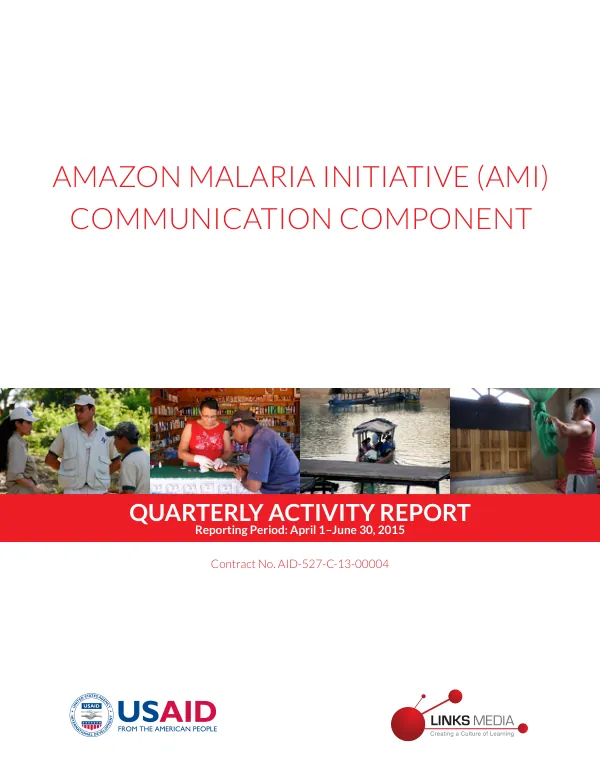
Quarterly Activity Report: Amazon Malaria Initiative (AMI) Communication Component
The Amazon Malaria Initiative (AMI) is a collaborative partnership among organizations and national malaria control programs in the Amazon basin and Central America.
2015 · 39 pages
Sign in to readA free account is required to download.
Abstract
Launched by the United States Agency for International Development (USAID) in 2001, the initiative's mission is to ensure that national malaria control programs substantially incorporate best practices and promote evidence-based policy changes in partner countries. The AMI's regional approach benefits partner countries through training and technical assistance, the development of standardized guidelines and protocols, the comparability of research and monitoring results, and coordinated approaches to addressing shared problems. The initiative currently supports 11 countries, including Belize, Brazil, Colombia, Ecuador, Guatemala, Guyana, Honduras, Nicaragua, Panama, Peru, and Suriname. Under the AMI Communication Component, Links Media's activities are designed to strengthen the initiative's role in improving malaria prevention and control in the Amazon basin and Central America through strategic communication, outreach, and dissemination approaches. During the period from October 1-December 31, 2015, Links Media worked directly with the National Malaria Control Programs of the supported countries to improve the use of communication interventions for malaria. Significant progress was made in advancing the AMI's three Intermediate Results (IRs) during this period. IR 1, the evidence base, was increased through the presentation of a poster on malaria elimination in the LAC region at the American Society of Tropical Medicine and Hygiene (ASTMH) 64th Annual Meeting. The poster analyzed qualitative data collected in communication assessments with 11 countries' NMCPs in 2014 and was disseminated to approximately 4,500 attendees from 98 countries. IR 2, the evidence base communicated and used, was advanced through the dissemination of the evidence base on malaria in LAC through various communication channels, including the AMI project website, social media platforms, an email listserve, and the UN website ReliefWeb.int. Knowledge management continued with the project website serving as the main hub for relevant information and materials. IR 3, the use of evidence-based communication and advocacy, was also advanced through the development of a communication strategy for the AMI, which aimed to increase the use of evidence-based communication and advocacy by NMCPs in the supported countries. The strategy included the development of a communication plan, the creation of a communication toolkit, and the provision of technical assistance to NMCPs. During this period, Links Media also conducted a communication assessment with the NMCPs of the supported countries to identify their communication needs and gaps. The assessment revealed that the NMCPs required technical assistance in developing their communication strategies and plans, as well as in creating communication materials and tools. The report also highlights the challenges and solutions faced by the AMI during this period. One of the main challenges was the limited availability of resources and funding, which hindered the implementation of the communication component. However, the AMI was able to overcome this challenge through the provision of technical assistance and the development of a communication strategy that was tailored to the needs of the supported countries. In terms of financials, the AMI received funding from USAID to support the communication component during this period. The funding was used to support the development of a communication strategy, the provision of technical assistance to NMCPs, and the dissemination of the evidence base on malaria in LAC. Overall, the report highlights the progress made by the AMI in advancing its three IRs during the period from October 1-December 31, 2015. The initiative's regional approach and the provision of technical assistance and training to NMCPs have been instrumental in improving malaria prevention and control in the Amazon basin and Central America.