SAVE THE CHILDREN FEDERATION/US
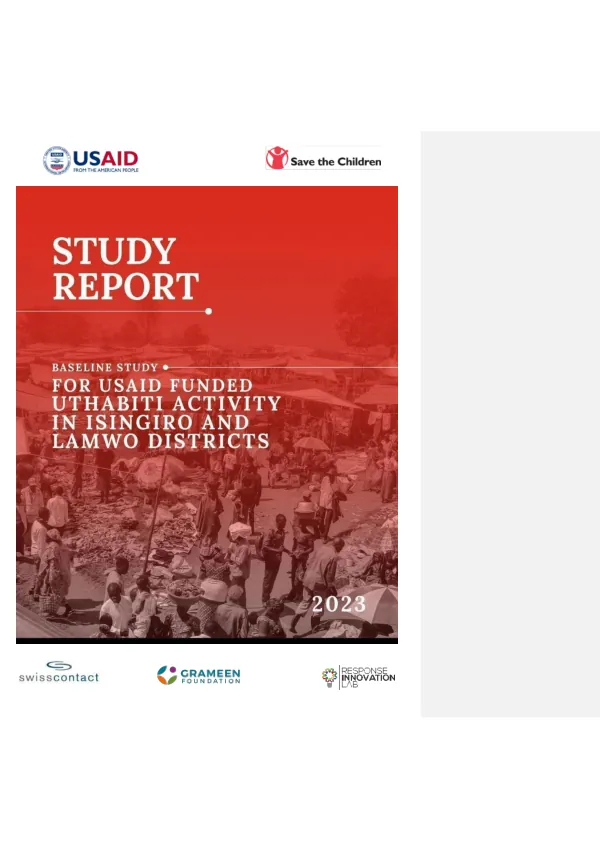
Uthabiti Activity Baseline Study Report
Uganda is one of the leading refugee-hosting countries in the world, hosting 1,470,858 refugees and asylum seekers in 2021.
2023 · 61 pages
Sign in to readA free account is required to download.
Abstract
The country has thirteen districts where refugees reside, including Isingiro and Lamwo districts, which are the focus of the Uthabiti project. The project aims to support youth and women from refugee and host communities in these districts, promoting value-added opportunities in primarily off-farm activities within selected value chains. The Uthabiti project is a three-year initiative funded by the United States Agency for International Development (USAID). The project focuses on market systems strengthening, reliable and cost-effective sources of clean energy, and access to finance. The project targets 70% refugees and 30% host community members, particularly youth and women, with the goal of improving their livelihoods and increasing their access to economic activities. A baseline study was conducted between December 21, 2022, and January 2, 2023, to establish baselines for impact and outcome indicators. The study aimed to determine baseline values of project outcomes and impact indicators, including the percent of households with poor, borderline, and acceptable Food Consumption Score (FCS), the mean and median Reduced Coping Strategies Index (RCSI), and the Adaptive Capacity Index (ACI). The study found that households in the host community had a higher acceptable FCS of 75%, while refugee households had an FCS of 58%. Refugees reported a higher percentage of coping strategies (over 65%) than members of the host community (below 65%). The adaptive capacity index showed that members of the host communities had higher capacity indexes as compared to refugees, generally and in relation to gender and age differences. The study also found that 55% of refugees and 49% of nationals reported generating a net income, with an average income of UGX 230,877 (USD $63) for refugees and UGX 318,856 (USD $87) for nationals. Less than 10% of the respondents reported engaging or actively practicing new livelihood activities, with the most common activity being recycling.