MERCY CORPS INTERNATIONAL
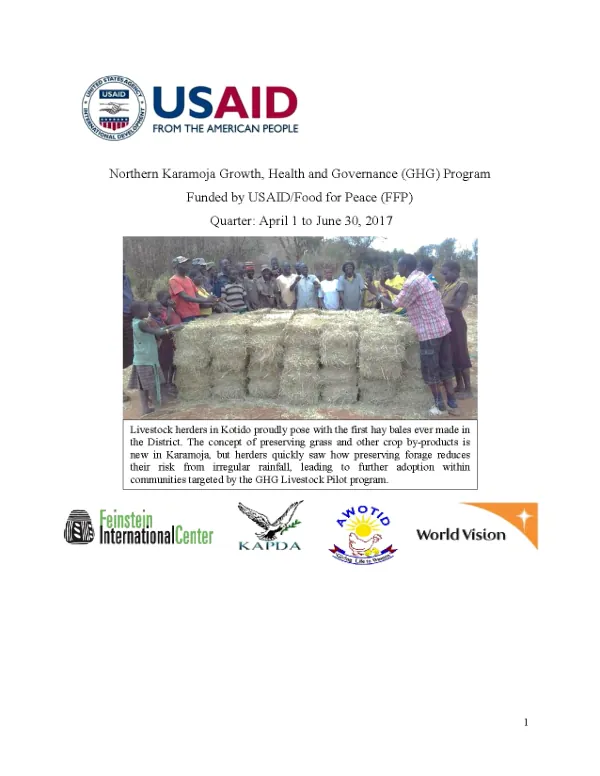
Northern Karamoja Growth, Health and Governance (GHG) Program
The Northern Karamoja Growth, Health and Governance (GHG) Program was designed to capitalize on the improved security situation in the region through a range of economic, health, and governance initiatives.
2015 · 40 pages
Sign in to readA free account is required to download.
Abstract
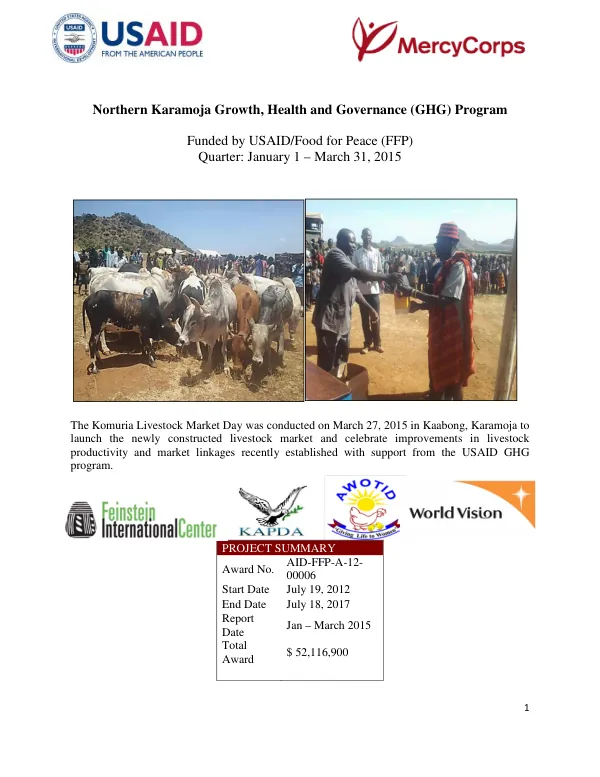
The program was funded by USAID/Food for Peace (FFP) and had a total award of $52,116,900. The program's geographical focus included the northernmost three Karamojong districts of Kaabong, Kotido, and Abim, home to approximately 457,000 individuals. The GHG program aimed to strengthen the livelihoods of the local population by improving productivity and market access among male and female agriculturalists, agro-pastoralists, and pastoralists. The program worked with cattle, sheep, goats, and poultry, and its activities were primarily on-schedule considering the seasonal nature of agricultural activities. The program also focused on improving governance and health services in the region, with a particular emphasis on addressing the needs of pregnant and lactating women and children under the age of two. One of the key lessons learned from the program was the importance of performance-based incentives in improving governance of health facilities. The program used this approach to motivate district health support staff to mentor facilities and build their capacity to provide high-quality services. However, the program also learned that the incentives alone were not enough to sustain the efforts and results, and that an empowered community was necessary to ensure that the improved services were maintained. The program also adopted an adaptive management approach, which allowed it to identify changes to its core assumptions and new opportunities during semi-annual program reviews. This approach enabled the program to make informed course corrections and balance adaptation with achieving results. The program also observed that the agro-input market in northern Karamoja was beginning to function, with new agrodealers voluntarily initiating activities due to the commercial opportunity. However, the program also noted that many Karamajong-origin commodity traders were not as effective at managing their businesses according to commercial, market-based principles as their non-Karamajong counterparts. The program plans to assess the reasons for this difference and develop interventions to reverse the trend. In terms of progress, the program reported that 65% of the target for farmers and others who had applied new technologies or management practices as a result of USG assistance had been achieved. The program also reported that 110% of the target for private enterprises, producer organizations, water user associations, women's groups, trade and business associations, and community-based organizations that applied new technologies or management practices as a result of USG assistance had been achieved. Additionally, the program reported that 84% of the target for individuals who had received USG-supported short-term agricultural sector productivity or food security training had been achieved.