ПРЕДСТАВИТЕЛЬСТВО МЕЖДУНАРОДНОГО ДЕТСКОГО ФОНДА В РЕСПУБЛИКЕ БЕЛАРУСЬ
Модуль V «Планирование в семейно-ориентированной социальной работе»
The methods of conducting social work interviews are crucial for effective communication and problem-solving.
1 pages
Sign in to readA free account is required to download.
Abstract
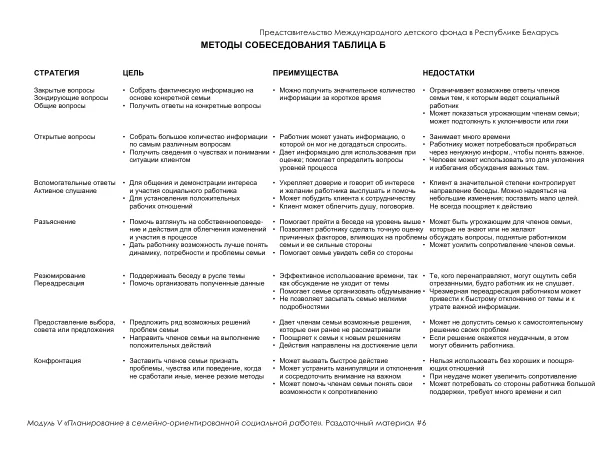
A key strategy is to use a combination of closed, open, and zondirovye questions to gather information and understand the client's perspective. Closed questions are used to gather factual information and can be effective in obtaining specific answers from clients. However, they may limit the scope of the conversation and can be perceived as threatening or leading. Examples of closed questions include "What is your income?" or "Do you have any children?" Zondirovye questions, on the other hand, are used to explore the client's thoughts and feelings about a particular issue. They can be effective in gathering information and understanding the client's perspective, but may require more time and effort to answer. Examples of zondirovye questions include "How do you feel about your current living situation?" or "What do you think is the main cause of your problems?" Open questions are used to gather a wide range of information and can be effective in encouraging clients to share their thoughts and feelings. However, they may be time-consuming and require active listening skills to ensure that the client feels heard and understood. Examples of open questions include "Can you tell me more about your current situation?" or "What do you think would be the best solution to your problem?" Active listening is a critical component of social work interviews, as it allows the worker to understand the client's perspective and build trust. This involves maintaining eye contact, nodding to show interest, and paraphrasing the client's words to ensure understanding. In addition to these methods, social workers may also use various techniques to facilitate the interview process. These include providing explanations, summarizing the conversation, and offering choices to the client. Providing explanations can help the client understand the purpose of the interview and the worker's role, while summarizing the conversation can help ensure that the client feels heard and understood. Offering choices can give the client a sense of control and agency, and can help them feel more invested in the problem-solving process. However, social workers must also be aware of the potential risks and limitations of these methods. For example, providing explanations may be perceived as threatening or manipulative, while summarizing the conversation may be seen as dismissive or condescending. Offering choices may be seen as coercive or controlling, and may not always be effective in achieving the desired outcome. Ultimately, the key to effective social work interviews is to use a combination of methods and techniques that are tailored to the client's needs and preferences. By being flexible and adaptable, social workers can build trust and rapport with their clients, and help them achieve their goals and overcome their challenges.