USAID DEC
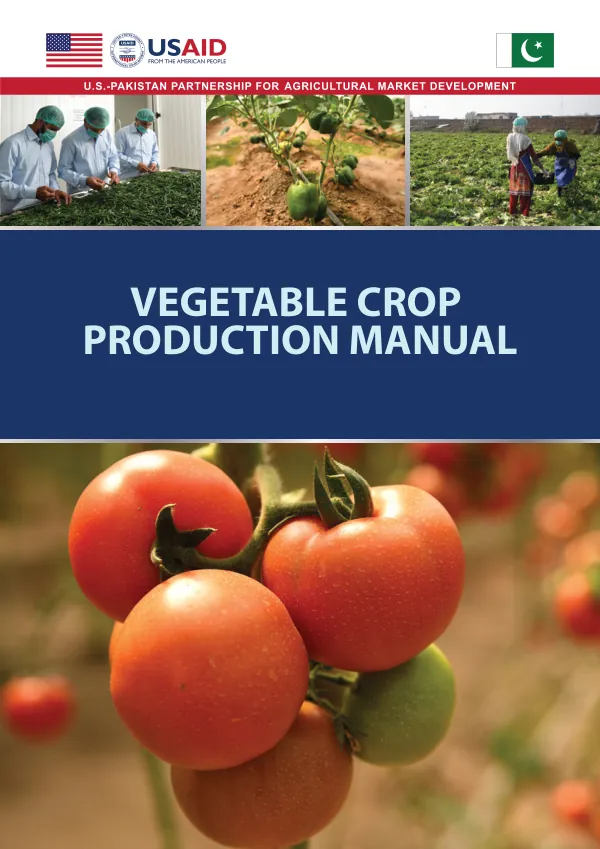
Vegetable Crop Production Manual
The U.S.-Pakistan Partnership for Agricultural Market Development (AMD) was a four-year project funded by USAID.
196 pages
Sign in to readA free account is required to download.
Abstract
The project aimed to increase the efficiency, quality, and profitability of four targeted product lines through strengthening related supply chains, improving market linkages, and developing the institutional capacity of catalytic actors. AMD collaborated with stakeholders to plan and execute interventions after a thorough sectorial and cost-benefit analysis of the livestock, HVOSV, citrus, and mango sectors. The project implemented assistance with competitively selected businesses (farmers and processors/exporters) through the introduction of new technologies by upgrading infrastructure and equipment through matching grant funds, advanced farm practices (capacity building through technical assistance and tailored trainings), and sustainable market linkages. AMD facilitated collaboration and synergies between producers and processors/exporters with stakeholders from the government, academic, and private sectors to make targeted product lines more efficient and competitive. AMD focused on upgrading product lines and infrastructure development through a matching grant fund mechanism to enhance efficiency or new product development for improved and sustainable supply chains. The project objectives included increasing the efficiency, quality, and profitability of selected product lines through the adoption of best practices in production, marketing, and business organization management, making supply chains more competitive. The project also aimed to improve market linkages within targeted product lines and develop the institutional capacity of catalytic actors within these value chains. AMD worked with processors, traders, retailers, and ancillary services providers that support the targeted value chains. The project intervention in the vegetable sector involved upgrading the facilities of grantees and improving their operations in sync with the changing food quality and safety requirements of the international market. AMD equipped these facilities with temperature-controlled processing areas, cold storage, blast chillers, and refrigerated vans. The equipment provided had the capacity to cool down and maintain the temperature of fruits and vegetables at 2+ to 4+ centigrade. These facilities, equipped with energy-efficient machines, can function throughout the year and have the ability to process and store multiple vegetables. Through an in-kind support package, AMD also provided refrigerated trucks/vans on a cost-share basis to enable on-farm cooling of fresh produce and transportation from farm to pack house to market, thereby protecting products from spoilage, damage, and adverse weather conditions. AMD selected humidifiers that offered advanced ultrasonic technology, a water evaporation capacity of 12 kilograms per hour, and an air volume of 610 cubic meters per hour. The provided humidifier is wheel-mounted and can be easily transferred to a processing hall, cold storage, or blast chiller, as per need and requirement. Use of the ultrasonic humidifier is not common in Pakistan, yet this technology is simple, cost-efficient, and effective. AMD provided technical assistance to grantees in Karachi and Lahore to ensure optimum warehouse layout, civil construction, arrangement of goods stored, and temperature-controlled humidity for various types of fruits and vegetables. Eggplant (brinjal) is a widely cultivated Solanaceous vegetable crop in Pakistan. It is one of the most common warm-season vegetable crops grown in all of the provinces and is available year-round. Eggplant fruit shape and color is highly diverse and ranges from oval to round to elongated, with external color ranging from white, yellow, green, and different shades of purple. Eggplant is a popular vegetable throughout Pakistan. In addition to domestic market sales, eggplant can be exported to markets in the Gulf States and high-end specialty markets in Europe and Asia. Domestic market prices are typically highest in the spring months of April and May. Eggplant fruits are typically peeled, sliced thin, and prepared as a cooked, baked, or boiled vegetable. Numerous dishes and food products are prepared from eggplant throughout the world. The fruit can also be pickled and dehydrated and may contain some beneficial medicinal properties. Commonly grown eggplant cultivars in Pakistan include Long Purple, Black Beauty, Black Pearl, Black Round, Jannat, Black Boy, Black Queen, Black Bahar, and various Advanta Seed Co. numbered hybrids. Most growers plant hybrid cultivars, which are generally higher yielding and produce more uniform fruit. The time of sowing eggplant seeds for transplant production should be 6-8 weeks before the intended time of field planting. The recommended times for field transplanting differ according to province as indicated below: Punjab: February, April, August; Sindh: March-April, October-November; Khyber Pakhtunkhwa: February-March; Balochistan: April, July-August, February. Eggplant production should be part of a crop rotation system, instead of continuous monoculture planting. Examples of appropriate crop rotations incorporating eggplant include eggplant and cucumber or bell pepper for poly tunnel plantings, eggplant and rice or wheat for field plantings, and eggplant, jantar, and potato for field plantings. Eggplant is a warm-season vegetable crop that has a long growing season. Initial fruit harvest can begin two months after transplanting of the early maturing cultivars