DAI GLOBAL, LLC
Vietnam Urban Energy Security Year 3 Workplan
Vietnam Urban Energy Security is a project aimed at improving energy resilience and security in Vietnam's urban areas.
2021 · 43 pages
Sign in to readA free account is required to download.
Abstract
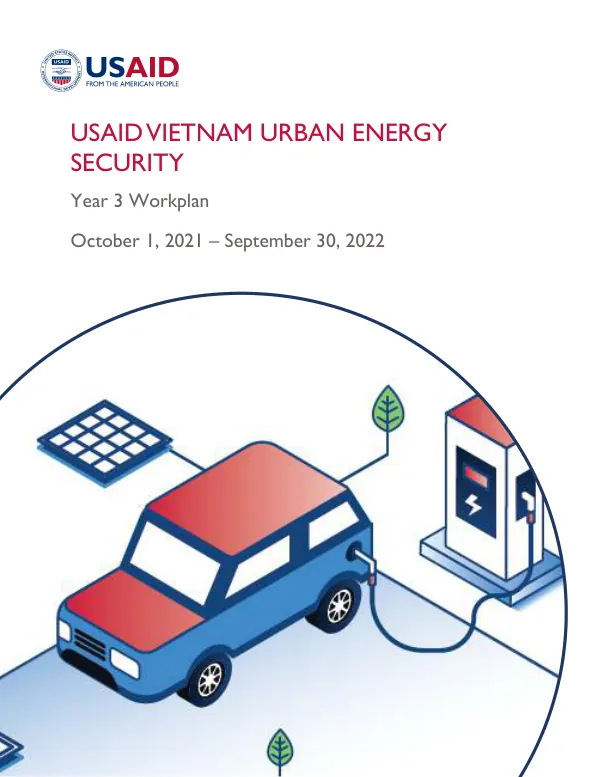
The project works closely with the United States Agency for International Development (USAID) and the Government of Vietnam (GVN) to improve enabling frameworks, mobilize investment, and increase the adoption of innovative solutions for advanced, distributed energy. The overall goal of the project is to deploy advanced, distributed energy solutions to improve urban energy resilience and energy security in Vietnam. The project aims to achieve several high-level expected results, including the deployment of at least 400 megawatts (MW) of advanced, distributed energy systems in Danang and Ho Chi Minh City, mobilization of at least $1 billion in public and private investment for advanced, distributed urban energy, and demonstration and/or commercialization of at least 20 innovative solutions to address urban energy and environment issues. In Year 3, the project will maintain momentum from Year 2 with ongoing activities. The project will strengthen its capacity by filling several full-time vacancies, recruiting short-term consultants, and partnering with sub-contractors. The project will extend its technical scope to cover electric vehicles (EVs) and electric vehicle charging stations (EVCS), a growing market in Vietnam's cities. Waste to Energy (WTE) projects are also a key element in the Year 3 workplan, with the project mobilizing resources to support WTE project developers with financial advisory services and help them access financial resources. The project aims to achieve full project approval in Ho Chi Minh City and will continue to align project activities with city strategies through close partnership and the support of the Department of Industry and Trade (DOIT) both in Ho Chi Minh City and Danang. The project's objectives in Year 3 include improving the enabling environment, mobilizing public and private sector investment, and increasing the adoption of innovative technologies, business practices, and financing models for advanced, distributed urban energy solutions. The Activity Fund will identify appropriate and innovative funding mechanisms to help meet the project's objectives and engage the right, diversified set of partners. The Innovation Challenge Fund and the Technical Assistance Window will remain two principal driving forces in the execution of the Activity Fund. As the project passes its implementation mid-way point, it will increasingly direct its energy towards sustainability efforts to ensure long-term impact. The project will develop a Sustainability Exit Strategy with each city, which will include meaningful exit strategies with clearly defined expectations and results for each city supported, innovative approaches in close partnership with local governments and other key partners to strengthen local leadership and facilitate sustainability of USAID-supported activities, stewardship and ownership of management practices among policy makers and managers, and transfer of skills, knowledge, and approaches, and the confidence to use them. The project will engage with key stakeholders, including the Department of Industry and Trade (DOIT) Danang, DOIT Ho Chi Minh City (HCMC), USAID/Vietnam, Electricity of Vietnam (EVN), National Renewable Energy Laboratory (NREL), VINBUS, and other key stakeholders, to meet priority needs and achieve the project's objectives. The project will also partner with sub-contractors, including RCEE-NIRAS, CrossBoundary, and New Energy Nexus, to support the achievement of the project's objectives. The project's technical approach will focus on three components: strengthening the local enabling environment, unlocking capital, and spurring innovation. The project will also establish a Management and Operations framework to ensure effective implementation of the project's activities. The project will maintain a strong focus on monitoring, evaluation, and learning to ensure that the project's activities are effective and efficient. The project's geographic focus is on Danang and Ho Chi Minh City, with a focus on improving energy resilience and security in these urban areas. The project's timeframes are from October 1, 2021, to September 30, 2022, with a focus on achieving the project's objectives and outcomes during this period.