USAID DEC
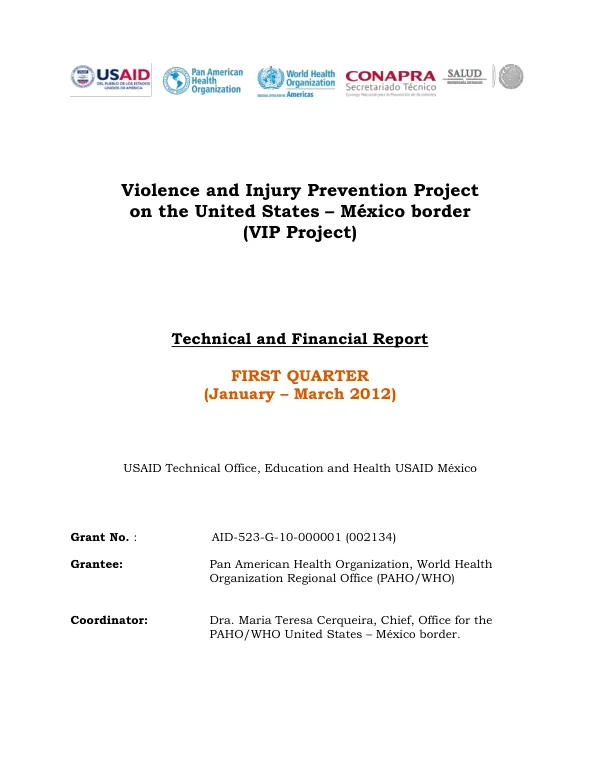
Violence and Injury Prevention Project on the United States – México border (VIP Project)
Sign inUSAID DEC
Violence and Injury Prevention Project on the United States – México border (VIP Project)
The Violence and Injury Prevention Project (VIP Project) on the United States – México border is a technical and financial report for the first quarter of 2012.
2012 · 27 pages
Sign in to readA free account is required to download.
Abstract
The project is implemented by the Pan American Health Organization, World Health Organization Regional Office (PAHO/WHO) with funding from the United States Agency for International Development (USAID). The project's objective is to consolidate the Observatory with a high-level institutional capacity and professional collaboration. To achieve this, the project focuses on three key areas: improving IT infrastructure, developing data standards, and improving data collection, exchange, and dissemination of information. A basic course in coding of medical information and medical procedures was held, with participation from various institutions, including hospitals and healthcare authorities. The project also aims to promote technical cooperation and training of professional and technical personnel of the Observatory. An integrated basic workshop on the use of IRIS was held, training personnel in the use of an information-based application developed by Instituto Nacional de Estadística, Geografía e Informática (INEGI). Additionally, a workshop on the analysis of geo-statistics of crime and violence was conducted, providing attendees with an understanding of spatial criminology and criminal mapping. The project also focuses on developing an integrated geo-spatial analysis through the Instituto Mexicano del Seguro Social (IMIP), including the printing of maps and the production of kml files for web use. A review of the Diagnosis of Roadway Incidence 2010 of the Municipality of Juárez was completed, and draft versions were developed for the Diagnosis of Crime Incidence for 2010 and the Diagnosis of Deaths by External Cause 2010. Furthermore, the project continues the development of Phase II of the Automated Indicator System, including the monitoring and surveillance at the municipal level regarding protection and risk factors. The project has reported 75% progress in the development of Phase II, with the completion of modules for security, administration of databases, and importation of registries of various file formats. The project also aims to strengthen the capacity of service providers of primary care and social service, of first responders, and community organizations for the implementation of strategies, programs, and services of violence and injury prevention. To achieve this, the project designs and operates a system for local-municipal integrated training in violence and injury prevention, TEACH VIP. Communication has been established with the Centro Colaborador (Collaborating Center) CISALVA regarding a technical proposal to organize an advanced workshop to TEACH-VIP for decision-makers in Ciudad Juárez. The project also produces and distributes local multimedia materials and content to explain the concepts and lessons of TEACH VIP. During the month of January 2012, there was a call for projects for young graphic artists to submit proposals to create flipcharts with diverse themes for the prevention of violence at the community level. However, no entries were received, and communication is ongoing with the School of Architecture, Design, and Art of the Autonomous University of Ciudad Juárez to re-launch the call for projects. Overall, the VIP Project aims to improve the capacity of the Observatory and its partners to collect, analyze, and disseminate data on violence and injury prevention, as well as to strengthen the capacity of service providers and community organizations to implement effective prevention strategies.
Related documents