USAID DEC
Technical Intervention Note 1.3: Monitoring & Evaluation of Cash Transfer and Voucher Programs
Sign inFHI 360
Technical Intervention Note 1.3: Monitoring & Evaluation of Cash Transfer and Voucher Programs
Cash transfer and voucher programs have been implemented to reduce poverty and improve human capital among vulnerable populations.
2015 · 2 pages
Sign in to readA free account is required to download.
Abstract
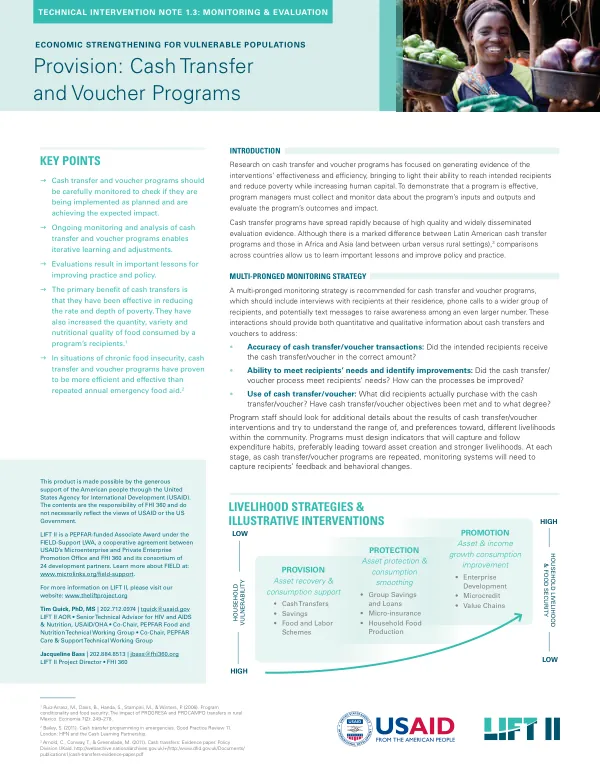
Research has focused on generating evidence of the interventions' effectiveness and efficiency, highlighting their ability to reach intended recipients and reduce poverty while increasing human capital. To demonstrate a program's effectiveness, program managers must collect and monitor data about the program's inputs and outputs and evaluate the program's outcomes and impact. Cash transfer programs have spread rapidly due to high-quality and widely disseminated evaluation evidence. Comparisons across countries allow for the identification of important lessons and the improvement of policy and practice. For example, in Latin America, cash transfer programs have been effective in reducing poverty and improving food security, while in Africa and Asia, similar programs have faced different challenges and outcomes. A multi-pronged monitoring strategy is recommended for cash transfer and voucher programs, which should include interviews with recipients at their residence, phone calls to a wider group of recipients, and potentially text messages to raise awareness among an even larger number. These interactions should provide both quantitative and qualitative information about cash transfers and vouchers to address accuracy, ability to meet recipients' needs, and use of cash transfer/voucher. Program staff should look for additional details about the results of cash transfer/voucher interventions and try to understand the range of, and preferences toward, different livelihoods within the community. Monitoring should take place after every major group of cash transfer/voucher distributions, with a percentage of recipients contacted to ensure that the cash/voucher mechanisms are functioning and that recipients are receiving the resources in the right amount. In-depth monitoring should also take place at regular intervals during the course of the intervention, as well as after implementation, to assess the intervention's effects. Organizations should consider using multi-pronged data collection strategies, as each method will inform different aspects of the cash/voucher intervention. The primary functions of monitoring and evaluation (M&E) of cash transfer and voucher programs are to ensure that programs are reaching the intended population, verify that they are providing planned benefits, identify additional benefits or unintended negative consequences, track changes in household needs and in the marketplace, and learn lessons to improve future practice and policy. Evaluation results show that cash transfer/voucher programs are effective means of promoting the accumulation of human capital among poor households, with on average 80 percent of the benefits going to 40 percent of the poorest families. The scope of the monitoring plan will depend on organizational capacity and resources, and even for a relatively simple plan, it is necessary to develop measurable indicators that can be tracked to verify results. General indicators are provided in the table below, including quantitative and qualitative measures such as the percentage of transfers verified as correctly delivered, household coping strategies, and average satisfaction rating from participants. These indicators can be adapted or expanded to capture impact on key populations, such as people living with HIV (PLHIV), or orphans and vulnerable children. Cash transfer and voucher programs have been implemented to address household vulnerability, with a focus on provision, protection, and promotion. The programs aim to provide consumption support, asset recovery and consumption smoothing, and asset and income growth consumption improvement. The primary functions of M&E of cash transfer and voucher programs are to ensure that programs are reaching the intended population, verify that they are providing planned benefits, identify additional benefits or unintended negative consequences, track changes in household needs and in the marketplace, and learn lessons to improve future practice and policy.
Related documents