ADVANCED ENGINEERING ASSOCIATES INTERNATIONAL, INC. /SGGA
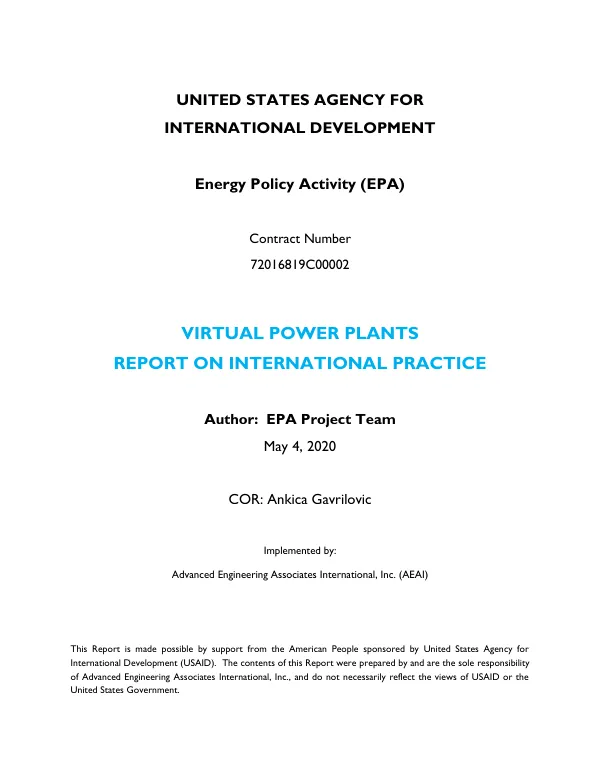
Virtual Power Plants Report on International Practice
The increased share of Variable Renewable Energy Sources (VRES) in an electricity system requires an innovative approach for providing the flexibility necessary for the stable and secure operation of the system.
2020 · 54 pages
Sign in to readA free account is required to download.
Abstract
The impact of VRES on the operation of the power system is in direct proportion to the degree of integration, i.e., participation in the total electricity generation. According to the categorization made by the International Energy Agency (IEA), the impact of VRES on the operation of an electricity system can be classified into 6 categories, starting from Phase 1, in which VRES does not have a significant impact on the operation of the system, up to Phase 6 in which seasonal or annual surpluses/shortages of generation from VRES occur. The maximum level corresponding to Phase 4 was observed in a small number of countries (Denmark, Ireland, and South Australia) with the expected tendency to increase the number of countries classified in this category. The vast majority of countries are still in Phase 1 and Phase 2, corresponding to the VRES share in total generation of 5-10%. This indicates that the integration of VRES into the power system is still in its early stages, and significant efforts are needed to ensure the stable and secure operation of the system. The concept of Virtual Power Plants (VPPs) has emerged as a potential solution to address the challenges posed by the integration of VRES. A VPP is a collection of distributed energy resources (DERs) that are aggregated and controlled to provide a single, virtual power plant. The VPP can provide a range of services, including frequency regulation, spinning reserve, and load management, which are essential for maintaining the stability and security of the power system. The characteristics of distributed generators related to flexibility are critical in determining the potential of VPPs to provide these services. Biomass and biogas power plants, combined electricity and heat generation power plants, solar power plants, wind power plants, and small hydro power plants are all potential contributors to a VPP. The flexibility of these generators can be enhanced through the use of energy storage devices, such as batteries, and advanced control systems. The architecture of a VPP consists of several key components, including telecommunications, software, and technical aspects. The telecommunications system enables the communication between the VPP and the grid operators, while the software provides the necessary control and monitoring functions. The technical aspects of the VPP include the selection and integration of the distributed generators, as well as the design and implementation of the energy storage devices. The commercial aspects of VPPs are also critical, as they determine the viability of the concept. The prequalification process is an essential step in the development of a VPP, as it ensures that the VPP meets the necessary technical and commercial requirements. The ancillary services market is another critical aspect of VPPs, as it provides the necessary revenue streams to support the operation of the VPP. The regulatory framework for VPPs is still evolving, but it is essential for ensuring the stable and secure operation of the power system. The capacity mechanism for conventional power plants is one of the key regulatory aspects of VPPs, as it determines the level of capacity payments that are made to the VPP. The impact of renewable energy sources on the conventional power plants is another critical aspect of VPPs, as it determines the level of competition between the VPP and the conventional power plants. The European Union has implemented several regulatory measures to support the development of VPPs, including the Capacity Remuneration Mechanism (CRM) and the Directives EC 2019/943. The CRM provides a mechanism for capacity payments to be made to VPPs, while the Directives EC 2019/943 sets out the necessary requirements for the development of VPPs. In conclusion, the integration of VRES into the power system poses significant challenges, but the concept of VPPs offers a potential solution. The characteristics of distributed generators, the architecture of the VPP, and the commercial and regulatory aspects of VPPs are all critical in determining the viability of the concept. The European Union has implemented several regulatory measures to support the development of VPPs, and further efforts are needed to ensure the stable and secure operation of the power system.