USAID DEC
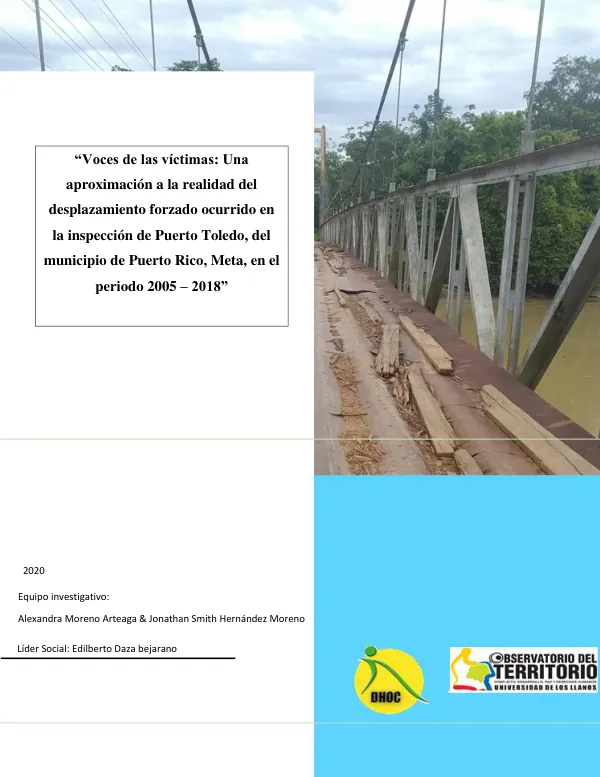
Voces de las víctimas: Una aproximación a la realidad del desplazamiento forzado ocurrido en la inspección de Puerto Toledo, del municipio de Puerto Rico, Meta, en el periodo 2005 – 2018
Sign inCONSULTORÍA PARA LOS DERECHOS HUMANOS Y EL DESPLAZAMIENTO – CODHES
Voces de las víctimas: Una aproximación a la realidad del desplazamiento forzado ocurrido en la inspección de Puerto Toledo, del municipio de Puerto Rico, Meta, en el periodo 2005 – 2018
The investigation into the forced displacement that occurred in the inspection of Puerto Toledo, a municipality in Meta, Colombia, between 2005 and 2018, was conducted by a research team led by Alexandra Moreno Arteaga and Jonathan Smith Hernández Moreno, in collaboration with Edilberto Daza Bejarano, a community leader.
2020 · 162 pages
Sign in to readA free account is required to download.
Abstract
The research aimed to shed light on the truth about the forced displacement that took place in Puerto Toledo through the voices of the victims. The research team employed participatory techniques and semi-structured interviews to gather information from the victims of forced displacement in Puerto Toledo and Villavicencio. Participatory techniques are characterized by recognizing that social agents can produce valid social knowledge, facilitating action, deconstruction, and construction of the past, promoting dialogue of knowledge, and the encounter between subjects of history and collective memory recovery. The research focused on the lived experience and historical narratives (individual and collective) that the victims have developed about the events that occurred during the armed conflict. This approach allowed the research team to understand the causes, patterns, and impacts of forced displacement from the perspective of those who were victims of victimization during the conflict. The research team conducted workshops in Puerto Toledo and Villavicencio, which enabled them to understand the construction of meanings and the consciousness of the significance of the events lived in two scenarios: the first in the place of expulsion and the second in the place of reception of those who were forcibly displaced. The workshops used visual tools and were accessible to the population, and participants were not asked to write due to the lack of literacy skills among some participants. The first encounter took place in the municipal capital of Puerto Rico, with the purpose of getting to know the participating population and reactivating the Human Rights Committees, due to the presence of armed groups in the region. Two workshops were then conducted, one with the population of Puerto Toledo and a later one with the population of Villavicencio. The first workshop focused on the collective memory of what was lived before the conflict struck. The research team used the participatory technique of the Patchwork Quilt, which is very useful in historical memory recovery work due to its ability to facilitate the recovery of memories and the construction of a collective memory. The research team also used other participatory techniques, such as the use of visual aids and the creation of a collective memory through the sharing of individual memories. The workshops were designed to be accessible and inclusive, allowing all participants to contribute and share their experiences. The research team's approach to gathering information from the victims of forced displacement in Puerto Toledo and Villavicencio was centered on the lived experience and historical narratives of the victims. This approach allowed the research team to understand the causes, patterns, and impacts of forced displacement from the perspective of those who were victims of victimization during the conflict. The research team's use of participatory techniques and semi-structured interviews enabled them to gather information from the victims of forced displacement in a way that was respectful and inclusive. The research team's approach also allowed them to understand the collective memory of the events lived during the conflict and the ways in which the victims have constructed meanings and consciousness of the significance of those events. The research team's findings highlight the importance of understanding the lived experience and historical narratives of the victims of forced displacement in order to shed light on the truth about the conflict and its impacts. The research team's approach also highlights the importance of using participatory techniques and semi-structured interviews to gather information from the victims of forced displacement in a way that is respectful and inclusive. The research team's findings also highlight the importance of understanding the collective memory of the events lived during the conflict and the ways in which the victims have constructed meanings and consciousness of the significance of those events. The research team's approach also highlights the importance of using visual aids and creating a collective memory through the sharing of individual memories. The research team's findings also highlight the importance of understanding the causes, patterns, and impacts of forced displacement from the perspective of those who were victims of victimization during the conflict. The research team's approach also highlights the importance of using participatory techniques and semi-structured interviews to gather information from the victims of forced displacement in a way that is respectful and inclusive. The research team's findings also highlight the importance of understanding the collective memory of the events lived during the conflict and the ways in which the victims have constructed meanings and consciousness of the significance of those events. The research team's approach also highlights the importance of using participatory techniques and semi-structured interviews to gather information from the victims of forced displacement in a way that is respectful and inclusive. The research team's findings also highlight the importance of understanding the causes, patterns, and impacts of forced displacement from the perspective of those who were victims of victimization during the