USAID DEC
Volcano Deformation and Modeling on Active Volcanoes in the Philippines from ALOS INSAR Time Series
Sign inUNIVERSITY OF MARYLAND
Volcano Deformation and Modeling on Active Volcanoes in the Philippines from ALOS INSAR Time Series
Volcanic deformation and modeling on active volcanoes in the Philippines from ALOS InSAR time series is a critical area of study due to the high population density in the region.
2015 · 6 pages
Sign in to readA free account is required to download.
Abstract
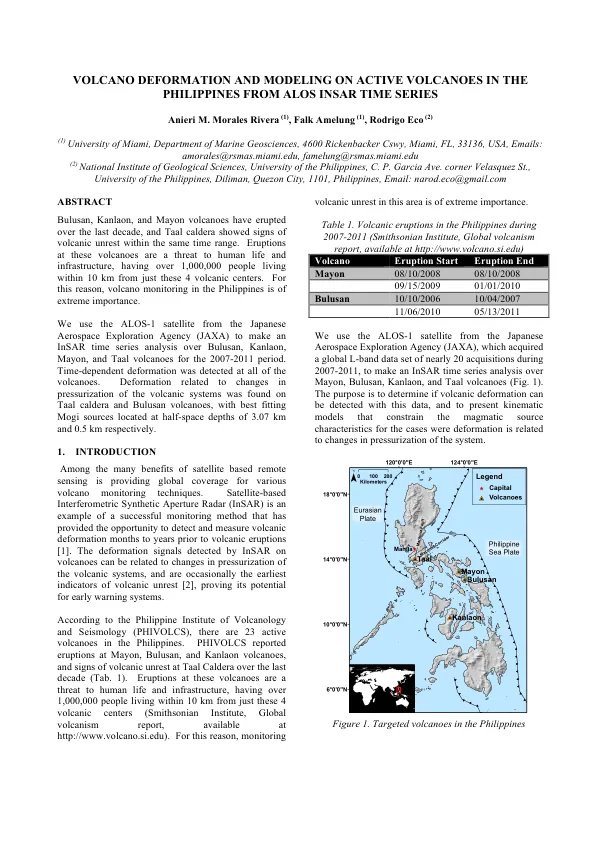
The Philippines is home to 23 active volcanoes, with Bulusan, Kanlaon, and Mayon volcanoes having erupted over the last decade, and Taal caldera showing signs of volcanic unrest within the same time range. Eruptions at these volcanoes pose a significant threat to human life and infrastructure, with over 1,000,000 people living within 10 km of just these four volcanic centers. The study utilizes the ALOS-1 satellite from the Japanese Aerospace Exploration Agency (JAXA) to create an InSAR time series analysis over Bulusan, Kanlaon, Mayon, and Taal volcanoes for the 2007-2011 period. Time-dependent deformation was detected at all of the volcanoes, with deformation related to changes in pressurization of the volcanic systems found on Taal caldera and Bulusan volcanoes. The best-fitting Mogi sources were located at half-space depths of 3.07 km and 0.5 km, respectively. The study employed a range of methods to process the InSAR data, including the Gamma SAR and Interferometric Processing Software, the ROI_PAC SAR Software, and the SNAPHU algorithm. The interferograms were phase unwrapped, and interferograms with perpendicular baselines of less than 1,500 meters were selected using the Delaunay method. The time-series were generated using the PySAR software, and corrections were made for DEM errors, phase ramp errors, and ionospheric and atmospheric errors. The results of the study show surface deformation at Mayon, Bulusan, Kanlaon, and Taal volcanoes. At Taal volcano, a LOS velocity increase was observed after February 2010, with a maximum rate of 14.1 cm/yr between February 2010 and January 2011. The signal extended to the western shore of Taal Lake and was likely caused by inflation due to pressurization of the volcanic system. LOS velocity decreases were observed at various regions E-NE of Taal Lake after August 2010, which were likely related to faulting systems within the region. The study's findings suggest that pressurization of the magmatic system led to inflation of the volcano, resulting in stress transfers within the region and faulting while the volcano continued to inflate. However, further data and modeling are necessary to fully understand the interactions occurring within the region. The study's results highlight the importance of continued monitoring of volcanic activity in the Philippines, particularly in areas with high population density and significant volcanic activity.
Related documents