CARE
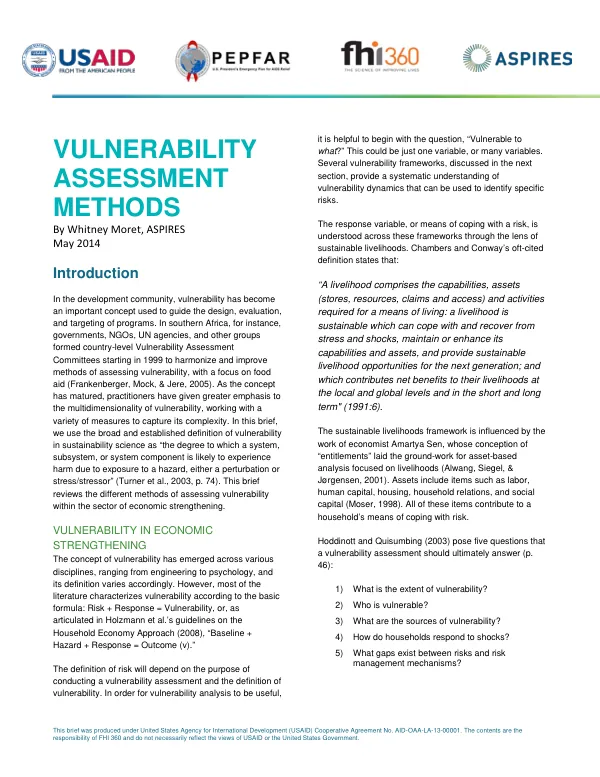
Vulnerability Assessment Methods in Economic Strengthening
The concept of vulnerability has become a crucial aspect in the development community, guiding the design, evaluation, and targeting of programs.
2014 · 8 pages
Sign in to readA free account is required to download.
Abstract
In southern Africa, governments, NGOs, UN agencies, and other groups formed country-level Vulnerability Assessment Committees starting in 1999 to harmonize and improve methods of assessing vulnerability, with a focus on food aid. As the concept has matured, practitioners have given greater emphasis to the multidimensionality of vulnerability, working with a variety of measures to capture its complexity. The definition of vulnerability varies across disciplines, but most literature characterizes it according to the basic formula: Risk + Response = Vulnerability. The definition of risk depends on the purpose of conducting a vulnerability assessment and the definition of vulnerability. To be useful, vulnerability analysis should begin with the question, "Vulnerable to what?" This could be just one variable, or many variables. Several vulnerability frameworks provide a systematic understanding of vulnerability dynamics that can be used to identify specific risks. The sustainable livelihoods framework is influenced by the work of economist Amartya Sen, whose conception of "entitlements" laid the groundwork for asset-based analysis focused on livelihoods. Assets include items such as labor, human capital, housing, household relations, and social capital. All of these items contribute to a household's means of coping with risk. Hoddinott and Quisumbing (2003) pose five questions that a vulnerability assessment should ultimately answer: What is the extent of vulnerability? Who is vulnerable? What are the sources of vulnerability? How do households respond to shocks? What gaps exist between risks and risk management mechanisms? Selecting vulnerability assessment methods depends on the purpose and focus of the vulnerability assessment. This will also affect the level of analysis required. Population level measures, used to segment a population into different categories of vulnerability, are useful for policy, planning, and project design. When used with participative methods, they can also be useful for community mobilization. For project targeting, household level methods will be required. The Household Economy Approach (HEA) is a livelihoods-based analytical framework developed by Save the Children UK in the early 90s. It is designed to obtain information on how people access food and cash based on multi-level analysis. HEA uses mixed methods, which can include analysis of secondary data, quantitative primary data, and participatory and qualitative approaches. It is primarily used to predict the impact of national-level shocks and disasters across different wealth groups, seeking to answer the following questions: Where is assistance needed, and of what type? Who needs it? How much is needed, when and for how long? The Individual Household Model (IHM) is a disaggregated version of HEA designed to provide more detailed vulnerability analysis at the household level. IHM employs different field methods, including semi-structured interviews with individual households selected using statistical sampling methods. The results of IHM analysis are expressed in terms of household disposable income rather than access to food and other resources. Household Livelihood Security Analysis (HLSA) is an asset-based, multidisciplinary framework with the intention of better understanding the broader systems that affect livelihoods. It looks specifically at the dimensions of economic security, food security, health security, educational security, and empowerment. HLSA was originally a primarily participatory method used to inform program design, drawing on both Participatory Rapid Appraisal (PRA) and Rapid Rural Appraisal (RRA) techniques. An alternative approach is to use the same conceptual framework of Household Livelihood Security (HLS) to develop quantitative surveys for population level segmentation. The Household Vulnerability Index (HVI) is a statistical index developed by the Food, Agriculture and Natural Resources Policy Analysis Network (FANRPAN) in 2004 to measure household vulnerability. The index examines household vulnerability through the lens of the influence of "HIV and AIDS pandemic on household agriculture and food security." The HVI is concerned with the following two questions: How can the 'most vulnerable' be identified and assisted? How can the impact of the epidemic on household food security be monitored and evaluated over time?
Related documents