USAID DEC
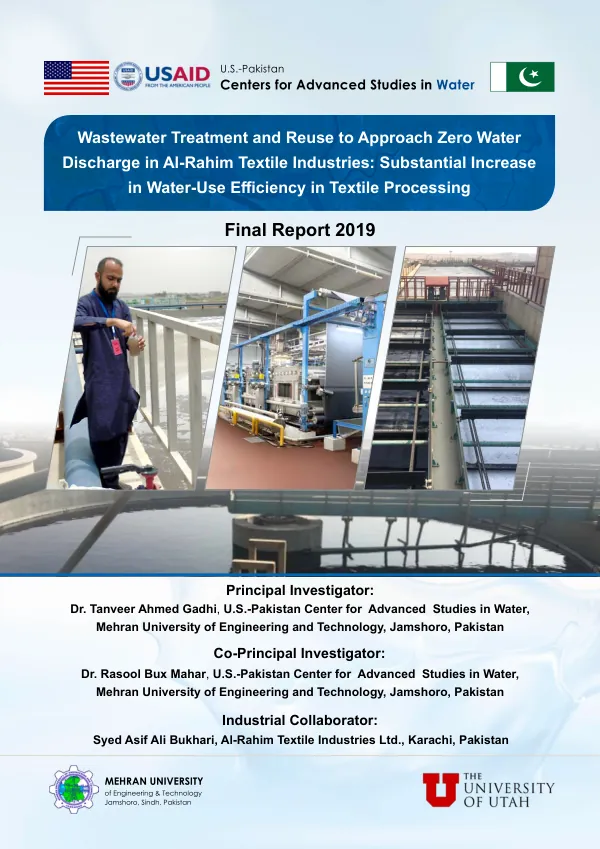
Wastewater Treatment and Reuse to Approach Zero Water Discharge in Al-Rahim Textile Industries: Substantial Increase in Water-Use Efficiency in Textile Processing
Sign inUSAID DEC
Wastewater Treatment and Reuse to Approach Zero Water Discharge in Al-Rahim Textile Industries: Substantial Increase in Water-Use Efficiency in Textile Processing
The textile industry in Pakistan is a significant contributor to the country's economy.
2019 · 71 pages
Sign in to readA free account is required to download.
Abstract
Al-Rahim Textile Industries, a major textile mill in Karachi, has been working to improve its water use efficiency and reduce wastewater discharge. The company collaborated with the U.S.-Pakistan Center for Advanced Studies in Water to implement a project aimed at achieving zero water discharge. The project focused on improving water use efficiency at the source, wastewater sampling and analysis, wastewater treatment development, and treatment and handling of RO membranes reject water. The team conducted a thorough assessment of the textile processing section, identifying areas for improvement and implementing measures to reduce water consumption. The project team developed a comprehensive plan to improve water use efficiency, including adjusting the actual process water requirement, effective management of on-site water reuse, and effective management of cooling water and steam condensate recovery. The team also implemented a wastewater treatment system, which included a combination of physical, chemical, and biological processes to remove pollutants and contaminants. The project achieved significant results, including a substantial increase in water-use efficiency and a substantial decrease in wastewater discharge. The team also conducted a thorough analysis of the wastewater characteristics, including pH, temperature, and chemical oxygen demand (COD). The results showed a significant improvement in water quality, with a reduction in COD and other pollutants. The project also focused on the treatment and handling of RO membranes reject water, which is a critical component of the textile processing industry. The team developed a system to treat and reuse the reject water, reducing the amount of wastewater discharged into the environment. The project had a significant impact on the textile industry in Pakistan, demonstrating the feasibility of achieving zero water discharge. The project outcomes were disseminated through various channels, including presentations, seminars, and publications. The project also produced a master's thesis and several research papers, which contributed to the advancement of knowledge in the field of water management in the textile industry. The project concluded that the textile industry in Pakistan can achieve zero water discharge through the implementation of efficient water management practices and wastewater treatment systems. The project recommended that the textile industry adopt a holistic approach to water management, including reducing water consumption, improving wastewater treatment, and promoting water reuse and recycling.
Related documents