USAID DEC
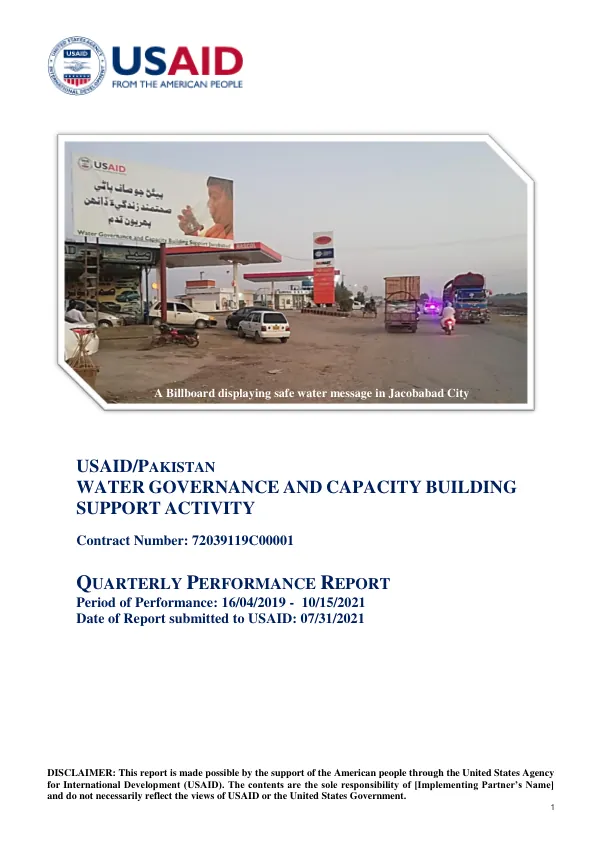
Quarterly Performance Report FY 2021 Q3: Water Governance and Capacity Building Support Activity
Sign inUSAID
Quarterly Performance Report FY 2021 Q3: Water Governance and Capacity Building Support Activity
The Water Governance and Capacity Building Support activity in Jacobabad, Sindh, aimed to build the capacity of the Municipal Committee Jacobabad to maintain, operate, and sustain its water supply system.
2021 · 40 pages
Sign in to readA free account is required to download.
Abstract
The activity was implemented from April 16, 2019, to October 15, 2021, with a total estimate cost of USD 2,053,426. The prime implementing partner was the Health and Nutrition Development Society (HANDS), and the major counterpart organizations engaged or supported were the Municipal Committee Jacobabad (MCJ) and the Sindh Local Government Department (LGD). During the reporting period, the technical team of the Water Governance and Capacity Building Support activity continued its assistance to the Municipal Committee Jacobabad in the operation and maintenance of the water supply system. As a result, MCJ supplied water to all six zones of the city, meeting the demand of all connected houses at a level of 25%, 14%, and 24% in April, May, and June 2021, respectively. The technical team also conducted water testing in the laboratory and monitored the quality of water regularly, with 228 water samples tested from all locations across the system from the Khirthar canal to the treatment plant. The pH, turbidity, and TDS at all locations were within the National Environmental Quality Standards (NEQs) standard. However, in the absence of a chemist, no sampling could be made at the end-user level, and no bacterial tests were conducted. The program kept close liaison with MCJ, MSDP, and Deputy Commissioner Jacobabad and continued following up on matters related to the smooth operation and maintenance of the water supply system. A long-awaited milestone of handing/taking over of the water supply system between MSDP and MCJ was completed, and the formal signing was done on 14th April 2021, duly signed by Administrator MCJ and Program Director MSDP. The handing/taking over of water supply included the transmission loop, water distribution system of all six zones, and complete water treatment plant. A Municipal Management Information System (M-MIS) comprised of six modules of Billing Management, Lab Reporting, O&M of the Water Supply System, Complaint Management, and Asset Management was jointly developed by the Water Governance and Capacity Building program and MSDP. During the reporting quarter, the plan of MIS implementation was rolled out through an orientation and training of MCJ staff, and hand-holding of notified staff of MCJ continued in all six modules of the MIS. Civic engagement activities continued through women and men Mohalla WASH Committees, health & hygiene sessions with citizens of the city, cable TV network, and Community Rabta groups on WhatsApp. In this regard, the social mobilization team attended 275 (72%) meetings of MWCs and conducted 370 health and hygiene sessions against the planned 192 sessions. Since MCJ is ready to start billing the water supply services, the focus of civic engagement activities was diverted towards "pay for water services campaign." In this connection, specific groups from different segments of the society were identified, and 82 stakeholder meetings were conducted to motivate the community for payment of water services. Earlier, the pay for water services campaign was launched by MCJ by inviting notables of the city in a seminar. In the seminar, Administrator Municipal Committee Jacobabad communicated a clear and loud message to the citizens of Jacobabad that they shall pay for water services so that MCJ can smoothly operate and maintain the water supply system and ensure meeting the water supply demand of the city. It is to highlight here that a USAID mission led by Mr. James Parys – the Deputy Mission Director Sindh & Baluchistan along with Mr. Hafeezullah Samo – COR WGCB and other fellows also visited Jacobabad water supply scheme in May 2021 and held meetings with MCJ, MSDP, WGCB, Community representatives, and DC Jacobabad. Again, some of the challenges continuously hampering the progress of the program continued this quarter, which includes; Lack of Technical Staff at MCJ, the COVID-19 pandemic situation, and the electric power breakdown. These challenges are beyond the program's control and are seriously affecting progress towards achieving the Water Governance and Capacity Building program objectives. The Municipal Committee Jacobabad has been working to improve the capacity of its staff to operate, maintain, and sustain the water supply system. The committee has been conducting training programs for its staff, and the Water Governance and Capacity Building program has been providing technical assistance to support the committee's efforts. The Water Governance and Capacity Building program has been working closely with the Municipal Committee Jacobabad, MSDP, and other stakeholders to ensure the smooth operation and maintenance of the water supply system. The program has been providing technical assistance, training, and capacity-building support to the committee to help it meet the water supply demand of the city. The Municipal Management Information System (M-MIS) has been developed to support the Municipal Committee Jacobabad in its efforts to manage the water supply system. The system has been designed to provide real-time data