USAID DEC
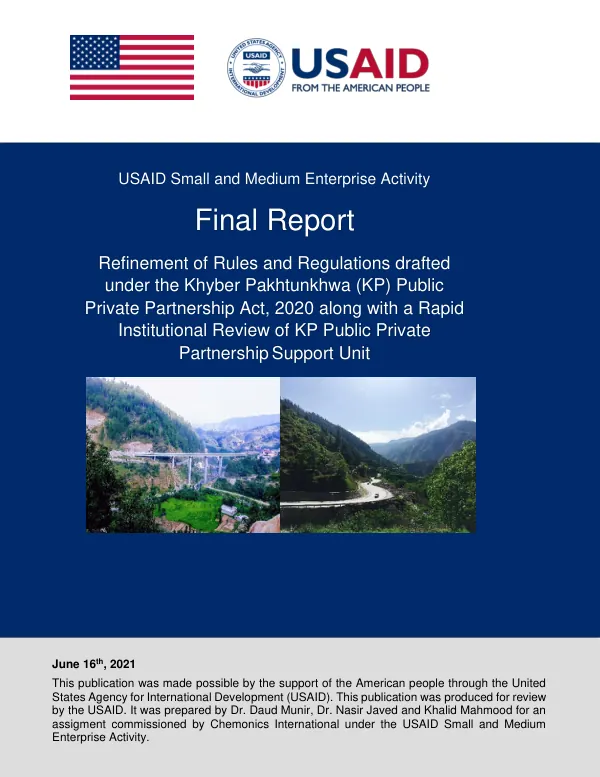
Refinement of Rules and Regulations drafted under the Khyber Pakhtunkhwa (KP) Public Private Partnership Act, 2020 along with a Rapid Institutional Review
Sign inCHEMONICS
Refinement of Rules and Regulations drafted under the Khyber Pakhtunkhwa (KP) Public Private Partnership Act, 2020 along with a Rapid Institutional Review
The Khyber Pakhtunkhwa (KP) Public Private Partnership (PPP) framework was refined under the USAID Small and Medium Enterprise Activity (SMEA) in 2021.
2021 · 281 pages
Sign in to readA free account is required to download.
Abstract
The refinement aimed to augment the PPP framework in KP, with a focus on improving the regulatory environment and fostering participation of small and medium enterprises (SMEs). The KP PPP Act, 2020, was analyzed from both theoretical and practical perspectives to determine how the framework can be refined. The theoretical study included analyzing the legislation, rules, and policies, as well as undertaking comparative research and exploring the different salient features of a PPP regime. The practical study involved understanding actual institutional dynamics and practical challenges faced by private partners and government bodies in the implementation of PPP projects, through consulting different stakeholders. The report identified several key challenges in the KP PPP framework, including inadequate rules and regulations, lack of transparency, and limited participation of SMEs. The authors recommended several measures to address these challenges, including the development of guidelines for designing further regulations, the establishment of a PPP unit, and the creation of a viability gap fund. The institutional review of the KP Public Private Partnership Support Unit (PPP SU) revealed several gaps in the unit's capacity and functionality. The authors recommended several measures to strengthen the PPP SU, including the development of a clear organizational structure, the establishment of a risk management unit, and the creation of a product development facility. The report also reviewed the KP PPP framework, including its structure and content, and conducted an ease of doing business (EODB) analysis. The authors identified several areas for improvement, including the need for clearer guidelines and procedures, the establishment of a PPP policy, and the development of successful PPP case studies. The conclusion of the report highlights the importance of refining the KP PPP framework to improve the business environment and foster participation of SMEs. The authors recommend several measures to implement the recommendations outlined in the report, including the establishment of a task force to oversee the implementation of the recommendations and the provision of technical assistance to the PPP SU. The report includes several appendices, including minutes of stakeholder consultative sessions, a review of the 2020 act and gap analysis, a comparison of KP, Sindh, and Punjab PPP acts, and a comparative review of PPP frameworks. The report also includes suggestions for the PPP SU's organizational structure and a review of the InfraScope index by Economist Intelligence Unit. Overall, the report provides a comprehensive analysis of the KP PPP framework and identifies several areas for improvement. The recommendations outlined in the report aim to refine the framework and improve the business environment in KP, with a focus on fostering participation of SMEs.