USAID DEC
Water and Sanitation Enhancement in Kurmuk, Geissan and Bau Phase 2 Semi-Annual Report
Sign inADRA
Water and Sanitation Enhancement in Kurmuk, Geissan and Bau Phase 2 Semi-Annual Report
The Water and Sanitation Enhancement in Kurmuk, Geissan, and Bau Phase 2 project began in July 2018 and was funded by USAID's Office of U.S.
2019 · 19 pages
Sign in to readA free account is required to download.
Abstract
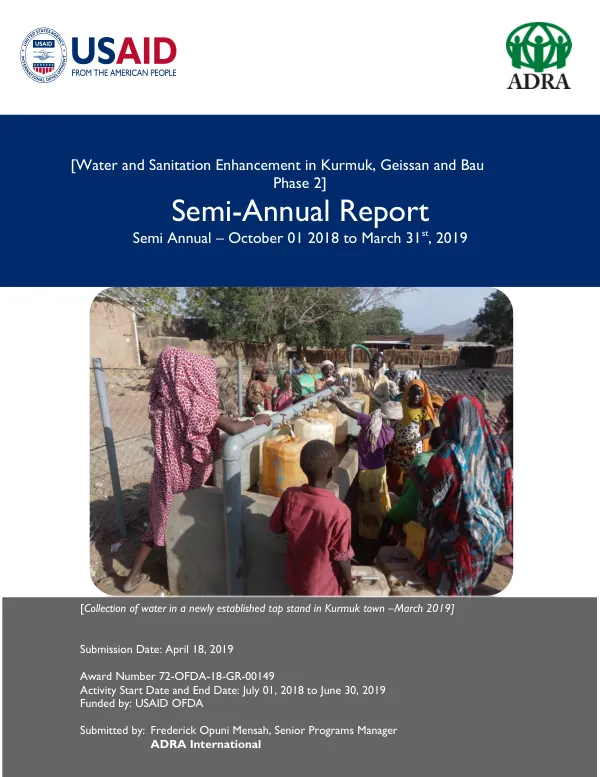
Foreign Disaster Assistance. The project aimed to improve access to safe drinking water and sanitation facilities in the target areas. The reporting period covered in this semi-annual report spans from October 1, 2018, to March 31, 2019. During this period, the project team conducted a baseline survey in seven villages, including Dindiro, Banjalulu, Yara, Adasi, Alhidour, Derange, and Maganza. The survey team consisted of 16 members, including project staff and volunteers from the local partner Mubadiroon. The data entry team consisted of 7 members, and the survey report was developed by Siara, ADRA Sudan's M&E Officer. Community sensitization and mobilization activities were conducted in the accessible communities simultaneously with the baseline survey. Seven communities were reached, including two villages in Kurmuk and Bau locality and three villages in Geissan locality. The project team created awareness about the project activities and expected community roles and response. WUC evaluation forms were filled during the FGD with the existing committees, and beneficiary registration for the NFIs distribution was done according to the set-up criteria. The project team also conducted an open tender for the distribution of NFIs, including soap and jerry cans. Four quotations were collected from different suppliers, and one supplier was selected and contracted to supply 645 cartons of soap and 2890 jerry cans. The distribution started on January 31, 2019, and included all four locations in Geissan locality, six in Kurmuk, and all five locations in Bau locality. A total of 2233 households received two jerry cans and six bars of soap, with 1412 households being female-headed households and 821 being male-headed households. The project team also procured hand pumps repair kits and spare parts, which were prepositioned in ADRA BN office in January 2019. The distribution module will include spare parts to four central locations, while the repair kits will be distributed to the target villages. The distribution will be done after the rehabilitation of the hand pumps and training of the WUCs, which is planned to commence during the fourth week of March 2019. The project team also conducted training for 45 hand pumps technicians and 15 WUCs. The rehabilitation plan was discussed with WES to synchronize it with the training of WUCs. The training was adjourned to be conducted in parallel to the rehabilitation, and it is planned to implement this activity followed by the distribution of the hand pumps repair kits and spare parts. The project team also rehabilitated 28 hand pumps, with nine hand pumps being rehabilitated in Kurmuk locality, eight in Geissan locality, and 11 in Bau locality. The rehabilitation work was finished for the 28 hand pumps as planned. The project team also rehabilitated the Hafier system in Kurmuk and Derange, with the contract being signed on January 23, 2019. The mobilization of machineries started on January 23, and the actual work started on January 27, 2019. The work was completed in the first week of March as verified by a team from the project and the DWC. The project team also conducted 60 water quality tests for 28 hand pumps and 2 Hafier systems. It was found that 15 samples were contaminated with fecal coliform, but after the rehabilitation and water treatment, all the 30 samples taken proved to be free of fecal coliform. Finally, the project team organized community awareness on HWWS in the 15 project locations, synchronized with the distribution of the NFIs. The number of attendees reached 2427 participants, including men, women, and children. The topics of the sessions covered the five critical times of washing hands, demonstration by volunteers on the proper way of washing hands, use of IEC materials to point out good and bad hygiene practices, and presentation of videos illustrating the negative and positive impacts of bad and good hygiene practices on general health.
Related documents