TETRA TECH
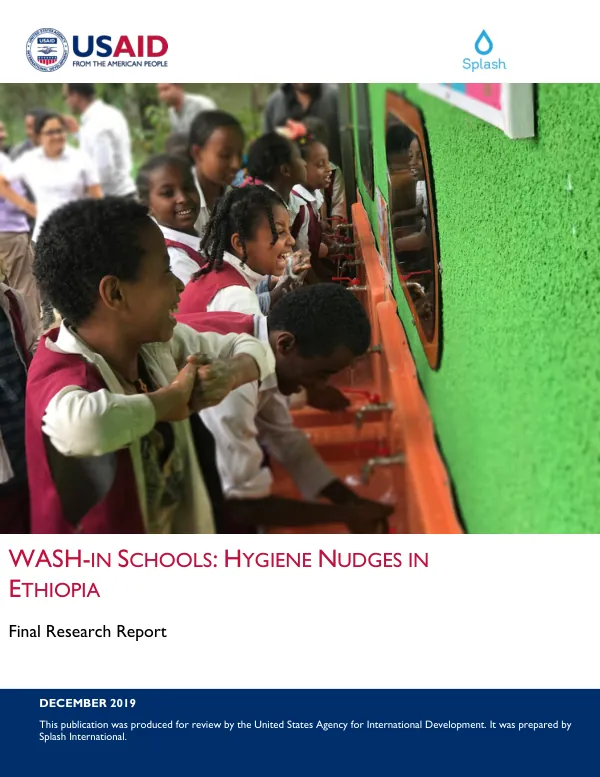
WASH-In Schools: Hygiene Nudges in Ethiopia Final Research Report
The Water, Sanitation, and Hygiene Partnerships and Learning for Sustainability (WASHPaLS) project is a 5-year task order implemented by Tetra Tech in collaboration with several non-governmental organizations and small-business partners.
2019 · 26 pages
Sign in to readA free account is required to download.
Abstract
The project supports the United States Agency for International Development's (USAID) goal of reducing morbidity and mortality in children under five by ensuring USAID programming employs high-impact, evidence-based environmental health and WASH interventions. The project identifies and shares best practices for achieving sustainability, scale, and impact by generating evidence to support the reduction of open defecation and movement of communities up the sanitation ladder, while also focusing on novel approaches for reducing feces exposure to infants and young children. Specifically, the project offers USAID missions and technical bureaus ready access to thought leaders and analytical expertise across a wide range of WASH themes, generates evidence through implementation research, administers a small grants program on innovations in hygiene behavior change, and engages and partners with national and global stakeholders to promote the use and application of WASHPaLS-generated evidence and global best practices. In 2018, WASHPaLS awarded a grant to Splash International, a US organization based in Seattle, WA, to test the introduction of subtle environmental nudges in school and household settings to influence the adoption of handwashing with soap by children and their families. The primary objectives of the grant were to conduct hygiene behavior change research to compare student handwashing behavior at schools with nudges to student handwashing behavior at schools that have no nudges, compare student handwashing behavior at schools with nudges combined with hygiene education to student handwashing behavior at schools that have nudges only, and compare handwashing behavior at households who have received nudges to handwashing behavior at households who have received no nudges. The research was conducted in Ethiopia, where Splash has worked with the Government of Ethiopia since 2008 on WASH programs for children living in poverty in Addis Ababa. The proposed activities align with the overall objective of the WASHPaLS grants program to investigate the effectiveness of innovative approaches to improving and sustaining hygiene behaviors. The research aimed to expand upon previous research demonstrating that nudges placed at school facilities alone are effective in increasing handwashing practices by students. However, the results from the baseline assessment showed higher than anticipated handwashing rates in both schools and homes, leaving Study A underpowered to document impact from proposed interventions, and, thus, unable to answer the proposed study questions. The following details Splash's findings and lessons learned from the study. The study compared student handwashing behavior at schools with nudges to student handwashing behavior at schools that have no nudges, and found that the schools with nudges had higher handwashing rates. The study also compared student handwashing behavior at schools with nudges combined with hygiene education to student handwashing behavior at schools that have nudges only, and found that the schools with nudges combined with hygiene education had higher handwashing rates. Additionally, the study compared handwashing behavior at households who have received nudges to handwashing behavior at households who have received no nudges, and found that the households with nudges had higher handwashing rates. The study's findings suggest that subtle environmental nudges in school and household settings can be effective in increasing handwashing practices by children and their families. However, the study's results also highlight the importance of considering the local context and baseline conditions when designing and implementing hygiene behavior change interventions.
Related documents