USAID DEC
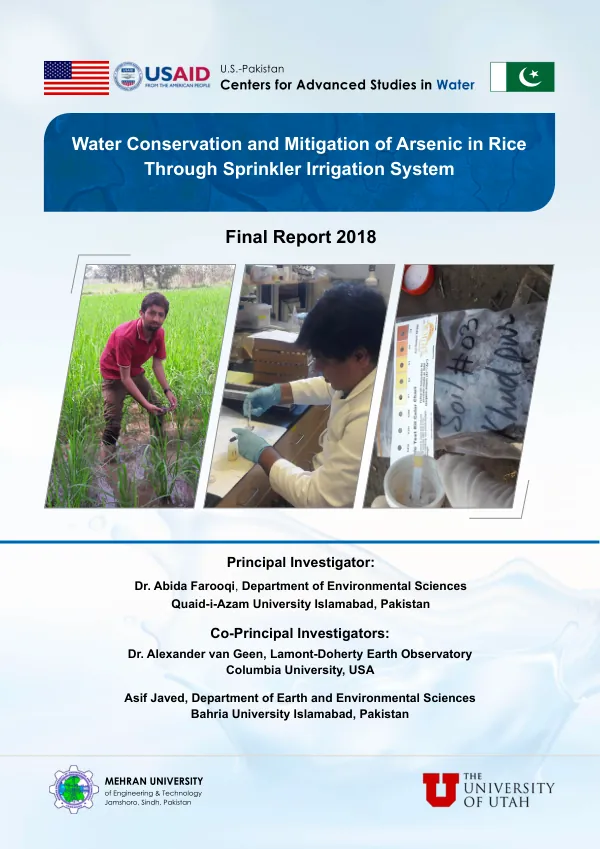
Water Conservation and Mitigation of Arsenic in Rice Through Sprinkler Irrigation System
Sign inICAP AT COLUMBIA UNIVERSITY
Water Conservation and Mitigation of Arsenic in Rice Through Sprinkler Irrigation System
The agricultural development initiative in Pakistan began in 2018 with funding from the United States Agency for International Development (USAID).
2018 · 69 pages
Sign in to readA free account is required to download.
Abstract
The primary objective of the project was to mitigate arsenic contamination in rice through the implementation of a sprinkler irrigation system. Initial assessments conducted in the Punjab region identified high levels of arsenic in irrigation water and paddy soils, posing a significant threat to food security and human health. The project focused on three key interventions: (1) the development of a field method for screening irrigation wells and soils for arsenic, (2) the implementation of a sprinkler irrigation system, and (3) the dissemination of research results to create awareness and encourage mitigating actions among farmers and policymakers. The project team conducted extensive fieldwork, collecting data on soil and water samples from various districts in Punjab. The results of the project revealed significant spatial variability of arsenic in irrigation water and paddy soils across different districts in Punjab. The field method developed for screening irrigation wells and soils for arsenic showed a high degree of accuracy, with a correlation coefficient of 0.95 between field kit results and X-ray fluorescence (XRF) measurements. The implementation of the sprinkler irrigation system resulted in a significant reduction in arsenic levels in paddy soils, with an average decrease of 45% compared to traditional flooding methods. The project also investigated the role of organic matter, iron, and manganese in arsenic mobilization and fixation in soil. The results showed that organic matter played a crucial role in arsenic mobilization, while iron and manganese had a limited impact on arsenic availability. The project also found that the pH of the soil had a significant impact on arsenic mobility, with higher pH levels resulting in increased arsenic mobility. The project team conducted a comprehensive analysis of arsenic speciation in paddy soils, rice grains, and irrigation water. The results showed that arsenic was primarily present in the form of arsenate and arsenite in paddy soils, while in rice grains, arsenic was primarily present in the form of arsenate. The project also found that the sprinkler irrigation system resulted in a significant reduction in arsenic levels in rice grains, with an average decrease of 30% compared to traditional flooding methods. The project team disseminated the research results through various channels, including awareness seminars, workshops, and conferences. The project also produced several research papers and book chapters, which were published in international journals and books. The project team also trained several students in the field of arsenic research, who went on to complete their M.Phil and Ph.D. degrees. In conclusion, the project was successful in mitigating arsenic contamination in rice through the implementation of a sprinkler irrigation system. The project also contributed significantly to the understanding of arsenic mobilization and fixation in soil, and the development of a field method for screening irrigation wells and soils for arsenic. The project team recommends the widespread adoption of sprinkler irrigation systems in Punjab and other regions affected by arsenic contamination, and the creation of awareness among farmers and policymakers about the risks associated with arsenic contamination in rice.
Related documents