USAID DEC
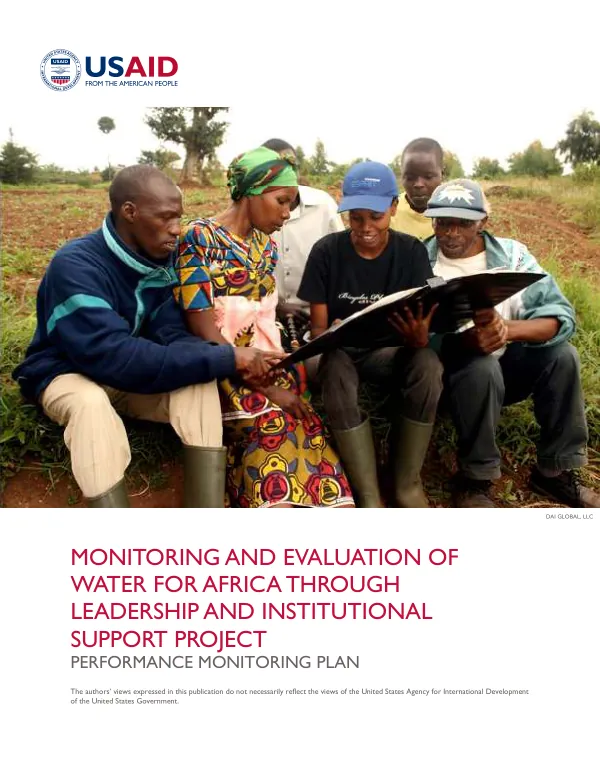
Water for Africa through Leadership and Institutional Support (WALIS) Project Performance Monitoring Plan
Sign inDAI GLOBAL, LLC
Water for Africa through Leadership and Institutional Support (WALIS) Project Performance Monitoring Plan
The Water for Africa through Leadership and Institutional Support (WALIS) project is a five-year initiative that aims to improve access to clean water and sanitation in Africa.
2020 · 23 pages
Sign in to readA free account is required to download.
Abstract
The project is implemented by DAI Global LLC and has a maximum total funding amount of $12,383,704. The project's overall objective is to support national and regional institutions and their development partners to improve the capacity of national water sectors to plan and implement policies and strategies that deliver sustainable water, sanitation, and hygiene (WASH) services. The project has four core task areas: developing and analyzing sound sector data, engaging in targeted research and pilot activities, strengthening country systems to improve policy and planning, and increasing the capacity required to support improved collection and use of sector knowledge. The project is implemented in 16 countries in Africa, with a focus on selected Tier 1 and Tier 2 countries that USAID has prioritized for investments in WASH and agricultural water management. The project's performance monitoring plan (PMP) is designed to promote ongoing discussions relevant to project implementation, define project outcomes and performance indicators, and outline a strategy to collect and validate data to measure and monitor project performance. The PMP is based on the Results Framework, which illustrates the hierarchy of necessary results to achieve the project's objective. The Results Framework has three intermediate results (IRs): WASH sector leadership, monitoring, and learning and knowledge sharing. The IRs are designed to strengthen national and regional institutions in the WASH sector, foster multi-stakeholder leadership, and increase levels of capacity development, knowledge-sharing, and peer-to-peer learning. The project's performance indicators are designed to measure progress towards the project's objective. The indicators are based on the language of the four core task areas and cover activities such as developing and analyzing sound sector data, engaging in targeted research and pilot activities, strengthening country systems, and increasing capacity to support improved collection and use of sector knowledge. The project's monitoring and evaluation (M&E) strategy is designed to ensure that the project is measuring and reporting on its progress towards its objective. The M&E strategy includes data collection, analysis, and review, as well as reporting and validation of data to ensure that the project is meeting its performance indicators. The project's overall objective is to support national and regional institutions and their development partners to improve the capacity of national water sectors to plan and implement policies and strategies that deliver sustainable WASH services. The project's performance monitoring plan is designed to ensure that the project is meeting its objective and making progress towards its performance indicators. The project's Results Framework is presented in Figure 1, which illustrates the hierarchy of necessary results to achieve the project's objective. The three program IRs are: IR1, WASH sector leadership; IR2, monitoring; and IR3, learning and knowledge sharing. The IRs are designed to strengthen national and regional institutions in the WASH sector, foster multi-stakeholder leadership, and increase levels of capacity development, knowledge-sharing, and peer-to-peer learning. The project's overall objective is to support national and regional institutions and their development