 1993
1993USAID DEC
Water/wastewater sector assessment - Cairo wastewater, Cairo water supply, Alexandria wastewater, canal cities water and sewerage
Sign inUSAID. MISSION TO EGYPT
Evaluates four urban water supply and/or wastewater services projects in Egypt.
Robieson, R.; Schacknies, B. · 1985
Abstract
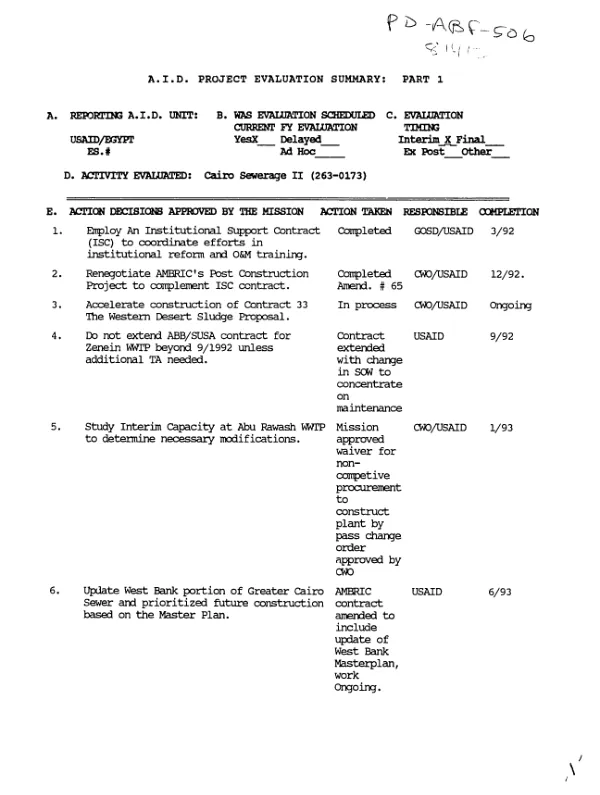
PES covers the period 9/77-5/85 and summarizes an attached special evaluation based on document review, site visits, and interviews with, among others, project staff, and Government of Egypt (GOE) and USAID/E personnel. Management problems within the implementing agencies have limited the success of these projects. The organizations are characterized by nonresponsive, nondirective management systems; lack of trained management and technical staff; insufficient operational and financial autonomy; ineffective coordination between national and local organizations; and poor construction management and operations/maintenance (O&M) practices. Existing training systems/capabilities in the sector are fragmented; training activities have been constrained by management deficiencies, poor compensation practices, and low employee motivation. AID-financed construction is reasonably on schedule, but the completion of critical system components is often not synchronized. Local construction contractors, whose work was poor, have been replaced by expatriate firms. Cost projections have been incorrect, construction of major parts of the system remain unfunded, reliable information by which to estimate costs is not available. There are also indications that the new water supply/wastewater systems are least benefiting those whose need it the greatest. It is recommended, inter alia, that: (1) the National Organization for Potable Water and Sanitary Drainage (NOPWASD) coordinate operations and sector data bases, develop curricula, set standards, and design and construct infrastructure; (2) local organizations be given autonomy and O&M responsibilities; (3) expatriate contractors provide construction and O&M assistance and training; (4) an information system to include cost monitoring and budgeting be set up; (5) the GOE review wastewater secondary treatment technologies; and (6) data collection be undertaken to estimate impact on beneficiaries and beneficiaries" ability to pay. (NE Bureau abstract)
Connected topics
Classification