FOOD AND AGRICULTURAL ORGANIZATION
West Africa – Ebola Outbreak Fact Sheet #2, Fiscal Year (FY) 2015
The U.N.
2015 · 6 pages
Sign in to readA free account is required to download.
Abstract
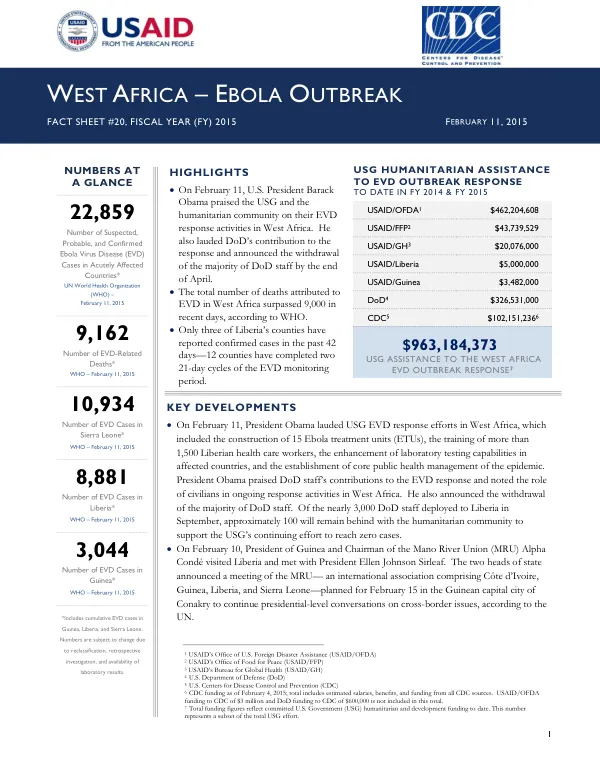
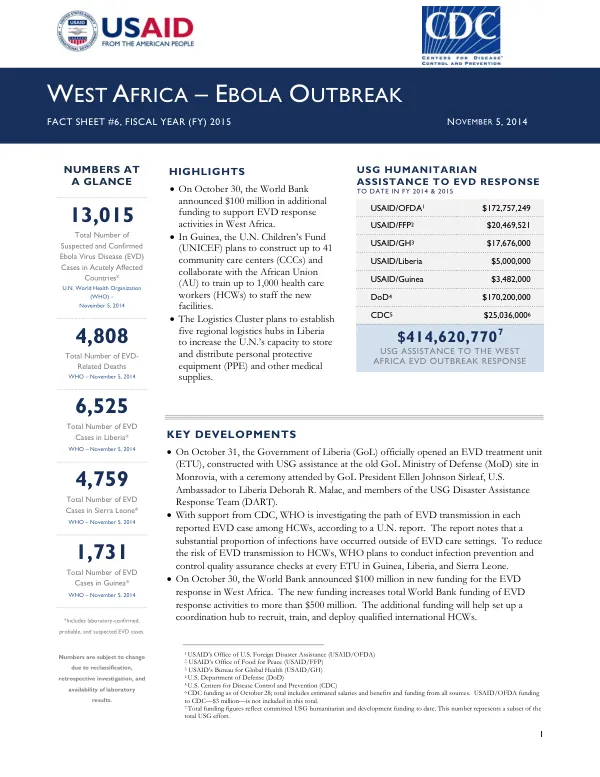
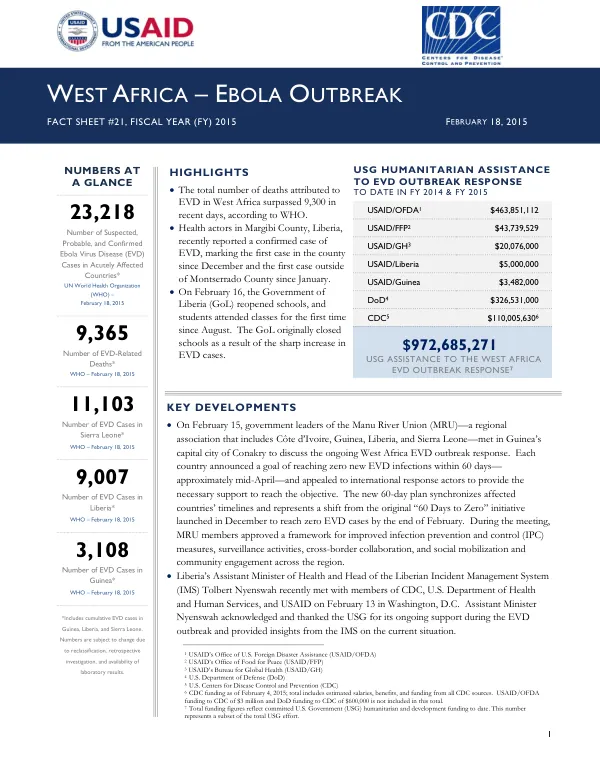
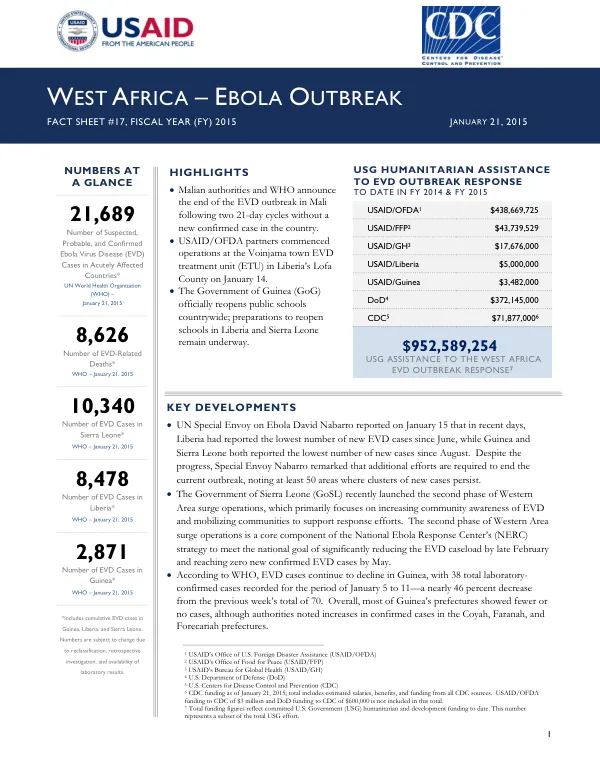
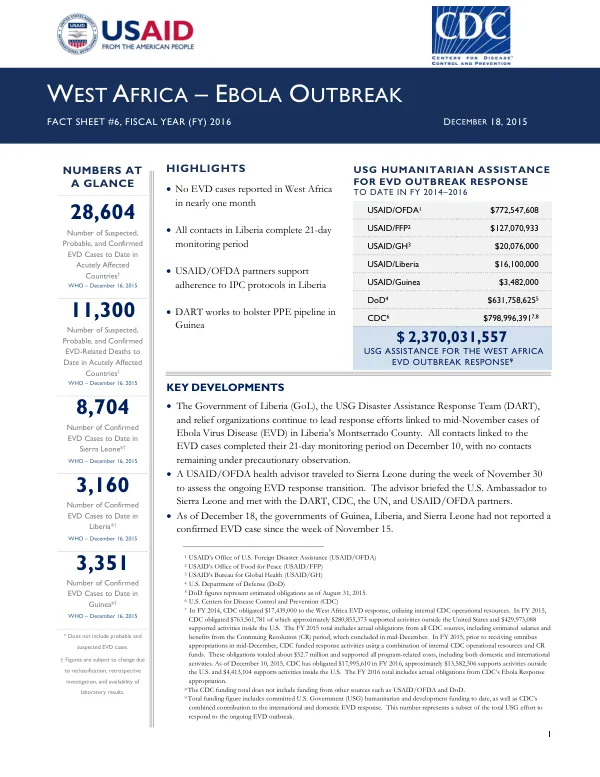
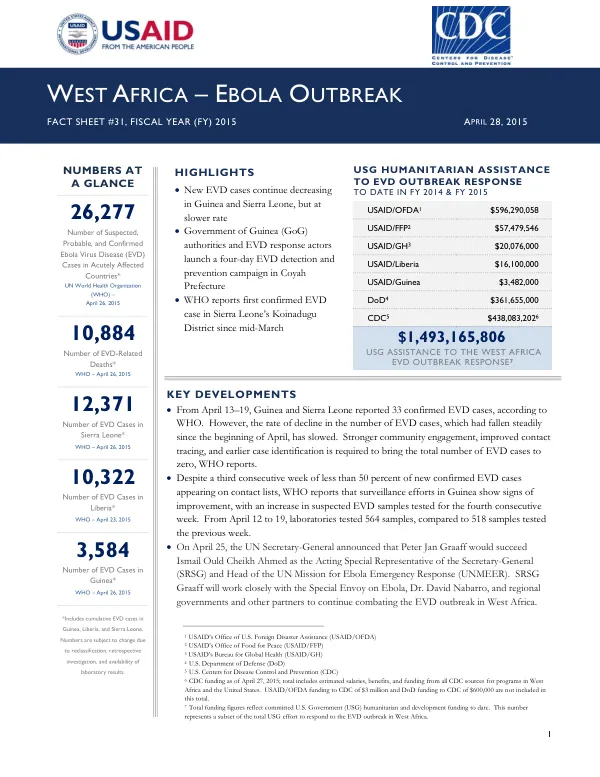
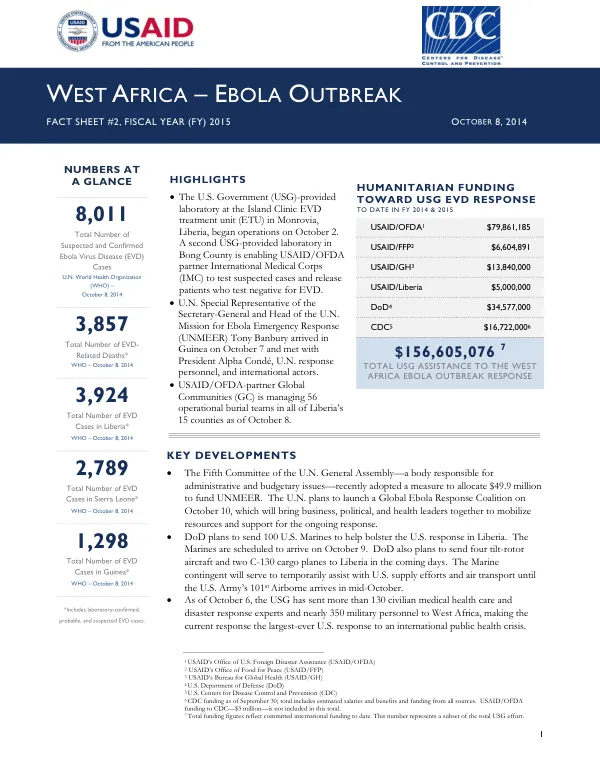
General Assembly's Fifth Committee recently adopted a measure to allocate $49.9 million to fund UNMEER, the U.N. Mission for Ebola Emergency Response. This funding will support the ongoing response to the Ebola outbreak in West Africa. The U.N. plans to launch a Global Ebola Response Coalition on October 10, which will bring together business, political, and health leaders to mobilize resources and support for the response. The U.S. Department of Defense (DoD) plans to send 100 U.S. Marines to Liberia to bolster the U.S. response to the outbreak. The Marines are scheduled to arrive on October 9 and will temporarily assist with U.S. supply efforts and air transport until the U.S. Army's 101st Airborne arrives in mid-October. DoD also plans to send four tilt-rotor aircraft and two C-130 cargo planes to Liberia in the coming days. As of October 6, the U.S. Government has sent more than 130 civilian medical health care and disaster response experts and nearly 350 military personnel to West Africa, making the current response the largest-ever U.S. response to an international public health crisis. The U.S. Government has committed significant funding to support the response, with a total of $156.6 million allocated to date in FY 2014 and 2015. The World Health Organization (WHO) reports that EVD transmission rates remain high in the three most severely-affected countries of West Africa. In Liberia, cases are doubling every 15 to 20 days, while in Sierra Leone and Guinea, cases are doubling every 30 to 40 days. Accurate data collection remains a challenge, and responders continue to face difficulties gathering accurate data from high-priority areas. The World Bank Group has released a report outlining the financial and fiscal impacts of the outbreak. In the short term, the World Bank estimates that annual gross domestic product (GDP) growth in Guinea may contract from 4.5 percent to 2.4 percent, in Liberia from 5.9 percent to 2.5 percent, and in Sierra Leone from 11.3 percent to 8 percent. With rapid containment of the disease, the loss in GDP for the West Africa sub-region could be as high as $2.2 billion in 2014 and $1.6 billion in 2015. In Liberia, the U.S. Government's Disaster Assistance Response Team (DART) and the International Organization for Migration (IOM) have traveled to Bomi County to attend a ceremony marking the start of ETU construction. DoD anticipates that construction will take between two and three weeks, with an initial capacity of 10 beds eventually scaling up to 100 beds in November. USAID/OFDA is supporting Global Communities (GC) to train and oversee safe burial teams in Liberia, with 56 burial teams active countrywide as of October 8. In Sierra Leone, CDC representatives have visited the national EVD call center and reported that it is operational and receiving more than 1,000 calls per day. Burial teams in Sierra Leone refused to work on October 7 due to a reported lack of hazard pay, but the strike was reportedly over as of October 8. A rapid assessment of rural communities in Kailahun and Kenema districts found that nearly 97 percent of respondents reported a drop in household income between May and August 2014. In Guinea, 19 suspected EVD patients were transported from Coyah Prefecture to the Donka ETU in Conakry on October 6, with five patients testing positive for EVD. WHO is working to expand the national Emergency Operations Center model to the prefecture level in Guinea, including social mobilization, epidemiological, and logistics components.