USAID/BANGLADESH
What Do Cooks Want? A Study of Improved Cookstoves in Bangladesh
In Bangladesh, a study on improved cookstoves was conducted to understand consumer needs and preferences.
2014 · 4 pages
Sign in to readA free account is required to download.
Abstract
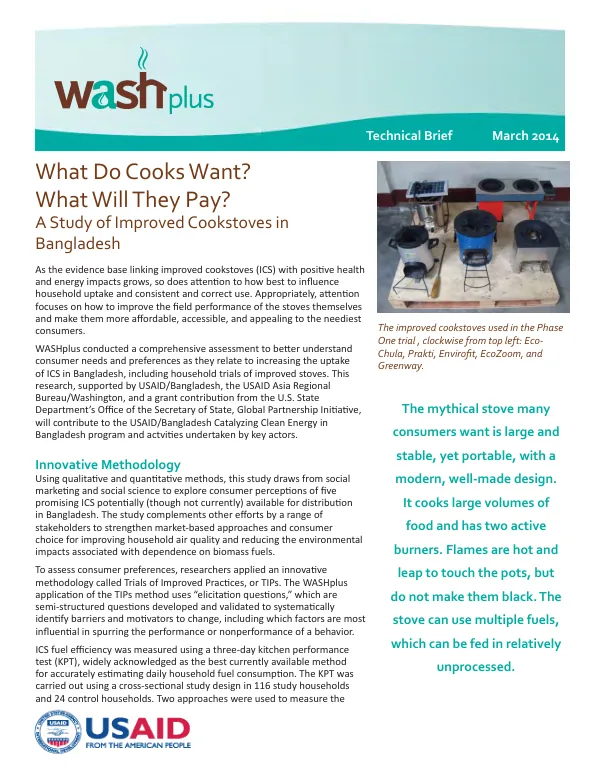
The study, supported by USAID/Bangladesh, the USAID Asia Regional Bureau/Washington, and a grant contribution from the U.S. State Department's Office of the Secretary of State, Global Partnership Initiative, aimed to increase the uptake of improved cookstoves (ICS) in Bangladesh. The research used a comprehensive assessment, including household trials of improved stoves, to identify consumer preferences and barriers to adoption. The study applied an innovative methodology called Trials of Improved Practices (TIPs), which used semi-structured questions to systematically identify barriers and motivators to change. The TIPs method was used to assess consumer preferences for five different imported ICS models, including the Envirofit Z3000, EcoZoom Dura, Prakti LeoChimney, Eco-Chula, and Greenway. The stoves were tested in 120 households in two wood-fuel burning areas of Bangladesh, Sylhet and Barisal. The study found that at least two stoves, the Prakti and Eco-Chula, were perceived as preferable to traditional cookstoves by many of those who tried them. Consumers most appreciated the Prakti and Eco-Chula stoves, with the preference for each stove varying by district. Overall, consumers reported liking the new stoves, which was a distinct indicator separate from whether or not they preferred the ICS to the traditional stove. However, consumers reported slower cooking times using the ICS, with three-fourths of respondents reporting slower cooking times. The most overarching complaint about all the cookstoves included in the trial was their inability to cook large volumes of food in large pots, especially the Prakti and Greenway cookstoves. Consumers also complained about the size and angle of the wood opening, which made it difficult to feed large wood pieces into the stove. Additionally, consumers found that excess ash collected in the stove and suggested a tray for easy emptying. The study's findings suggest that consumers value a large and stable stove with a modern, well-made design that can cook large volumes of food and has two active burners. The study's results have implications for the design and marketing of improved cookstoves in Bangladesh. The findings suggest that consumers are willing to adopt improved cookstoves that meet their needs and preferences, but that these stoves must be designed to address the specific challenges faced by consumers in Bangladesh. The study's results also highlight the importance of consumer education and follow-up from service agents or health outreach workers to address the barriers to adoption identified in the study.
Related documents