JHPIEGO
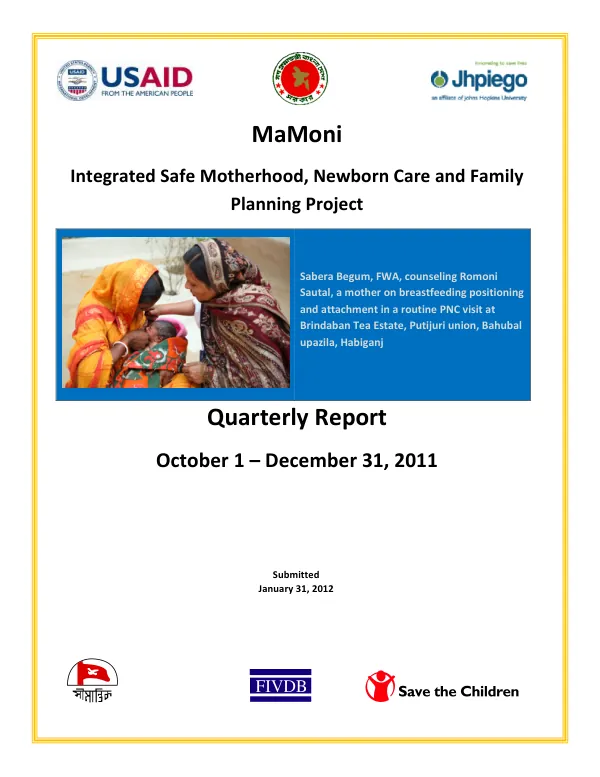
MaMoni Quarterly Report, October-‐December 2011
The MaMoni Integrated Safe Motherhood, Newborn Care, and Family Planning Project is a key initiative aimed at improving maternal and newborn health in Bangladesh.
2011 · 25 pages
Sign in to readA free account is required to download.
Abstract
The project is implemented in Habiganj district, with a focus on increasing knowledge, skills, and practices of healthy maternal and newborn behaviors in the home. The project also aims to increase the utilization of home and facility-based essential maternal and newborn health (MNH) and family planning (FP) services. Baseline surveys and formative research were conducted by the Alive & Thrive project in Bishwanath and Companyganj upazilas between July and September 2011. A total of 1,065 mothers of under-1 year children were surveyed, along with focus group discussions (FGDs) and in-depth interviews with health workers and community influencers. Preliminary data is available, with the final report being prepared. Some key findings from the baseline surveys include: * Only one in 20 mothers had knowledge on how to maintain the supply of breast-milk or assess milk supply. * A large knowledge gap exists on critical areas of complementary feeding, with less than one-third of mothers able to mention the correct amount of food for children at 7 or 10 months. * Less than 10% of mothers have ever seen or used micronutrient powder (MNP). * Around 40% of mothers took any iron supplementation in her last pregnancy. The MaMoni project aims to address these knowledge gaps and improve maternal and newborn health outcomes in Habiganj district. The project is working to increase the utilization of home and facility-based essential MNH and FP services, as well as promote healthy maternal and newborn behaviors in the home. The project has also completed the nutrition intervention in Sylhet in December, and is examining the results to design a nutrition promotion strategy for Habiganj. The project is working to mobilize community action, support, and demand for the practice of healthy MNH behaviors. The MaMoni project is supported by the American people through the United States Agency for International Development (USAID) under the terms of Associate Cooperative Agreement No. 388-A-00-09-0104-00, through MCHIP, managed by Jhpiego Corporation. The contents of this report are the responsibility of Jhpiego Corporation and do not necessarily reflect the views of USAID or the United States Government. The project has made significant progress in consolidating gains and ensuring program quality, despite the reduced number of staffing in Sylhet. The project is working to accelerate the momentum of key MNH-FP interventions on the ground in Habiganj, and is committed to improving maternal and newborn health outcomes in the district.
Related documents