USAID DEC
What Works To Prevent Lethal Youth Violence in the LAC Region: A Global Review of the Research
Sign inTHE AMERICAN INSTITUTES FOR RESEARCH
What Works To Prevent Lethal Youth Violence in the LAC Region: A Global Review of the Research
The Latin America and Caribbean (LAC) region has some of the highest rates of interpersonal and community-based violence in the world.
2019 · 4 pages
Sign in to readA free account is required to download.
Abstract
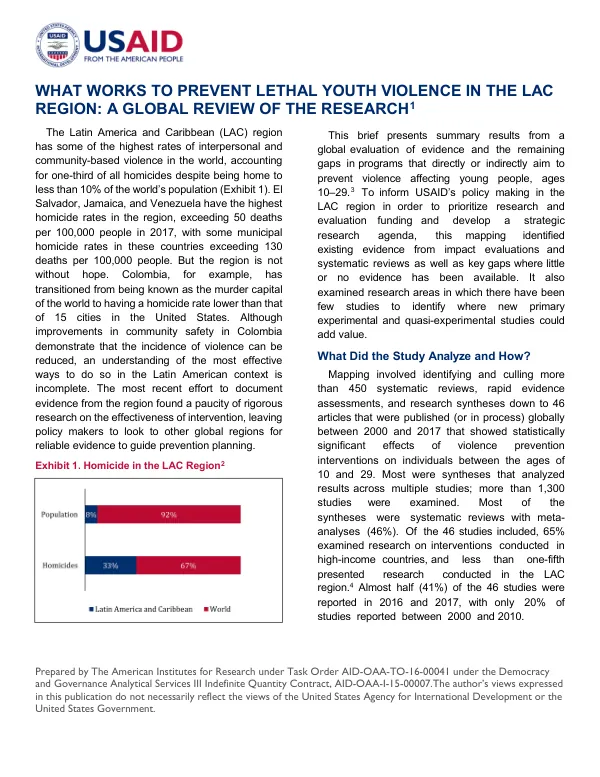
According to available data, the region accounts for one-third of all homicides, despite being home to less than 10% of the world's population. Countries such as El Salvador, Jamaica, and Venezuela have the highest homicide rates in the region, exceeding 50 deaths per 100,000 people in 2017. However, the region is not without hope. Colombia, for example, has transitioned from being known as the murder capital of the world to having a homicide rate lower than that of 15 cities in the United States. This improvement in community safety in Colombia demonstrates that the incidence of violence can be reduced. Despite this progress, an understanding of the most effective ways to do so in the Latin American context is incomplete. A global review of research on violence prevention in the LAC region was conducted to inform USAID's policy making and prioritize research and evaluation funding. The review involved identifying and analyzing more than 450 systematic reviews, rapid evidence assessments, and research syntheses published globally between 2000 and 2017. The analysis focused on interventions that showed statistically significant effects on individuals between the ages of 10 and 29. The review found that most interventions were person-based and not tied to any physical or social environment. The most common foci of interventions were gun violence prevention studies, school-based violence prevention studies, and studies that examined published literature on any type of violence prevention approach excluding gun and gang violence. The most common outcomes studied were some type of violence against persons, followed by violence according to place, and changes in skills related to intervention objectives. The review also identified several key research gaps, including a lack of studies from the LAC region, a dearth of research focusing on females as perpetrators or victims of violence, and a lack of studies examining environmental design impacts on violence directed toward youth. Additionally, the review found that individual behavioral outcomes were rarely measured, and knowledge, attitudes, beliefs, and skills were the most common ways that studies measured the impact of intervention. The results of this evidence gap analysis provide several key insights to inform the USAID and stakeholder research agenda and program planning efforts to reduce and prevent youth violence in the region. First, there is an imperative for researchers to accurately and completely document the implementation process (including cost) so interventions can be implemented according to design and have the best chance of producing comparable results in other places. Second, there is a need to improve the way that research is conducted to enhance the credibility of results on which to base future programmatic or policy decisions. Guidance on which outcome indicators to target in future evaluations of violence prevention programming in the LAC region would enable USAID to more rapidly increase the body of evidence for prevention strategies.