FHI 360
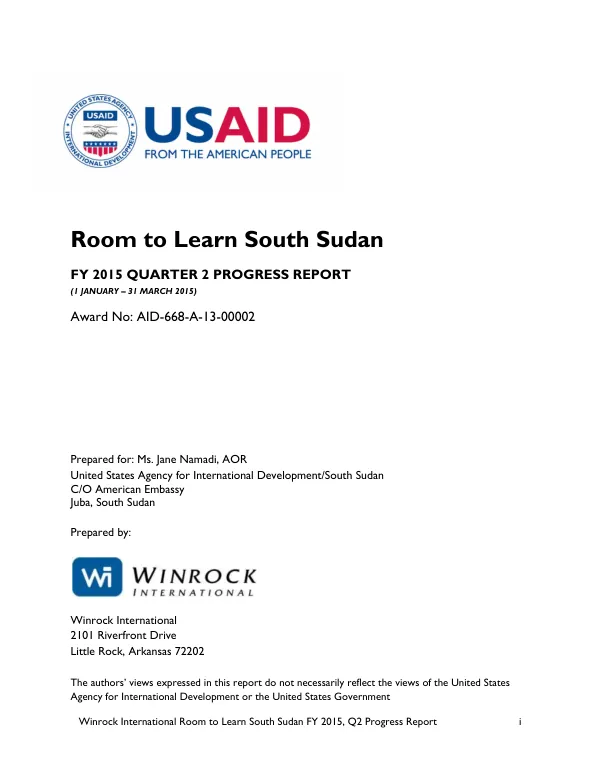
Winrock International Room to Learn South Sudan FY 2015 Q2 Progress Report
Room to Learn South Sudan successfully conducted the pilot community entry and program rollout during the reporting period.
2015 · 43 pages
Sign in to readA free account is required to download.
Abstract
The project completed significant preparatory work and effective engagement of national, state, and county education authorities in the pre-community entry and selection of schools in accordance with Room to Learn's criteria. This was followed by mobilization of communities through a focused process running over the course of four to five days in each community to ensure stakeholder buy-in and ownership of the program activities. A baseline survey was conducted in each community entered, interviewing head teachers, teachers, Parent Teacher Association (PTA) members, and learners. The Room to Learn county teams presented preliminary findings to the community to assist them in realizing their needs and prioritizing school improvements. A detailed analysis of the baseline data will feed into a decision-making process to determine the indicators that will be used in the Safer School Index (SSI). Room to Learn county teams assisted the communities in identifying priority needs and updating the existing School Development Plans (SDP). Project ideas were prepared for USAID's approval. Some shared themes and needs emerged in school communities that Room to Learn staff reached during the quarter. Volunteer teachers and water facilities were commonly cited as lacking in many schools. School feeding was a priority in Kapoeta South, an area with food shortages. Following the pilot phase, the Room to Learn team met with USAID to share and discuss lessons learned. Room to Learn discussed ways to further streamline the process and reduce the number of community consultation days so that participation can be kept at high levels while maintaining the quality of the work. During the quarter, Room to Learn reached 30 formal schools and six Accelerated Learning Programs (ALPs) within primary schools in the four counties where community entry began on February 23. A total of 11,644 learners (5,224 females and 6,420 males) were enrolled in these schools, with 520 pupils enrolled in ALPs. There were 2,295 students in five schools in Central Equatoria State, 6,028 students in 15 schools in Eastern Equatoria State, and 3,321 students in 10 schools in Western Bahr el Ghazal State. Room to Learn worked with a PTA at each of the 30 school communities. Room to Learn's project staffing was reviewed, and additional positions were identified as needed. A joint field and home office top-to-bottom executive review in March confirmed many of the positions and steps needed for successful implementation in the fluid South Sudanese environment. The Room to Learn grants database was activated during the quarter, with data from school communities populating the database. The finance and grants departments reviewed the reports and agreed upon regular reconciliations of the data. Room to Learn will continue to expand its geographic footprint, with plans to deploy staff in new sites in Central Equatoria State, Warrap State, Western Equatoria State, Northern Bahr el Ghazal State, and Western Bahr el Ghazal State. The project will also add new teams in Yei, Wau/Bagari, and Magwi/Nimule counties. Room to Learn will work to streamline the community consultation process and maintain high levels of participation while ensuring the quality of the work. The project will continue to monitor and evaluate its progress, using the Safer School Index (SSI) and other indicators to measure its impact.
Related documents