USAID DEC
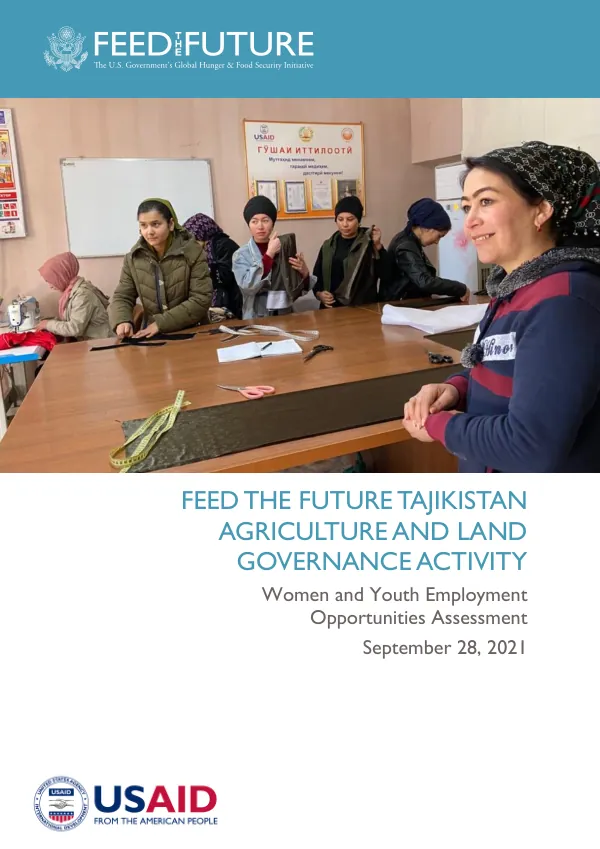
Women and Youth Employment Opportunities Assessment for the Feed the Future Tajikistan Agriculture and Land Governance Activity
Sign inABT. GLOBAL
Women and Youth Employment Opportunities Assessment for the Feed the Future Tajikistan Agriculture and Land Governance Activity
The agricultural sector in Tajikistan is a significant contributor to the country's economy, with the majority of the population engaged in agriculture.
2021 · 49 pages
Sign in to readA free account is required to download.
Abstract
However, the sector faces numerous challenges, including limited access to credit, lack of market information, and inadequate infrastructure. The Feed the Future Tajikistan Agriculture and Land Governance Activity aims to address these challenges by developing more productive and efficient agriculture systems, building the resilience of smallholder farmers, and improving the enabling environment for sustainable and long-term agriculture-led growth. The Activity will implement an inclusive market systems approach to strengthen Tajikistan's agricultural systems, engaging with local and regional private sector actors to develop and expand market opportunities. The Activity will also work with government and civil society to drive systemic reforms in the enabling environment for agriculture, allowing smallholders and private sector firms to invest and upgrade land through improved registration and administration. The Activity's purpose will be achieved through three components: Enhance productive agriculture systems, Strengthen the resilience of vulnerable smallholders, and Improve the enabling environment. Prior to starting activities, the Activity conducted several assessments to identify gaps in employment opportunities and develop relevant interventions to address those gaps. The Women and Youth Entrepreneurship Opportunities Assessment was conducted under Component II to define the disadvantages that vulnerable groups of young males and females face in the labor market and in entrepreneurship in the Khatlon region. The assessment identified several challenges faced by women and youth in the labor market, including limited access to education and training, lack of job opportunities, and inadequate social protection. The assessment also found that women and youth face significant barriers to entrepreneurship, including limited access to credit, lack of market information, and inadequate infrastructure. The assessment took place in 12 districts of the Khatlon region and involved individual household-level interviews with women and youth. The data collected during the assessment provides a narrative description of the challenges faced by women and youth in the labor market and in entrepreneurship. The report presents the findings of the assessment and provides recommendations for improving the situation with regards to women and youth employment in the Khatlon region. The Labor Code of Tajikistan defines employment as any type of activity that meets employees' personal and public demands, brings income to them, and does not contradict with regulatory documents of the Republic of Tajikistan. Unemployment is considered a socio-economic phenomenon related to lack of demand for a certain portion of the labor force in the labor market. Seasonal work is defined as a type of work performed within a specific period of the year. The official unemployment rate in Tajikistan declined from 7.5% in 2015 to 6.6% in 2019, but increased again to 7.5% in 2020 due to Covid-19-related workforce reductions. The country's economy is heavily dependent on migration and remittances, with labor migration and remittances remaining the only option for employment and the prime source of household income for the vast majority of the population. The assessment identified several key informants, including entrepreneurs, government officials, and civil society representatives, who provided valuable insights into the challenges faced by women and youth in the labor market and in entrepreneurship. The assessment also involved the development of survey questionnaires and the collection of primary data necessary for the assessment. The report presents the findings of the assessment and provides recommendations for improving the situation with regards to women and youth employment in the Khatlon region. The recommendations include increasing access to education and training, improving job opportunities, and enhancing social protection for women and youth. The report also recommends increasing access to credit, improving market information, and enhancing infrastructure to support entrepreneurship among women and youth. The Activity will implement several interventions to address the challenges faced by women and youth in the labor market and in entrepreneurship. These interventions include business and vocational training, internship and apprenticeship programs, and business incubation. The Activity will also work with government and civil society to drive systemic reforms in the enabling environment for agriculture, allowing smallholders and private sector firms to invest and upgrade land through improved registration and administration. The Activity's purpose will be achieved through the implementation of these interventions and the development of relevant policies and programs to support women and youth employment in the Khatlon region. The Activity will also work with local and regional private sector actors to develop and expand market opportunities, and will engage with government and civil society to drive systemic reforms in the enabling environment for agriculture.