ABT. GLOBAL
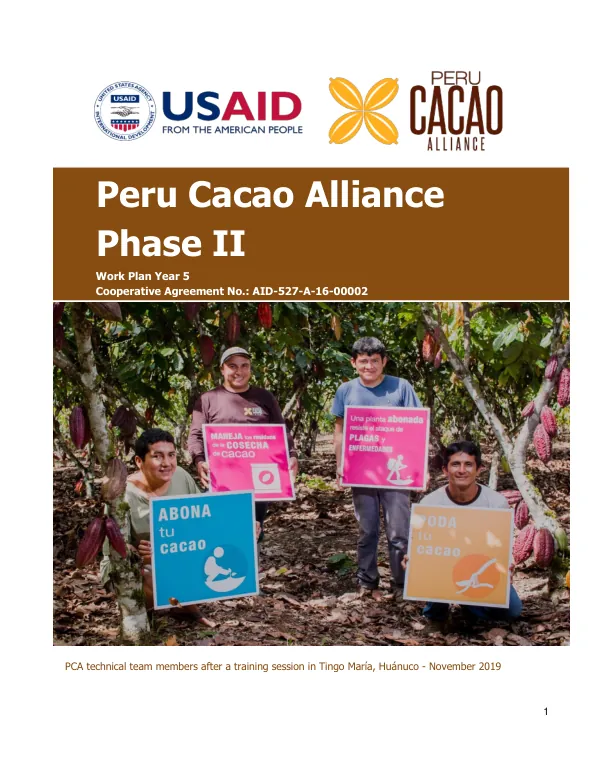
Peru Cacao Alliance Phase II Work Plan Year 5
The Peru Cacao Alliance Phase II Work Plan Year 5 aims to facilitate market access for rural families in alternative development areas.
2020 · 49 pages
Sign in to readA free account is required to download.
Abstract
To achieve this goal, the alliance will implement several activities, including strengthening producer organizations' organic certification programs and supporting commercial Supply Chain Managers (SCMs) to develop relationships with independent farming families. In Year 5, the alliance will conduct 32 trainings on integrated pest management (IPM) for leading producers, agricultural technicians, and PCA technicians. These trainings will focus on cultural, physical, chemical, and biological control and will be held in Pasco, Ucayali, Huánuco, and San Martín regions. The trainings will be conducted in micro-corridors, with a total of 865 people trained. Additionally, 20 SCMs will strengthen their organic programs in the Ucayali, Huánuco, and San Martín regions. These SCMs will work with farmers to implement IPM practices and improve the quality of their cacao. The alliance will also connect farmers with SCMs that are active in each region, with the goal of developing commercial relationships. The alliance will work with more than 15 SCMs, including Villa Andina SAC, CAC Colpa de Loros, Central de Curimana, and CAC Oro Verde, to access new domestic and international cacao markets. PCA will also connect 11,310 independent farmers with these SCMs to develop commercial relationships. The Peru Cacao Alliance will continue to offer critical information and technical support to farmers and partners through various channels, including radio programs, phone consultations, SMS and WhatsApp messaging, and online conferences and training sessions hosted via Zoom and Facebook Live. The alliance will also continue to work with private sector partners to establish linkages with cacao-growing farmers and build farmer capacity. The alliance's activities in Year 5 will focus on facilitating market access for rural families in alternative development areas. The goal is to connect farmers with buyers in high-value markets and improve the quality and quantity of cacao produced. The alliance will work with SCMs and farmers to implement IPM practices and improve the quality of cacao, and will connect farmers with buyers in high-value markets. The Peru Cacao Alliance will also continue to work with the Government of Peru to implement activities that support the development of the cacao value chain. The alliance will work with technology companies, financial firms, and Supply Chain Managers to build farmer capacity and establish linkages with cacao-growing farmers. In Year 5, the alliance will close its offices in the San Martín and Ucayali regions, as well as in parts of the Huánuco region. However, PCA partners will continue to work with the farmers that supply them with cacao. The alliance will still implement select activities in these areas, including periodically strengthening the technical skills of agricultural technicians, implementing quality control activities, and supporting financial inclusion. The Peru Cacao Alliance will also continue to work with private sector partners to establish linkages with cacao-growing farmers. The alliance will build on the commitment of technology companies, financial firms, and Supply Chain Managers to the ongoing development of the cacao value chain and to continue to build farmer capacity. The alliance's activities in Year 5 will have a significant impact on the development of the cacao value chain in Peru. The goal is to connect farmers with buyers in high-value markets and improve the quality and quantity of cacao produced. The alliance will work with SCMs and farmers to implement IPM practices and improve the quality of cacao, and will connect farmers with buyers in high-value markets. The Peru Cacao Alliance will also continue to work with the Government of Peru to implement activities that support the development of
Related documents