ICF
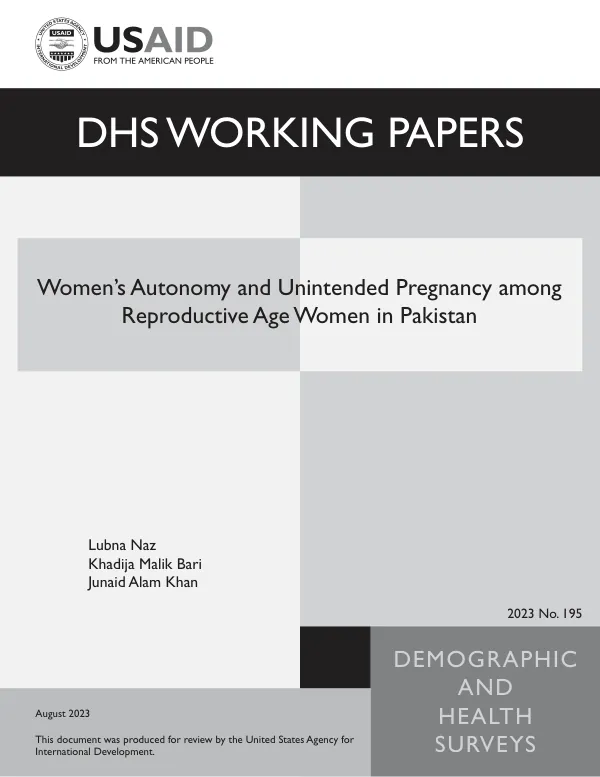
Women’s Autonomy and Unintended Pregnancy among Reproductive Age Women in Pakistan
Women's Autonomy and Unintended Pregnancy among Reproductive Age Women in Pakistan is a study conducted by Lubna Naz, Khadija Malik Bari, and Junaid Alam Khan.
2023 · 37 pages
Sign in to readA free account is required to download.
Abstract
The research aims to explore the association between women's autonomy within the household and the prevention of unintended pregnancy in Pakistan. The study employed a sample of 8,228 married women aged 15-49 who have experienced a pregnancy in the five years before the survey, extracted from the Pakistan Demographic and Health Survey 2017-18. The dependent variable was pregnancy intendedness, categorized into planned, mistimed, and unwanted. A chi-square test was used to validate the association of each explanatory variable with pregnancy intendedness. The analysis found a significant association between women's autonomy and pregnancy intendedness at the 5% significance level, except for high autonomy. However, after accounting for other factors, the analysis shows that women's autonomy and pregnancy intendedness are not significantly associated. The interactive influence of women's autonomy and contraceptives was found to be insignificantly associated with pregnancy intendedness. The study also found that the relative risk of mistimed and unwanted pregnancies were more prevalent among women who ever utilized contraceptives, had terminated a pregnancy, had more sons, and belonged to wealthy families. The husband's education was inversely associated with unintended pregnancy. The study concluded that women's autonomy and the interactive effect of women's autonomy and contraceptive use on pregnancy intendedness are not significant in Pakistan when other factors are considered. This may be due to data limitations, particularly those related to biased gender norms and patriarchal values in the construction of women's decision autonomy. The study results call for more in-depth investigation into social norms and patriarchal values that govern women's reproductive behavior in Pakistan. The study employed a multinomial logit model to compare the risk of mistimed and unwanted pregnancies among reproductive age women relative to the planned pregnancies. The model included covariates such as women's education, couple's education level, and household wealth. The results of the regression analysis showed that women's autonomy and pregnancy intendedness are not significantly associated, but the interactive effect of women's autonomy and contraceptives was found to be insignificantly associated with pregnancy intendedness. The study's findings have implications for policy and program development aimed at reducing unintended pregnancies in Pakistan. The results suggest that addressing social norms and patriarchal values that govern women's reproductive behavior is crucial for promoting women's autonomy and reducing unintended pregnancies.