AFGHAN MINISTRY OF RURAL REHABILITATION AND DEVELOPMENT
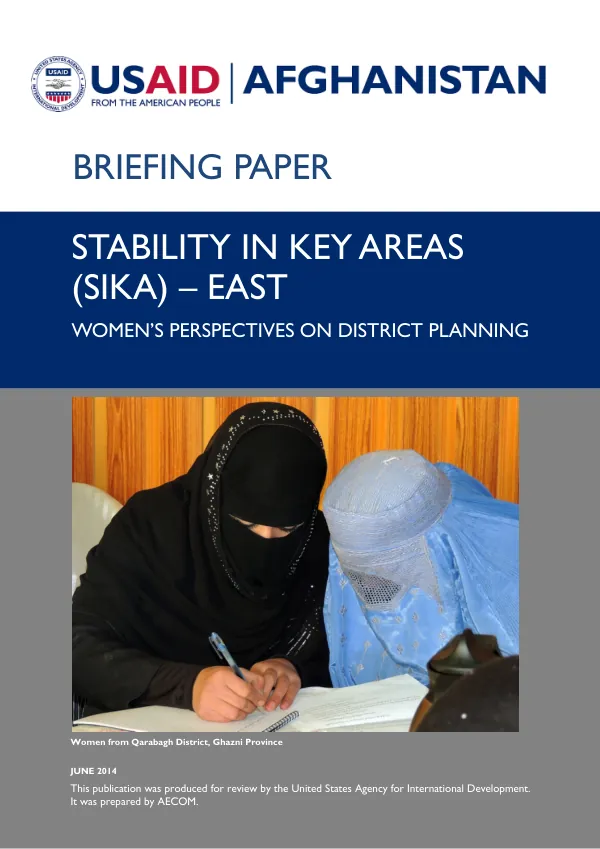
Women’s Perspectives on District Planning
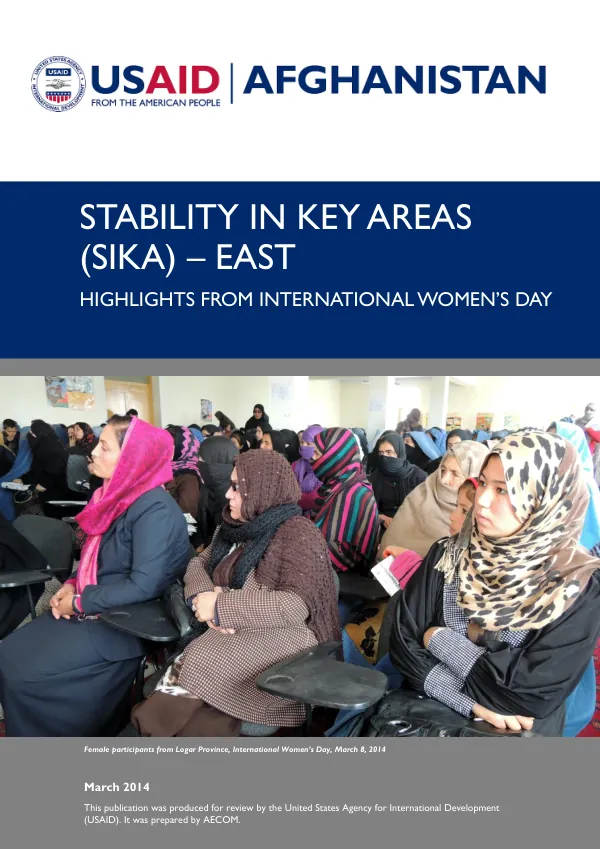
Women's Perspectives on District Planning examines the role of women leaders in district planning processes facilitated by SIKA-East in 2012 and 2013 under the aegis of Independent Directorate of Local Governance (IDLG) and Ministry of Rural Rehabilitation and Development (MRRD) in 21 districts in five provinces: Ghazni, Khost, Logar, Maydan Wardak, and Paktya.
2014 · 24 pages
Sign in to readA free account is required to download.
Abstract
In coordination with male leaders and GIRoA authorities, the women develop a district strategic plan that encapsulates their perspectives about local problems, root causes, and solutions – the District Project Portfolio (DPP). This DPP becomes the guiding document for local leadership and GIRoA to improve the district's governance and service delivery with the technical and financial support of SIKA-East. Key findings from the study indicate that women played an important role in district planning in 75% of districts, particularly given the conflict-affected context. Women identified an array of issues and solutions, informed by their unique life experiences and the roles they play in families, communities, and society at large. Their contributions resulted in distinctive, gender-sensitive district plans. The planning process proved a valuable platform for women leaders to represent district perspectives and expand leadership beyond their traditional local domain, including to the provincial level. However, women were largely unsuccessful in transforming influence into equitable representation on the final plans and ensuring women's priorities were fast-tracked for action and resourcing. Women District Development Assembly Plus (DDA+) members and DDA+ Communication Committees served as essential conduits for women's perspectives, with information deftly used to mobilize action. However, insufficient coordination between men and women at times hampered progress. While women and girls will clearly benefit from many of the communal services delivered in response to male demands, they are not as likely to experience a proportional benefit in response to their own demands, which have not always been prioritized and resourced. SIKA-East promotes good governance and effective service delivery by building the capacity of IDLG and MRRD in conflict-affected areas. Through its work, the program fosters strengthened relationships and engagement between district and provincial entities and constituencies, and supports the development of district strategic plans that reflect the perspectives of women and other marginalized groups. The program's efforts aim to inform the discourse on "gender disparity in Afghanistan" and enrich inclusive practices and women's empowerment in accord with the aims of the Government of the Islamic Republic of Afghanistan (GIRoA). The study highlights the importance of cultivating women's representation and leadership capacity, responding to their concerns, and resourcing their priorities in order to achieve sustainable gains for women. SIKA-East shares its experiences and analysis with the intent to inform the discourse on "gender disparity in Afghanistan" and to enrich inclusive practices and women's empowerment in accord with the aims of the Government of the Islamic Republic of Afghanistan (GIRoA). The program's efforts aim to promote good governance and effective service delivery, and to support the development of district strategic plans that reflect the perspectives of women and other marginalized groups.