AFGHAN MINISTRY OF RURAL REHABILITATION AND DEVELOPMENT
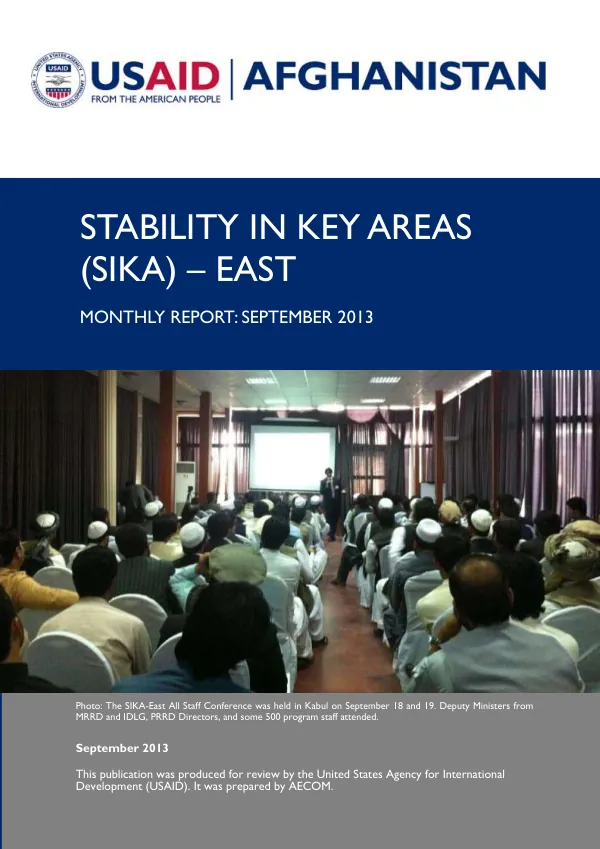
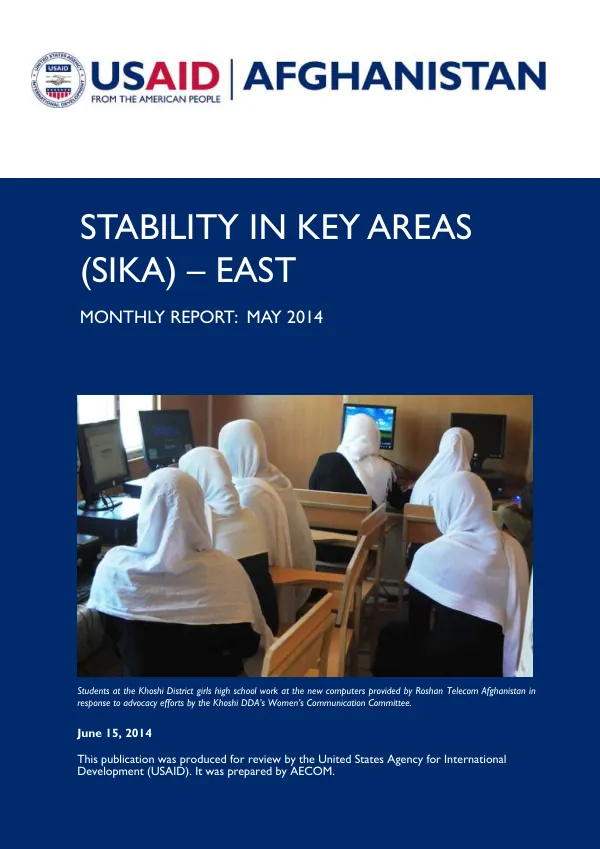
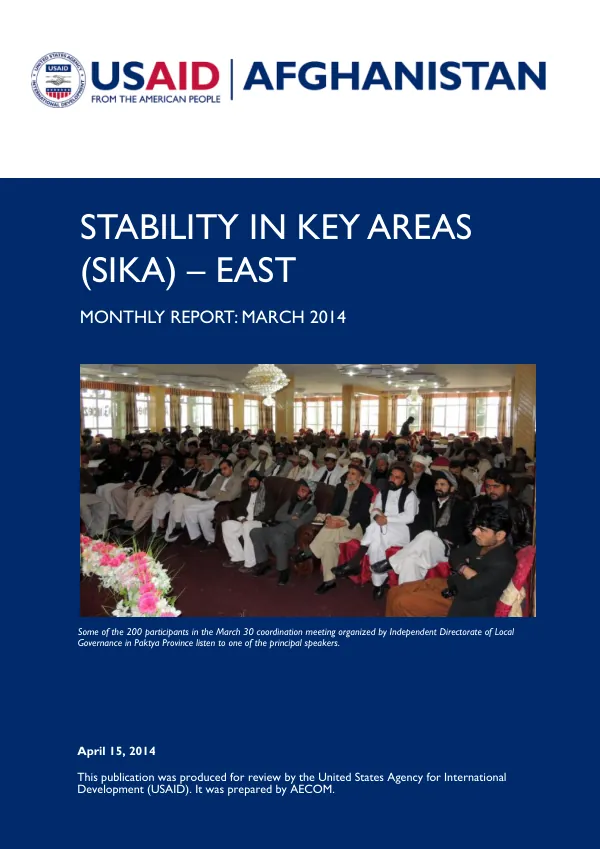
Stability in Key Areas (SIKA) - East Monthly Report: March 2014
Stability in Key Areas (SIKA) - East is a program working to strengthen governance and service delivery in conflict-affected districts of southeastern Afghanistan.
2014 · 45 pages
Sign in to readA free account is required to download.
Abstract
The program, in collaboration with the Afghan Ministry of Rural Rehabilitation and Development (MRRD) and the Independent Directorate of Local Governance (IDLG), aims to improve stability and reduce the impact of the insurgency through capacity building with MRRD and IDLG in the areas of intervention. The program is focusing on three key areas: engagement and building relationships between provincial and district entities and constituencies, improved technical capacity for good governance, and enhanced service delivery in community requests for stabilizing interventions. To achieve these objectives, SIKA-East is working closely with expanded District Development Assemblies (DDA), or so-called DDA Pluses (DDA+), which are informal, voluntary, highly representative district bodies consisting of District Governors (DG), DDA members, and traditional and professional authorities. The program is conducting a wide-ranging capacity building program for DDA+s, enabling them to identify, analyze, and monitor root causes of local instability, develop and execute strategic plans to address the identified concerns, and forge alliances and generate public activism to raise awareness about and advocate for district stability and improved governance. This core curriculum under the program is known as Stability Planning Process (SPP) and has now been completed in all 21 original districts. The SIKA-East capacity building program consists of trainings in three thematic areas: stability, outreach, and technical training. The stability thematic area includes trainings in stability planning, verification of sources of instability, root causes and solutions, stakeholder orientation, and governance foundation. The outreach thematic area includes trainings in fundraising, lobbying, negotiation strategy, unity building, and resource dialogue and advocacy. The technical training thematic area includes trainings in grant process and application development, grant management, infrastructure project planning, infrastructure project implementation, and operation and maintenance. In March 2014, USAID and SIKA-East's government partners agreed to expand the program into new districts, including two in the newly targeted province of Paktika. The lack of development and a concurrent lack of good governance, especially at the district level and its link to provincial administration, threaten to erode the legitimacy of the Afghan government and further impede its ability to expand authority and deliver basic services throughout the country. The primary objective of the SIKA-East program is to promote good governance and service delivery in targeted districts with the intended effects of promoting stability and reducing the impact of the insurgency. The program is focusing on three key areas: engagement and building relationships between provincial and district entities and constituencies, improved technical capacity for good governance, and enhanced service delivery in community requests for stabilizing interventions. The program is working closely with expanded District Development Assemblies (DDA), or so-called DDA Pluses (DDA+), which are informal, voluntary, highly representative district bodies consisting of District Governors (DG), DDA members, and traditional and professional authorities. Women's inclusion in these bodies is essential to the SIKA-East Gender Mainstreaming Strategy. The program has expanded into new districts, including two in the newly targeted province of Paktika. The program is working to promote good governance and service delivery in targeted districts with the intended effects of promoting stability and reducing the impact of the insurgency. The program is focusing on three key areas: engagement and building relationships between provincial and district entities and constituencies, improved technical capacity for good governance, and enhanced service delivery in community requests for stabilizing interventions. The SIKA-East capacity building program has created opportunities for local leaders to discuss and address local instability, develop and execute strategic plans to address the identified concerns, and forge alliances and generate public activism to raise awareness about and advocate for district stability and improved governance. The program has completed the Stability Planning Process (SPP) in all 21 original districts and is working to expand into new districts.
Related documents