USAID DEC
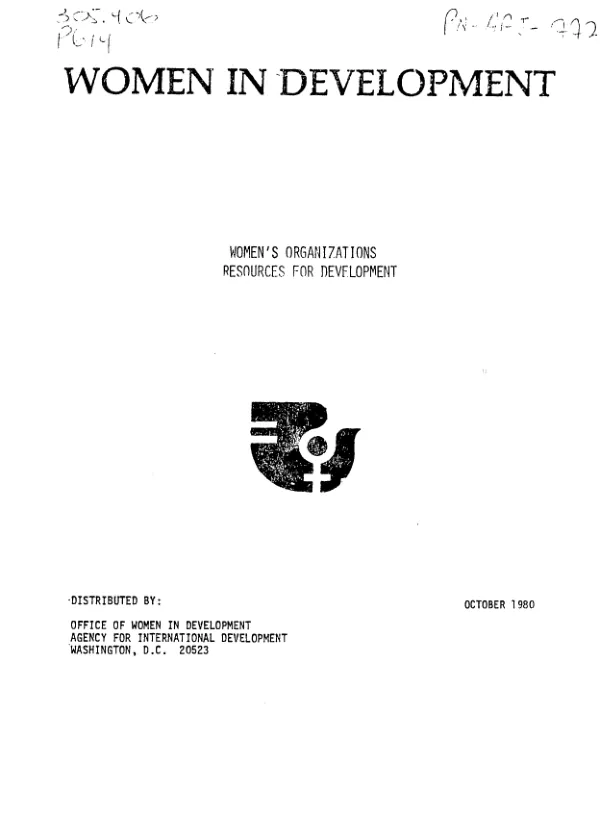
Women"s organizations resources for development
Women"s groups are a uniquely effective means for promoting women in development (WID) activities.
Piepmeier, Katherine B. · 1980
Sign in to readA free account is required to download.
Abstract
Against a background discussion of these groups" general development potential and needs and of institutional resources capable of assisting women"s groups, this report develops strategies and makes recommendations for donor assistance. Factors as diverse as stereotyping men as breadwinners, excluding women"s economic contributions from official statistics, and assuming that women will benefit from the trickle-down effect of a modernized society keep women"s real and potential contribution to development largely invisible. Reversing this situation will require meeting women"s key needs -- expanding their productive capacity by developing appropriate technologies and childcare facilities and improving women"s access to education, vocational training, and health care. Although governmental institutions devoted to women exist in over 100 countries, their assistance depends largely on the effectiveness of intermediary non-governmental groups at the international, regional, and subnational levels, including women"s groups themselves. The most effective intermediaries are those which are committed to development (not just to social welfare) and to women"s causes and are well-managed and have access to country resources and government channels. Donors should assist these intermediary groups by: (1) providing them management training in such areas as fund raising, securing technical assistance, and monitoring activities; (2) providing grants for under $5,000 and for the 5 years needed for a WID project to achieve self-sufficiency--contrary, in both instances, to donor policy; (3) helping groups gain political recognition by supporting them in publicizing women"s issues; and (4) helping groups develop linkages in terms of resources and experiences at both the national and regional levels. Such donor assistance is best channeled to indigenous groups through international organizations such as the Associated Countrywomen of the World, the International Alliance of Women, and the International Council of Women; or through regional or national mechanisms, e.g., respectively, UN regional commissions and the Canadian MATCH organization. A total of 25 specific recommendations are appended.
Related documents