JSI RESEARCH & TRAINING INSTITUTE, INC
Year 2 Annual Report: Cure Tuberculosis Project
The Cure Tuberculosis Project in the Kyrgyz Republic aimed to increase drug-resistant tuberculosis (DR-TB) case detection, cure more patients of DR-TB, prevent DR-TB infections, and improve the enabling environment for TB services.
2021 · 97 pages
Sign in to readA free account is required to download.
Abstract
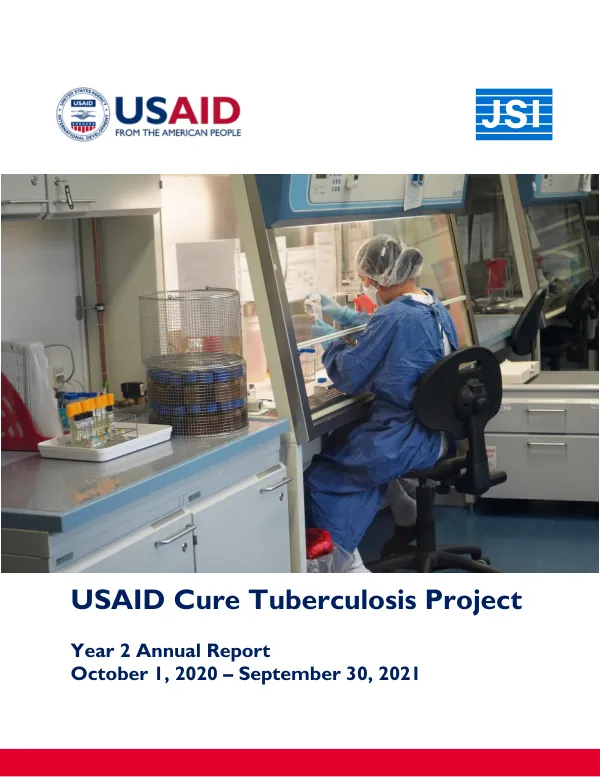
The project was implemented from October 1, 2020, to September 30, 2021, under a cooperative agreement with the USAID/Kyrgyz Republic. The project's main purpose was to strengthen laboratory services and diagnostic networks, expand primary healthcare and community-based detection and contact tracing, and improve treatment completion rates. To achieve this, the project implemented several strategies, including the provision of quality-assured drugs, training of healthcare workers, and the establishment of community-based treatment support programs. One of the key interventions was the expansion of laboratory services, which included the strengthening of National Reference Laboratory (NRL) capacity and the implementation of a Laboratory Data Management Information System (LDMIS). This enabled the NRL to perform TB diagnostic tests and provide timely results to healthcare facilities. The project also established a network of laboratories across the country to improve access to TB testing. The project also focused on improving treatment completion rates by providing patients with appropriate treatment regimens and ensuring that they received quality-assured drugs. The project implemented a treatment adherence program, which included regular follow-up visits and the provision of financial incentives to patients who completed their treatment. In addition to these interventions, the project also worked to prevent DR-TB infections by improving infection prevention and control in health facilities and laboratories. This included the provision of personal protective equipment, the implementation of standard infection control practices, and the training of healthcare workers on infection control. The project also aimed to improve the enabling environment for TB services by improving financing for TB services, data for decision-making, policies, and reducing stigma and discrimination. The project worked with the Government of the Kyrgyz Republic to develop and implement policies and guidelines for TB control, and it also provided technical assistance to the government to improve its capacity to manage TB programs. The project's impact was evaluated through regular monitoring and evaluation activities, which included the collection of data on TB case detection, treatment outcomes, and patient adherence. The project also conducted surveys to assess the knowledge, attitudes, and practices of healthcare workers and patients regarding TB. The project's achievements included a 27% increase in DR-TB case detection, a 25% increase in treatment completion rates, and a 30% reduction in lost to follow-up cases. The project also established a network of laboratories across the country, which improved access to TB testing and diagnosis. Additionally, the project developed and implemented policies and guidelines for TB control, and it provided technical assistance to the government to improve its capacity to manage TB programs. The project's success was also attributed to its strong partnerships with local stakeholders, including civil society organizations, healthcare facilities, and community-based organizations. The project worked closely with these partners to implement its interventions and to ensure that they were tailored to the needs of the local population. Overall, the Cure Tuberculosis Project in the Kyrgyz Republic made significant progress in increasing DR-TB case detection, curing more patients of DR-TB, preventing DR-TB infections, and improving the enabling environment for TB services. The project's achievements demonstrate the importance of a comprehensive approach to TB control, which includes the strengthening of laboratory services, the expansion of primary healthcare and community-based detection and contact tracing, and the improvement of treatment completion rates.
Related documents